
So long, Farewell, Aufwiedersehen dear Munich (Part 1)
When we told our friends in Munich that we were moving back to France, most of them were sad, but not surprised.
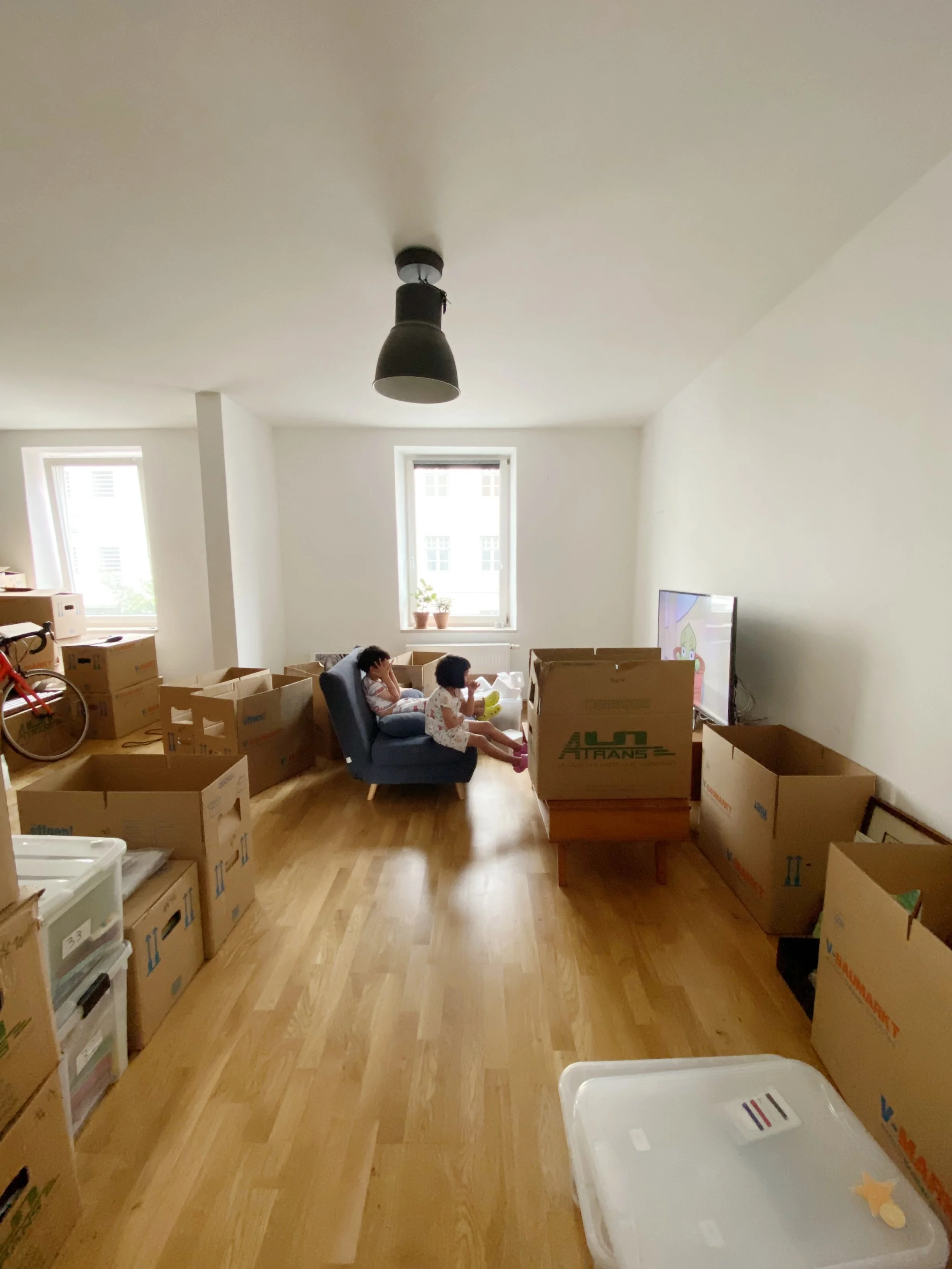
We first moved to Germany in 2014, when I was offered an internship in an advertising agency. It was supposed to be a six-month adventure - maybe a year at most. But the internship turned into a job, and six months turned into nine years. For most of that time, I was thrilled to call Munich our home. When we would travel, we’d often think to ourselves “this is nice, but it isn’t Munich”. The city’s infrastructure, the cleanliness, and even the (often cold) politeness of the Germans appealed to us tremendously. You see, we’d moved to Munich from Paris, which is a beautiful but chaotic, dirty, and frankly rude city. Parisians have a reputation of being rude, and you may become rude too after you’ve lived there for some time. I wasn’t a fan of the person I was becoming. As a student, and as I started off my career in advertising, I loved saying that I lived in Paris, but I’m not sure I loved living there. I only realized this after our move.
Munich felt like the best kept secret. We’d been there before for Oktoberfest (naturally) and I remember thinking that it was a great place to visit, but I couldn’t picture myself living there. So imagine how joyously wrong I discovered myself to be when the internship opportunity occurred, and with it a whole new perspective on what living in Munich was really like. History gives the city a heavy bad rap, and rightfully so, but modern day Germany was the most accommodating experience I’d had in my then six years as an expat. My German colleagues were fun and made me feel instantly welcome, even if my level of German was basic. I know this isn’t everyone’s experience of Germany, or specifically Bavaria, but I was fortunate in that sense. Even after I left the agency and switched careers, I still felt welcome. With time came two kids, and Munich remained unbeatable in its quality of life for our young family of four.
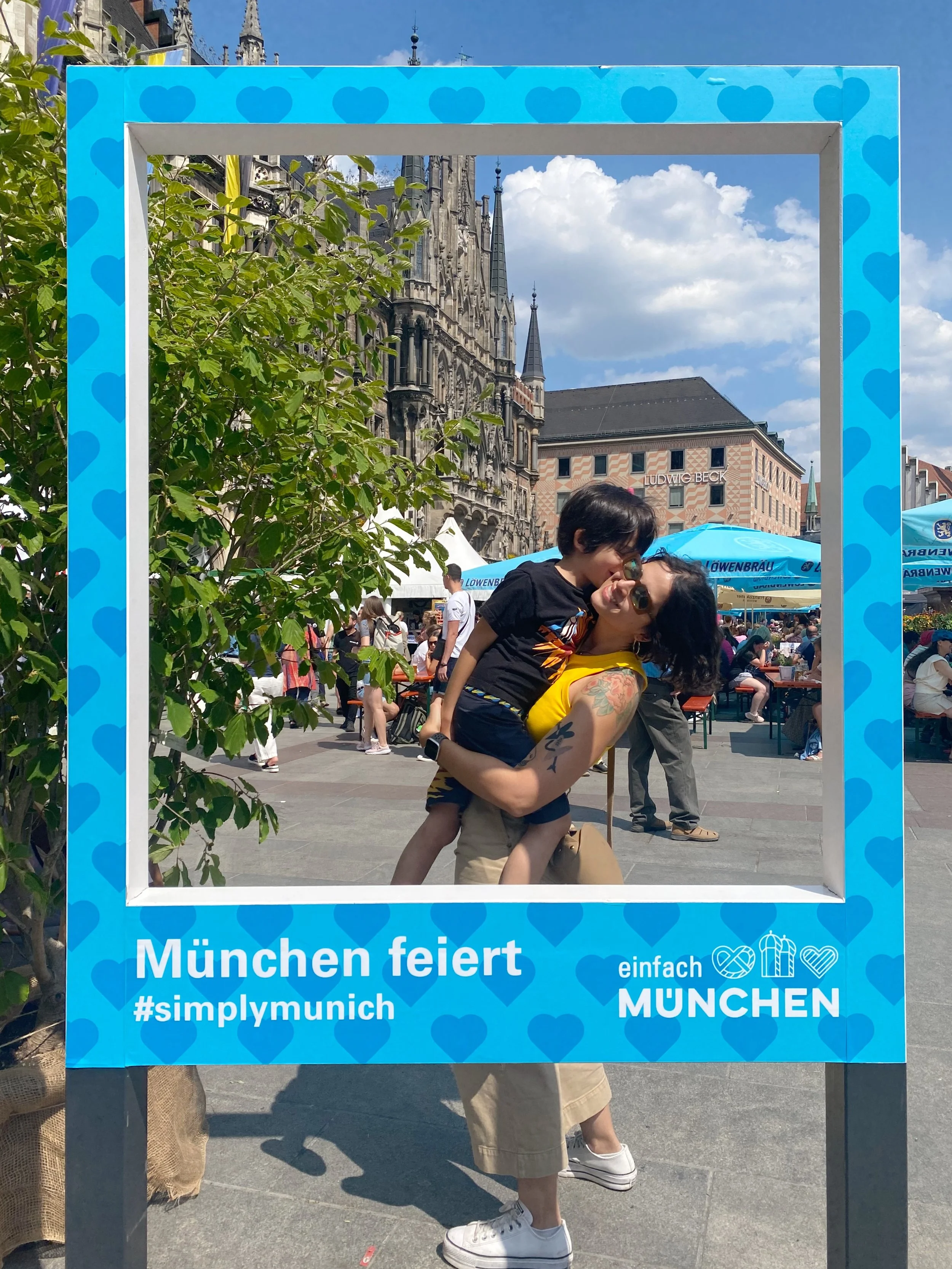
So why move?
Well, for one there is a difference between feeling welcome and belonging. We felt welcome, even though we never quite belonged. This is on us, as I believe we’d always had the lingering sense that we wouldn’t be there forever.
I couldn’t see myself retiring in Munich.
YY and I grew up by the ocean and although the Isar is great, we missed the salty water.
When our kids were born, we realized that as long we lived in Germany we would be raising them in an environment completely different and foreign from our own. We didn’t master the language. We appreciated, but didn’t quite follow German traditions. Even the food felt like an adaptation. We were grateful for experiencing all of it, but when it came to our kids, what did we actually want to pass on? How could a Brazilian from a Catholic family and a French-American Jew find common ground when raising two kids in Germany?
We started asking ourselves whether we were up to the challenge of raising two little foreigners in a foreign country that would never be ours, or their own. We wondered whether we were up to the challenge of long winters and months of overcast weather, when we’d both been raised near the ocean in hot (Rio) and moderate (California) climates. Were we also up to the challenge of raising our kids far from our families? For the past six years we went back-and-forth on this decision, hesitating between California and France as potential places for us to settle down. Every winter we would think “this is the year we’re moving!” and then when summer rolled around we would inevitably backtrack. “Maybe next year”, we’d decide. Neither of us grew up with real seasons and the timeliness of the changes in southern Germany captivated us year after year. You could expect flowers to bloom in April, and leaves to start falling by the end of September. You could also expect a good amount of snow in January, and a fun time by the lakes and the Isar in the longer summer nights from June onwards. The predictability of the seasons cast somewhat of a spell on us.
That being said, after almost two years of living under Covid restrictions, I craved support. We made it through the pandemic aged and exhausted, like most of the world, but also with some clarity regarding our need for a support system for us and the kids. Furthermore, I also craved roots. I wanted to settle down in a place where I could envision the next step in my career without having to worry about belonging, or rather whether my kids felt like they belonged. We knew that this level of stability wasn’t a reality for us in Germany. There was a glass ceiling after all, and we’d reached it. It was time to move on.
To be continued.
Have you had a similar experience as an expat? Did you also feel like there’s a difference between feeling welcome versus belonging?
Saudades
(Texto em português abaixo)
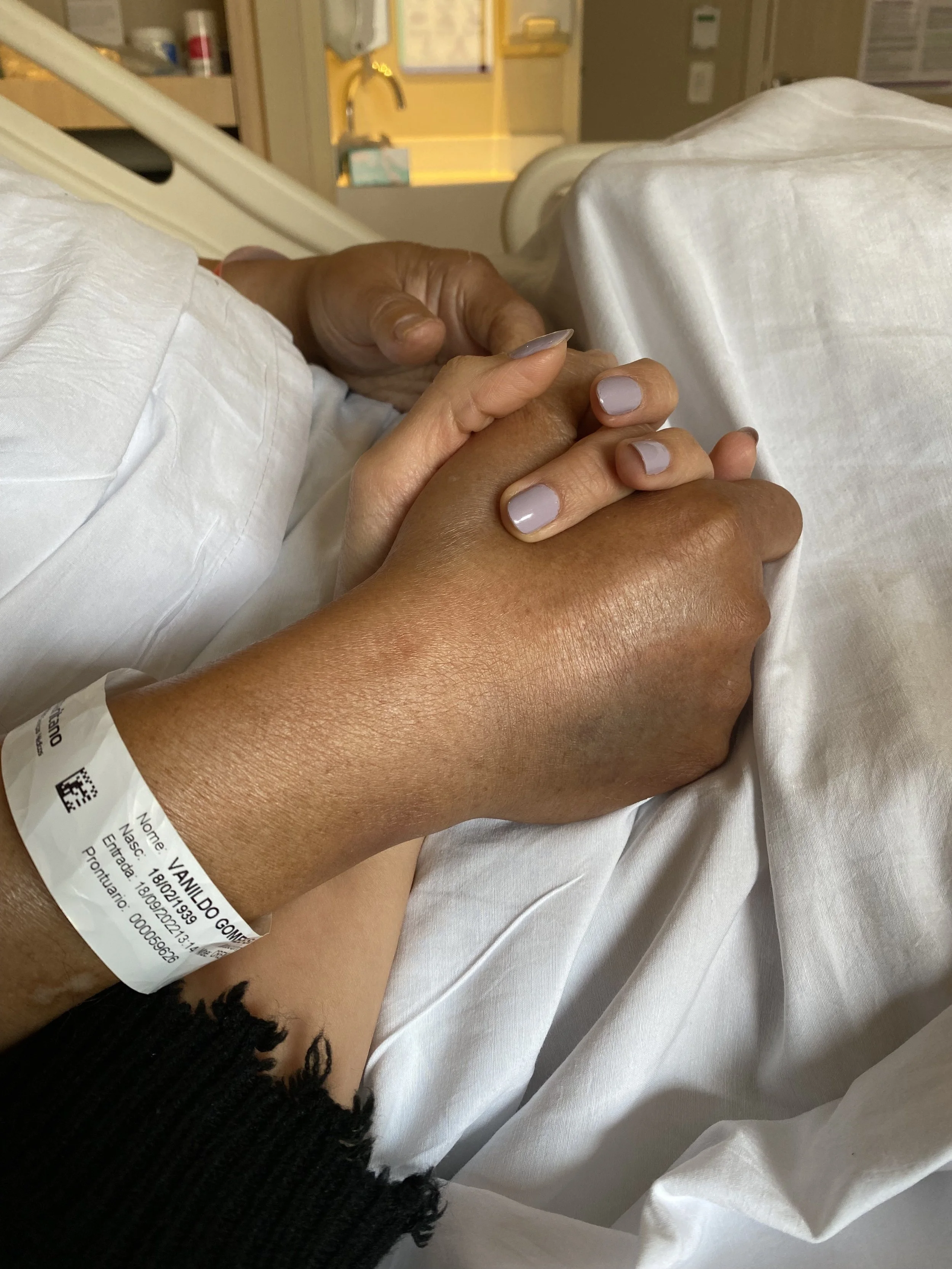
From the moment your cancer metastasized in 2020, I’d been preparing for our physical goodbyes. I let our hugs linger for longer when we were lucky enough to be together, I took every chance to go on a walk with you, I hoarded everything with your signature scent (Vetiver by Guerlain), I cherished every WhatsApp message (even the ones I didn’t agree with). Not one day or exchange was taken for granted. I started preparing for what life might feel like without your expansive presence, your loud laughter, your reassuring tone. At the very end, it felt unfair for me to have to adjust to a life without you physically in it. I wanted to yell - I DIDN’T ASK FOR ANY OF THIS, I DO NOT WANT IT, NO, THANKS - but instead, I resigned to the sobering reality that you would no longer be here. That is it, and that is all there is. For a hyper-prepared, anxiety-prone person such as myself, just like you were, it was quite the lesson to realize that there are things in life you can’t prepare for, not really.
I am grateful to have spent weeks by your side at the hospital. It didn't matter that my heart would break into a thousand pieces every day. At night, I’d try to mend it together, knowing full well that it would shatter again the moment I saw you laying on the hospital bed the following morning. I am so thankful to have held your hand as you passed on, exactly one year ago. Witnessing your dying moment, the moment the suffering stopped, the moment you looked up and found comfort, the moment your breathing calmed down and eventually stopped. Witnessing my hero meet his end on this Earth in what was ultimately a calm, warm, intimate, and sobering moment - it made me question my fear of death and showed me that, without a doubt, there is an afterlife and in it you had met your loved ones, my ancestors, and you would finally be at ease again. I am grateful to have witnessed all of it. You were, and are, my mentor until the very end.
I think of everything I’d lived for 33 years, every mundane moment filled by the reassurance that you were a few steps or a phone call away. When I didn’t want to go to school in the morning, you were there. When I graduated high school, college, Masters - you were there. When I got married, you were there. When I had one baby, then two - you were there. When my heart was broken, you were there. How was I supposed to go on without you here?
This past year I ran a marathon, moved countries, and fulfilled one of our greatest dreams. This whole time I have trusted your teachings, even if I wondered if you’d agree with some of my decisions (while also knowing that, even if you could, you wouldn’t give me your opinion unless it was solicited). Thank you for teaching me to trust and to honor my choices with the bravery and the confidence that only those with the support of someone like you for a father could fathom. Now I know that you are still here.
My love for you, like your love for me, knows no boundaries of time or space or presence or circumstance - it just exists, forever strong and supported by gratitude to have had you as my greatest supporter for 34 years and counting. Onwards and upwards. Obrigada pai.
_____________________________________________________________
Desde o momento em que o seu câncer voltou em 2020, me preparei para nossas despedidas físicas. Deixei nossos abraços durarem mais quando tínhamos a sorte de estarmos juntos, aproveitei todas as oportunidades de passear com você, guardei tudo com seu perfume característico (Vetiver da Guerlain), valorizei cada mensagem de WhatsApp (mesmo aquelas com as quais não concordei). Nem um dia ou troca foi em vão. Comecei a me preparar para como seria a vida sem sua presença expansiva, sua risada alta, seu tom tranquilizador. No final, pareceu-me injusto ter que me adaptar a uma vida sem você fisicamente. Eu queria gritar - NÃO PEDI NADA DISSO, NÃO QUERO, NÃO, OBRIGADA - mas em vez disso, me resignei à dura realidade de que você não estaria mais aqui. É isso, e isso é tudo que há. Para uma pessoa hiper preparada e propensa à ansiedade como eu, assim como você, foi uma grande lição perceber que há coisas na vida para as quais você não pode se preparar.
Sou grata por ter passado suas últimas semanas ao seu lado no hospital. Não importava que meu coração se partisse em mil pedaços todos os dias. À noite, eu tentava consertá-lo, sabendo muito bem que ele iria se partir novamente no momento em que eu visse você deitado na cama do hospital na manhã seguinte. Sou muito grata por ter segurado sua mão quando você faleceu, exatamente um ano atrás. Testemunhar o momento da sua morte, o momento em que o sofrimento parou, o momento em que você olhou para cima e encontrou conforto, o momento em que sua respiração se acalmou e finalmente parou. Testemunhar meu herói encontrar seu fim nessa Terra no que foi, enfim, um momento calmo, caloroso, íntimo e sóbrio - isso me fez questionar meu medo da morte e me mostrou que, sem dúvida, existe uma vida após a morte e nela você encontrou seus entes queridos, meus antepassados, e você finalmente estava em paz novamente. Sou grata por ter testemunhado tudo isso. Você foi e é meu mentor até o fim.
Penso em tudo que vivi durante 33 anos, cada momento mundano preenchido pela garantia de que você estava a poucos passos ou a um telefonema de distância. Quando eu não queria ir para a escola de manhã, você estava lá. Quando me formei no ensino médio, na faculdade, no mestrado - você estava lá. Quando me casei, você estava lá. Quando eu tive um filho, depois outro, você estava lá. Quando meu coração estava partido, você estava lá. Como eu deveria continuar sem você aqui?
Nesse ano que se passou eu corri uma maratona, mudei de país e realizei um dos nossos maiores sonhos. Durante todo esse tempo confiei em seus ensinamentos, mesmo que me perguntasse se você concordaria com algumas das minhas decisões (embora também soubesse que, mesmo que pudesse, você não me daria sua opinião a menos que fosse solicitada). Obrigada por me ensinar a confiar e a honrar minhas escolhas, com a coragem e a confiança que somente aqueles com o apoio de alguém como você como pai pode ter. Agora eu sei que você ainda está aqui.
Meu amor por você, assim como o seu amor por mim, não conhece limites de tempo, espaço, presença ou circunstância - ele simplesmente existe, sempre forte e sustentado pela gratidão por ter tido você como meu maior apoiador por 34 e muitos mais anos. Seguimos em frente. Obrigada, pai.
Parenting and the pandemic
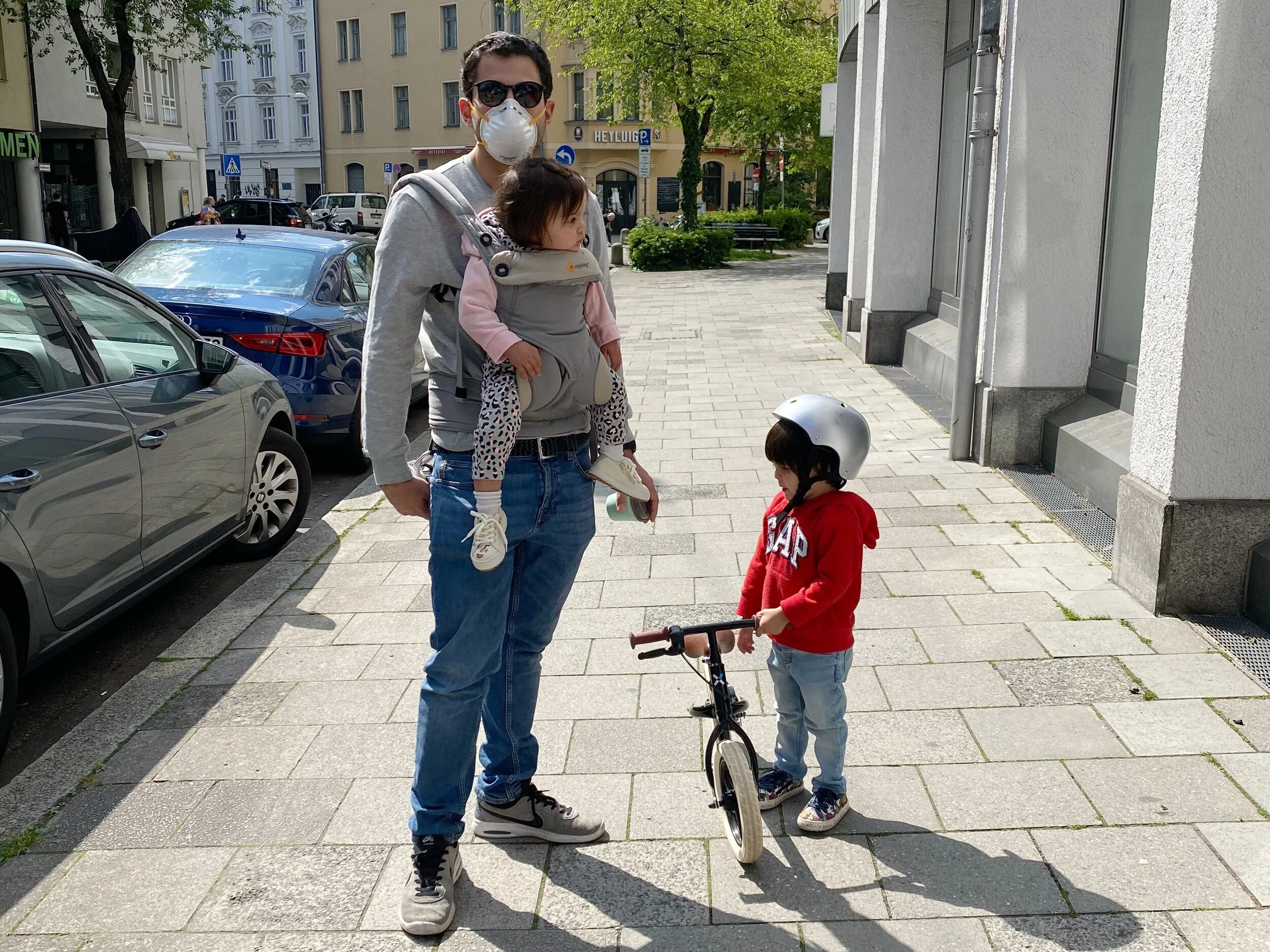
Last night, once the kids were finally in bed (S recently discovered that he can climb out of his crib! Exciting!), I just wanted to crawl into the fetal position - which is what I did. I had nothing left to give. As I curled up on my couch, all I could think was that I couldn’t do this anymore. Not for another day. Another week. Another month. I would’ve called it quits then and there; but, of course, that was never a real option.
I know for a fact that I’m not alone in the way that I am feeling, and yet it feels so lonely. I lost it again this afternoon, just like I have every day lately. Snapping doesn’t surprise me any longer; it just makes me incredibly sad in its aftermath. Inevitably, there comes a time in the day when I can’t stand the yelling any longer. I can’t explain to S again that he can’t watch TV right now. I can’t explain once again that I’m trying to work, or that I’m trying to study. I can’t deal with wrestling with my kids to get their clothes on to go out for some fresh air; only to come back to another wrestle to get them clean.
Full disclosure: My husband and I are incredibly lucky in the sense that we’ve had help all this time. My (fairy) godmother came to Germany with us back in January, and got stranded here due to Covid-19. She goes above and beyond to support us, and yet…
I am still the mother. I am still a mother who is starting a new career. I am still a mother while working part-time, and I am still a mother while studying full-time. I prioritize my kids (and I always will), but I’ve been pregnant and/or breastfeeding for the past 3+ years. I had just started to feel like my own person again when the lockdown hit. And, to be frank, I refuse to let that feeling go - but juggling everything is proving to be near impossible.
This pandemic is taking its toll on so many aspects of our lives; personally, it’s taking the biggest hit at my parenting skills. I started off optimistic - at first, day care centers were supposed to reopen in 5 weeks. I was excited to have breakfast with the kids every day without having to rush out the door. I looked forward to doing yoga with S in the afternoon. I looked forward to the quiet moments nursing L before putting her down for her nap. It was scary, but I really thought we could make it work. Fast forward two months, I’m not so sure that we can.
But again, of course, “not making it” is not a real option. At what cost, though?
I’ve been reading about the toll that this pandemic has had (and will continue to have) on mental health. I personally haven’t had mental health issues in the past (other than a lingering hint of anxiety). I am, by all standards, a healthy individual. I am happily married. I have a roof over my head. I love living where I live. My kids are healthy. I am so, so grateful. Yet, I too am losing it.
By this point I’ve given up on reading the news. If it isn’t about the day care centers reopening at least partially, I’m not interested. I was livid when I heard that playgrounds would reopen before the day care did. How exactly does that help working parents (someone still has to take the kids and watch them)? Let’s also talk about what a brilliant idea it is to mix different groups of kids every day. Every time I pass by the one near our place, it’s packed. Day cares are still closed. I am still losing it.
Tell me I’m not the only one who isn’t quite a model for positive parenting these days. It is so hard to admit that you’re failing as a parent, but can we be honest for a second? We could all benefit from knowing that we are not alone in this; now more than ever. We’ve gone from having bad days to having bad weeks (months?). And as of yet, there is no light at the end of the tunnel, which for me is by far hardest part of this whole ordeal.
Yes, former generations had it rougher and many, many, many people still do - but we are all allowed to feel shitty every once in a while. And, to be frank, this is the worst I’ve felt in as long as I can remember.
Bottom line is: I absolutely love my kids unconditionally, but I need a break and I won’t find it in my weekend glass of wine. Make no mistake when you see happy pictures of my kids on social media (or anyone’s kids, I’m confidently assuming). The struggle, my friends, is extremely real.
If you have any proven coping methods, do send them my way. Let us virtually lean on each other. I know this will pass, but until it does, I guess we just have to our best not to lose our minds - one day at a time.
California with kids - Santa Barbara
I’ve been wanting to put together a post about our California trip since we got back, but I honestly didn’t know where to begin. I decided to split it up, otherwise it would’ve been way too long. We’re starting off with Santa Barbara (and a tiny bit of Solvang)!
We went to the US to visit my husband’s family, and to be honest I wasn’t super excited about this trip at first. The short flights we’ve done in Europe recently were frankly overwhelming. Our toddler decided to use us (mostly YY) as punching bags from take off until about 10 minutes before landing, when he would inevitably pass out - leaving us beaten and a little bit shaken up. As you can imagine, I was therefore a tiny bit intimidated and not exactly looking forward to a 12-hour flight with our adorable little monster(s). Experience so far has taught me to keep my hopes waaay low, so my intention was to go into this trip entirely free of expectations. No plans = no frustration if they don’t work out, right?
Long story short: I’m so glad I was wrong. Because overall, the kids were total champs and we actually got to do a lot. I hadn’t been to the US in 11 years (basically since I moved to Europe), but California has this easy-breezy 90s vibe that felt very familiar and extremely easy to get used to.

View from Shoreline park, as I tried to spot whales and dolphins
For the first two weeks we stayed mainly in Santa Barbara with the in-laws, and it’s one of the most beautiful places I’ve ever been. My husband grew up in this little slice of paradise, and in the 10 years we’ve been a couple we hadn’t yet gone there together. I jokingly told him that’s because he knew I wouldn’t want to leave… No, seriously. I grew up visiting the US almost every year, but Southern California remained a bit of a beautiful mystery to me. And this trip has left me wanting to discover so much more of it.

The Santa Barbara courthouse

View from the Santa Barbara courthouse
Discovering places is great, but discovering places through food is so much better. Eating in California can be a real treat. Since we’re very much landlocked in Munich and any seafood we can get our hands on is inevitably frozen, I was yearning for some of the fresh stuff.
My favorite restaurant meal in Santa Barbara was hands-down the one at Brophy Bros. It was definitely worth the 20-minute wait with a toddler on full meltdown mode, after he had just accidentally lost his last pacifier on the pier water. My one criticism? The clam chowder isn’t served in sourdough bread. Womp womp.
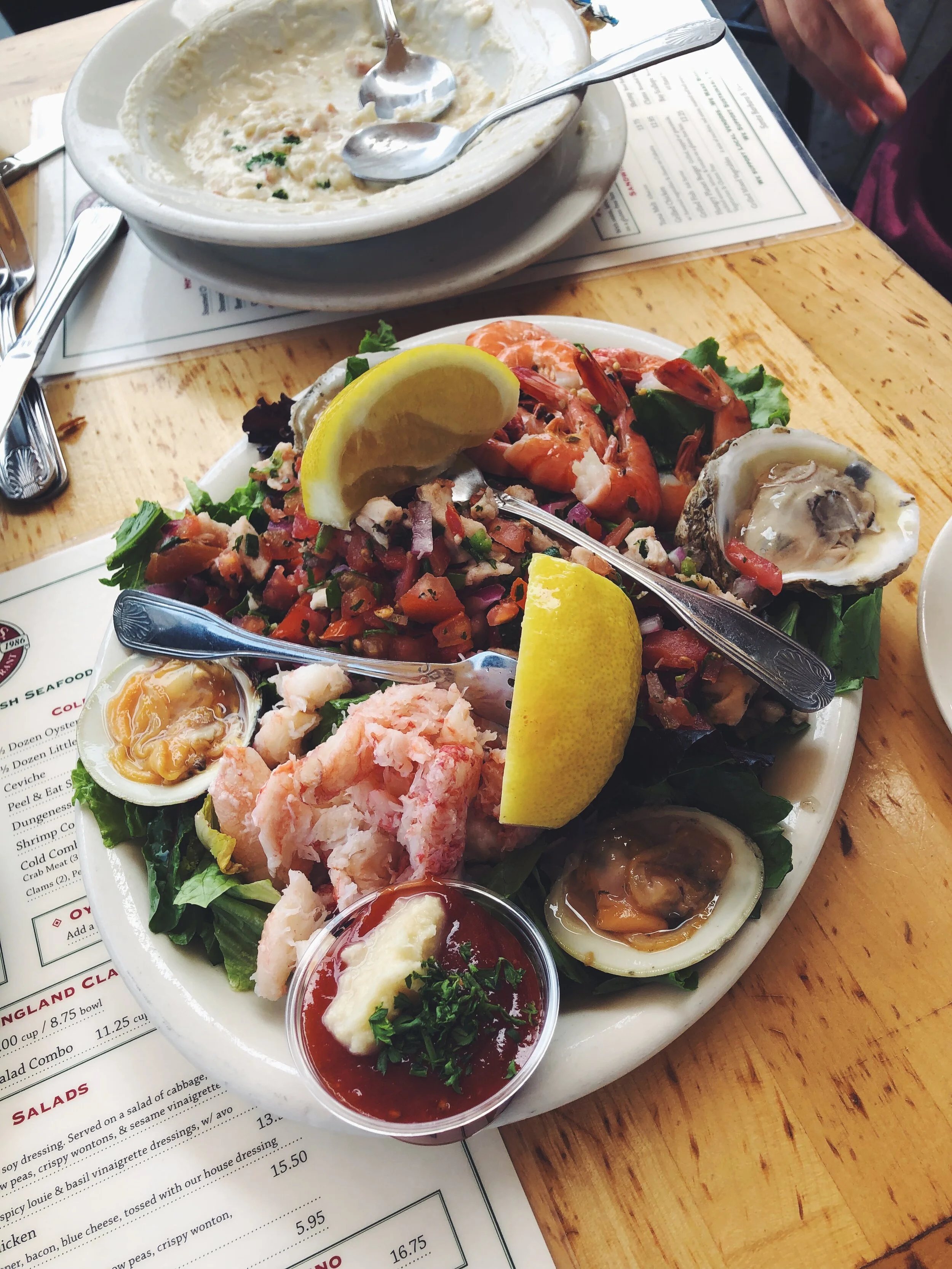
The cold seafood starter mix from Brophy Bros, which YY and I easily shared as our main dish. In the back, an almost finished plate of clam chowder which S loved and almost made him forget his pacifier.
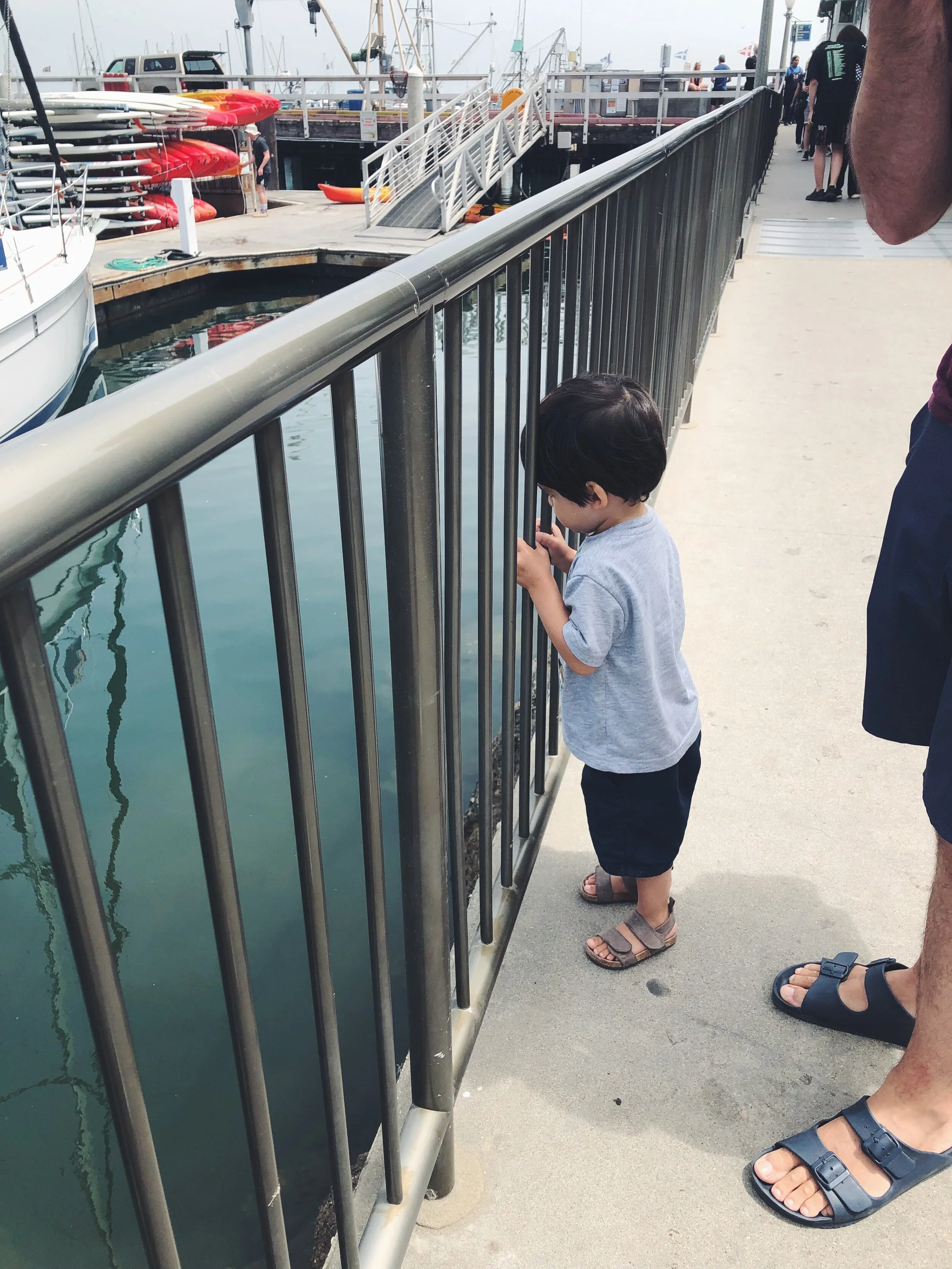
A heartbroken S after losing his pacifier.
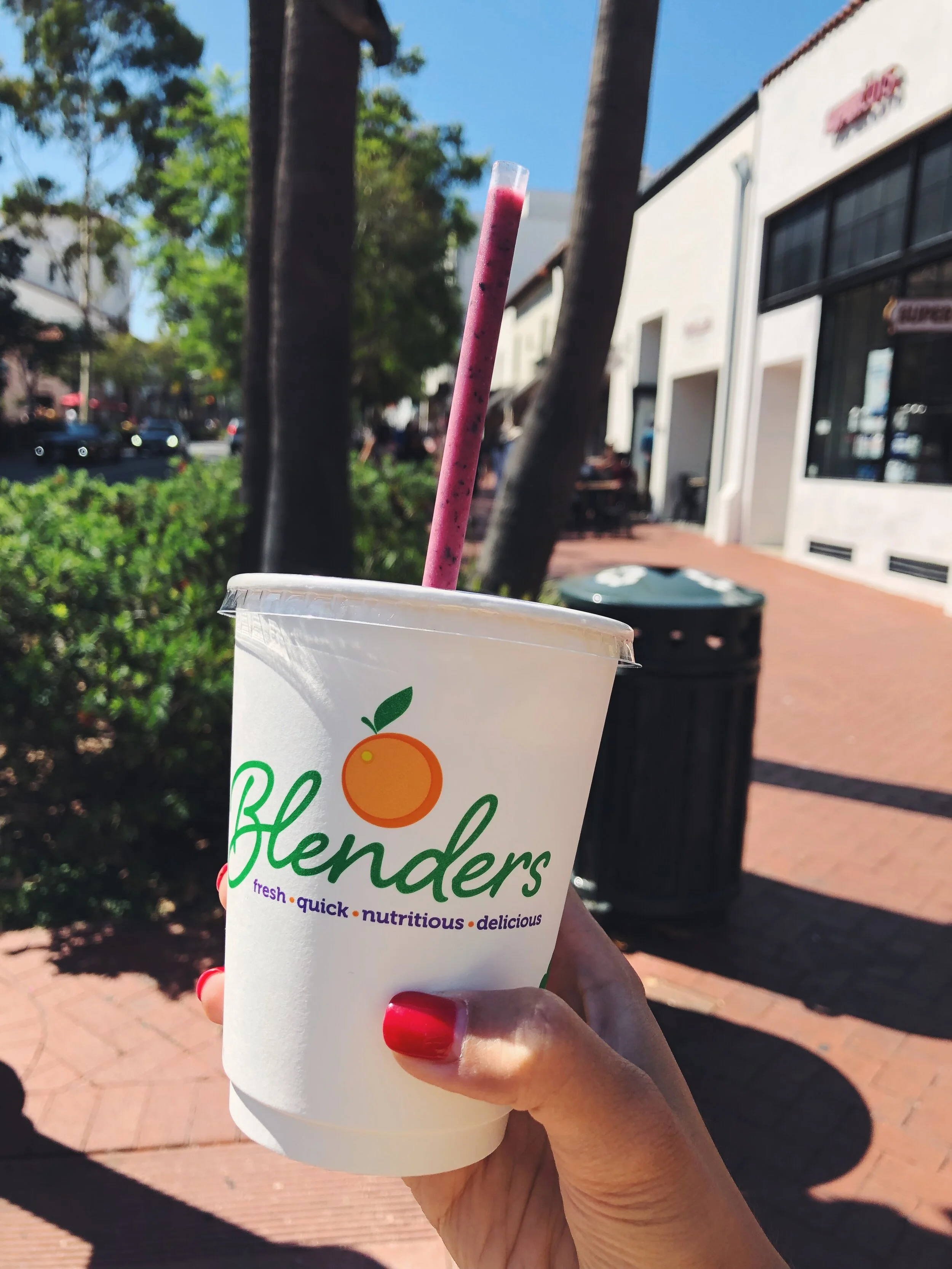
While Brophy Bros’ was the best meal we had, the best overall find for me was without a doubt Blenders In The Grass. This was another mythical place which YY would incessantly tell me about, so I was really looking forward to meeting it in person. The Blenders’ concept is to serve “fresh, quick, nutritious, delicious” shakes, and boy to they deliver. The possibilities are endless. I made it my personal mission to taste a different one every day while we were in Santa Barbara. My favorite? Peanut butter. All. The. Way.
Still speaking of food, I was also finally introduced to Trader Joe’s! And I was genuinely heartbroken to said goodbye to it by the end of the trip. We literally went from a Trader Joe’s to LAX on our way back to Munich.
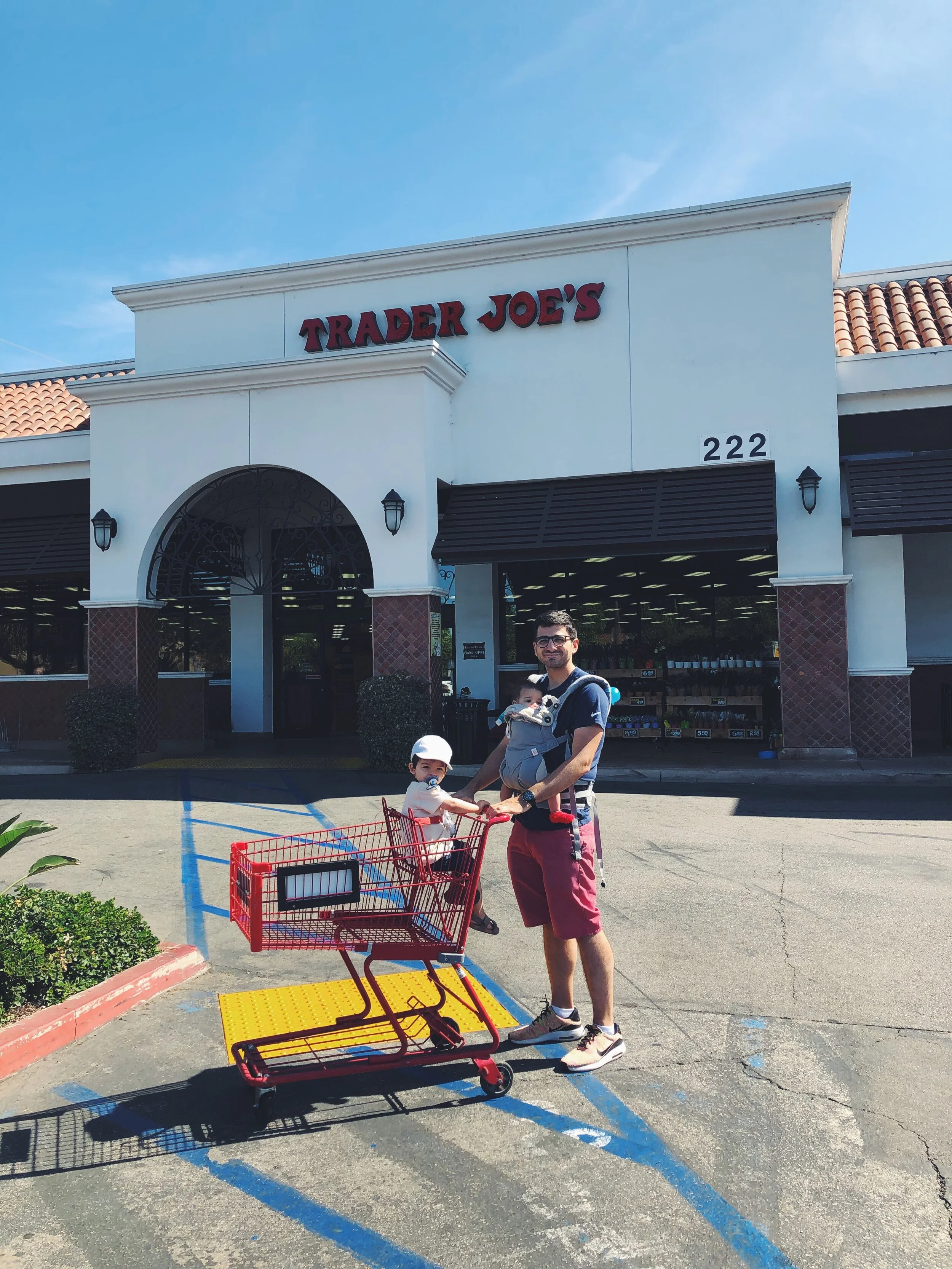
We found happiness at the Santa Barbara Trader Joe’s
While we’re still on this topic, coffee also counts as food, right? Maybe not with/for the kids, but one of our favorite things in the world is to explore cool coffee shops wherever we go. That’s something I’m not willing to compromise as a mom. We’ve been raising kids in coffee shops since 2017, and this trip to California was no exception. And honestly, Santa Barbara did not disappoint.
Although definitely pricier than what we’re used to in Munich, Handlebar Coffee Roasters is a cycling-inspired coffee shop (if you can’t tell by their name) that has some of the best coffee I’ve ever had. It easily beat every coffee shop we went to in LA. The staff is also very willing to look the other way and not scold you if you must change your baby’s explosive diaper, which I’m honestly grateful for since there were no changing tables in sight (few things are more anxiety-inducing to a parent than a baby covered in poop and no place to change them). Anyhow. To this day, we’re dreaming of their nitro coffee and regret not having brought back more of their cool merch.
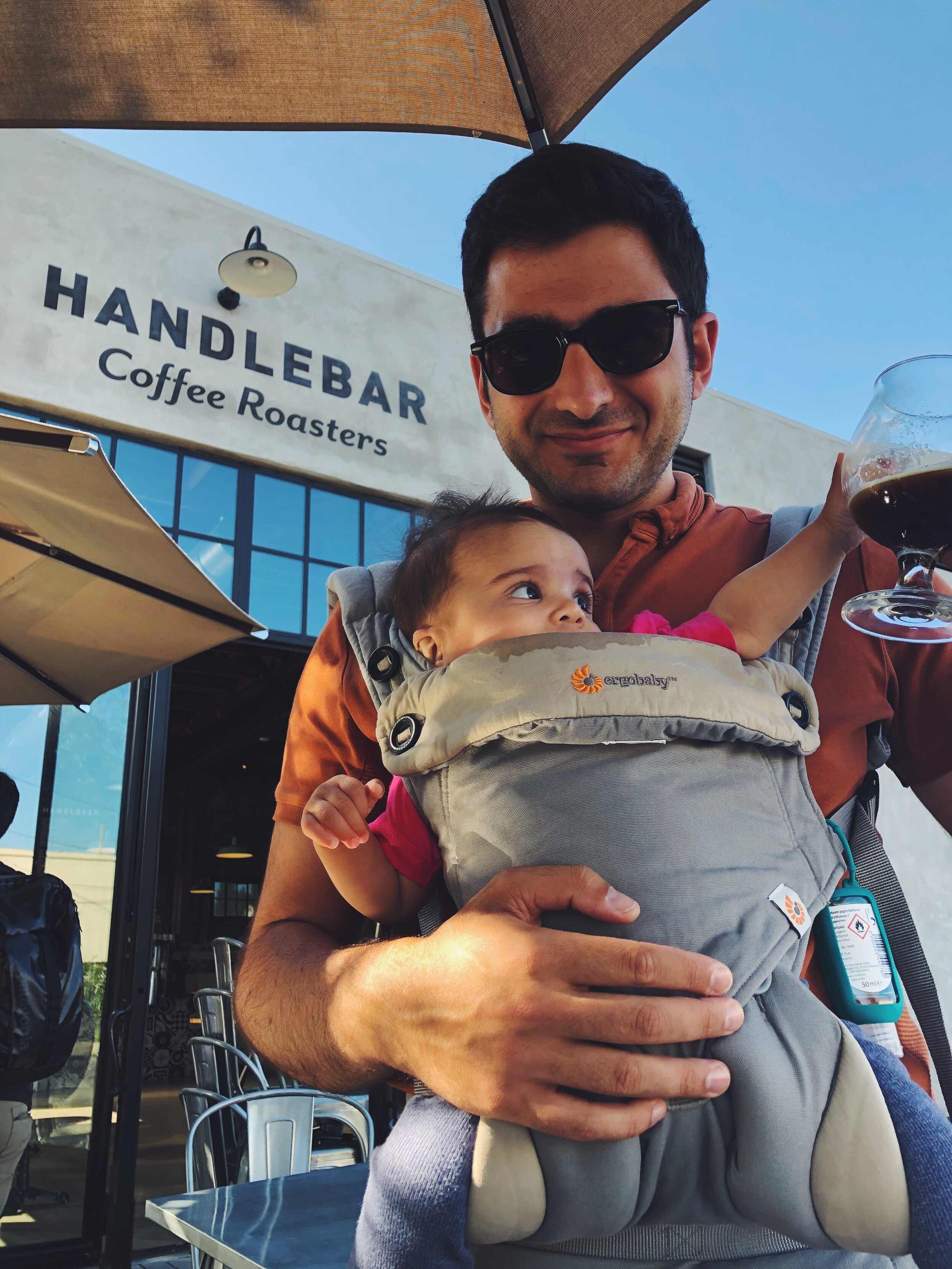
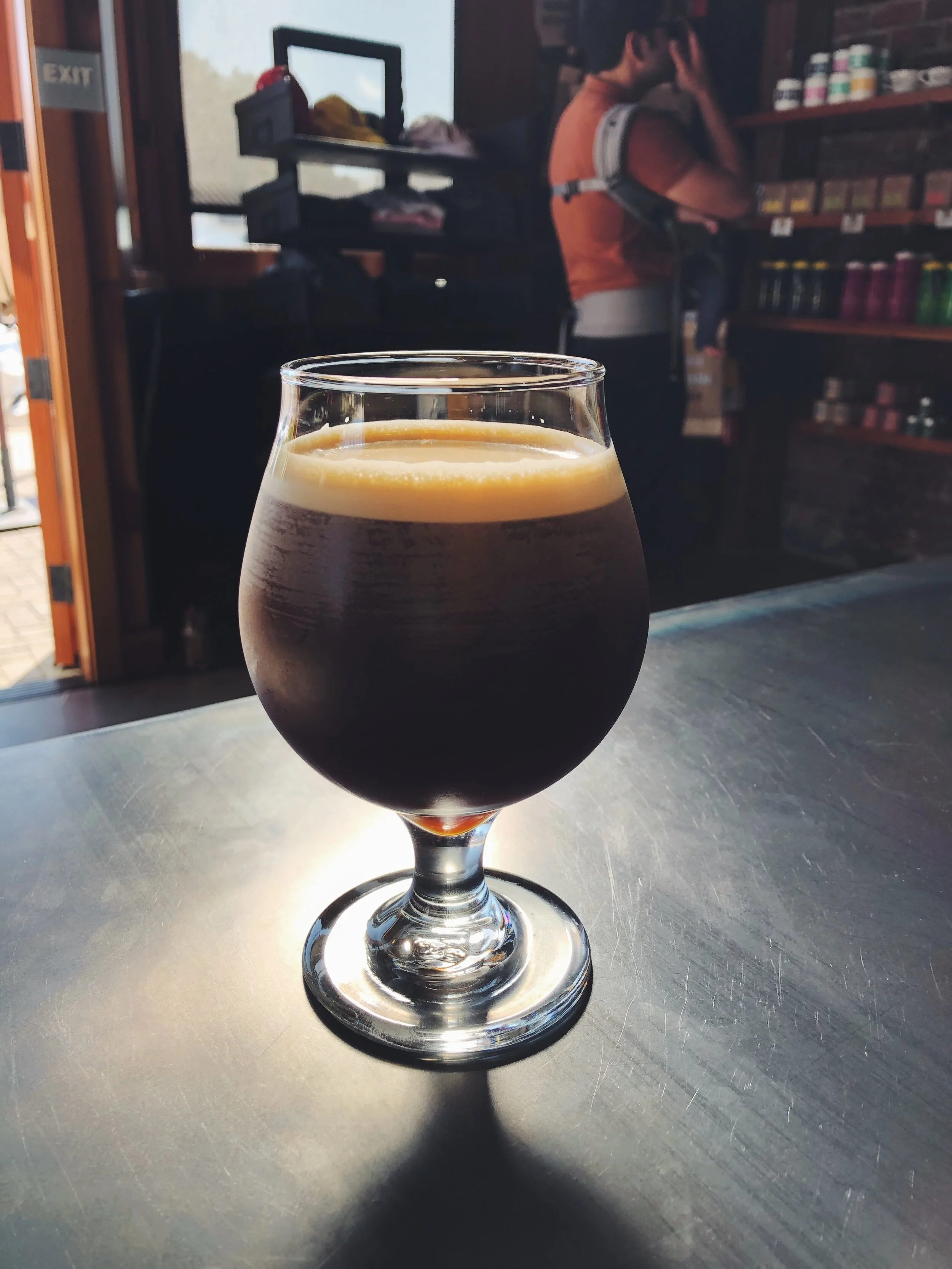
The nitro coffee at Handlebar is a true work of art.
Another cool coffee shop is Dune Coffee Roasters, aka The French Press. I wasn’t as into their nitro, but the iced matcha latte was seriously impressive (and yes, I realize I sound very stereotypically true to my generation with that statement).
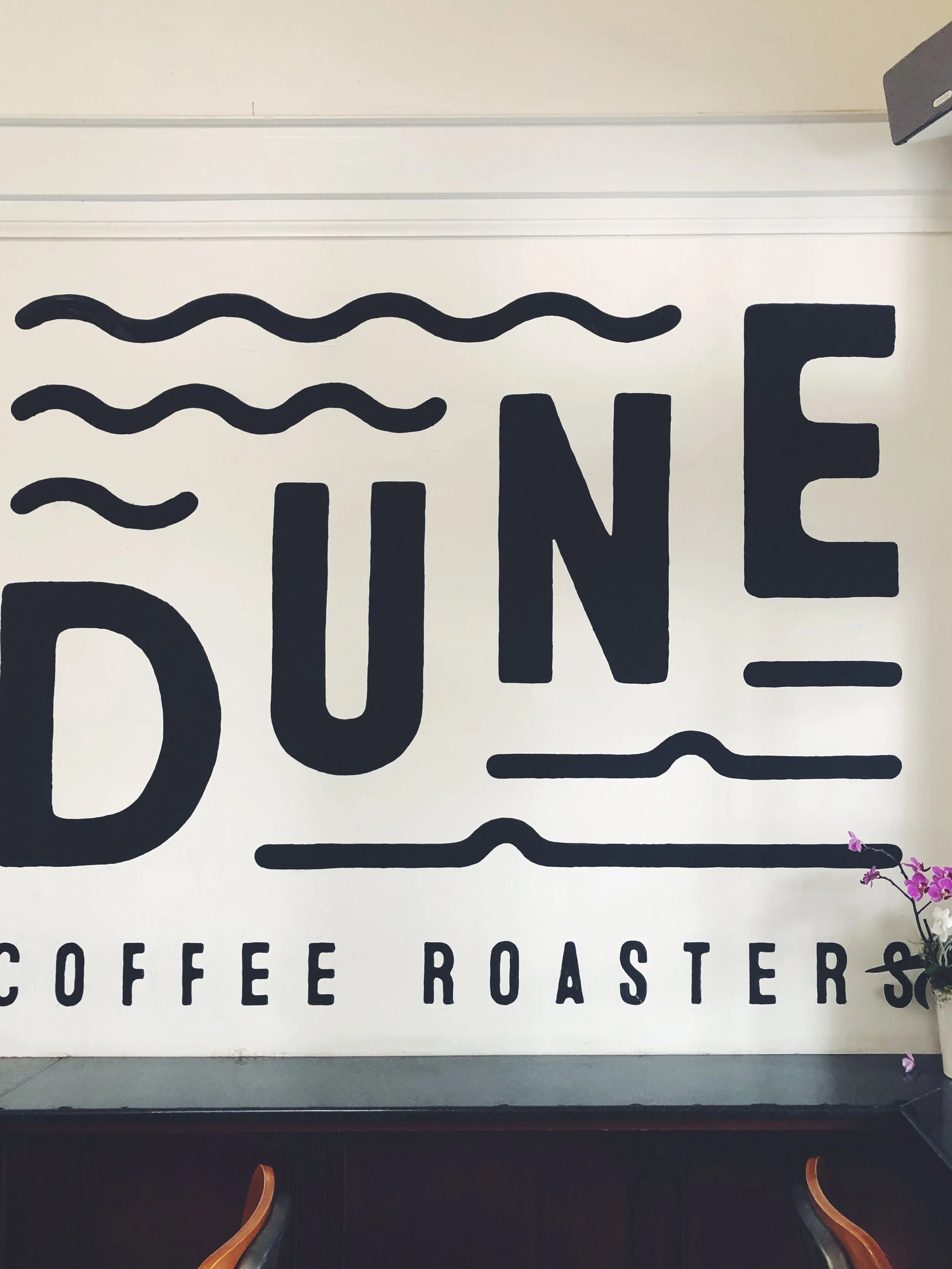
Cool wall at The French Press on State Street
I know you’re probably here to read more about actually handling kids while traveling, so here we go. Full disclosure: Since we were staying with the in-laws and YY’s sisters were also around, we shamelessly made full use of the support we don’t normally have in Munich. That is to say that for many of these outings, 2 year old S stayed at home for naps and playtime with his slightly older cousin. L on the other hand, who turned 6 months during our trip, was often with us since I was (am) still breastfeeding her full-time. That said, carrying an agreeable, nap-anywhere-anytime 6-month old around is much easier than a toddler. It all changed when we went to LA and had full custody of S once again, though.
That isn’t to say that we didn’t see our son for days. We sure did some fun activities with him too, like going to the Santa Barbara Zoo.
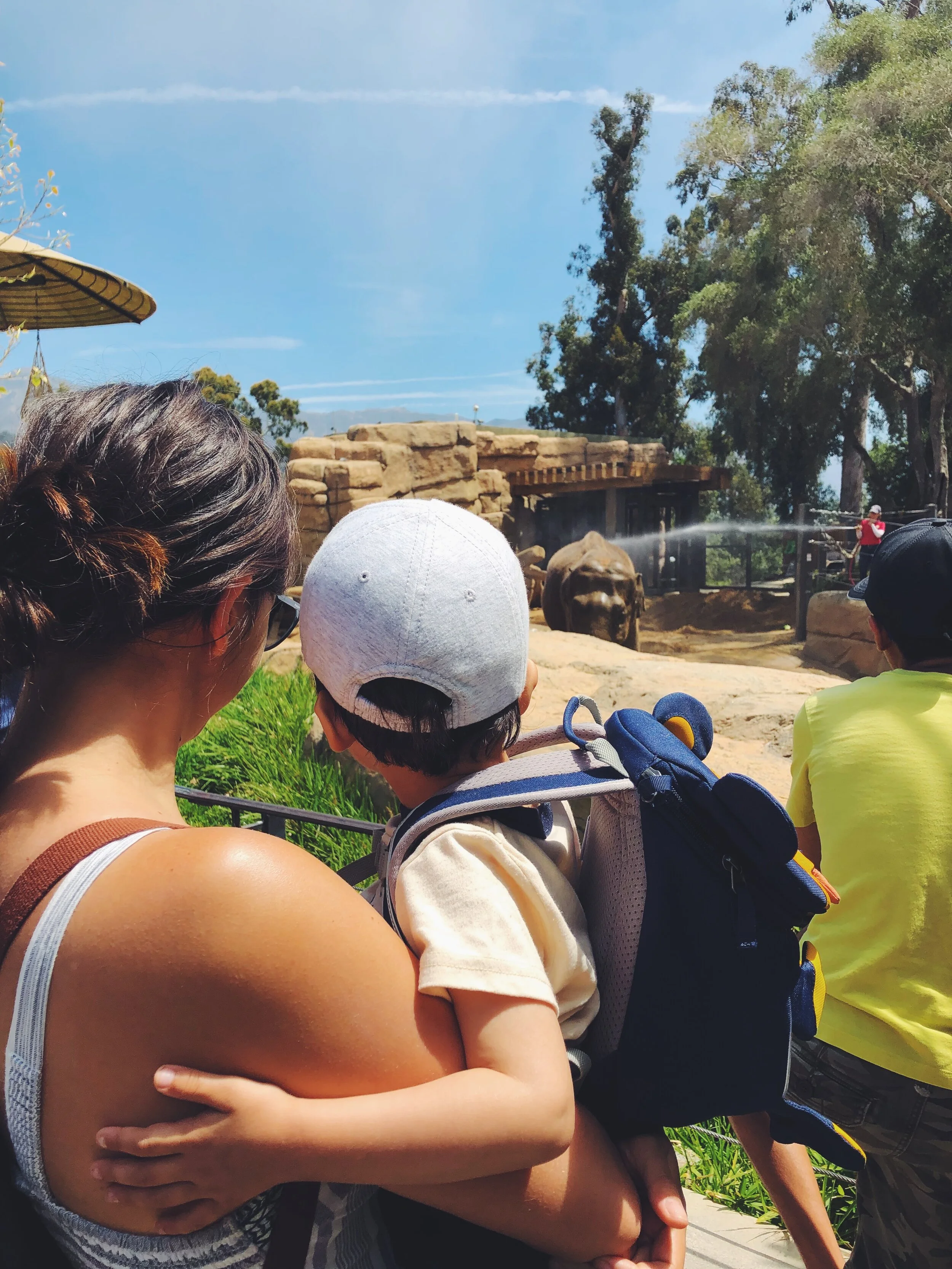
S with his aunt at the zoo, watching the elephants.
We were also in town for the famous “Fiesta”, which between us…. Was probably the most shamelessly cultural-appropriating event I’ve ever attended. I unfortunately really wasn’t very into it (but of course I don’t judge those who are, to each their own). The kids are too young to care about such matters and definitely had fun at the parade, so I guess that’s the silver lining. I’m just not sure I’d personally go back for it.
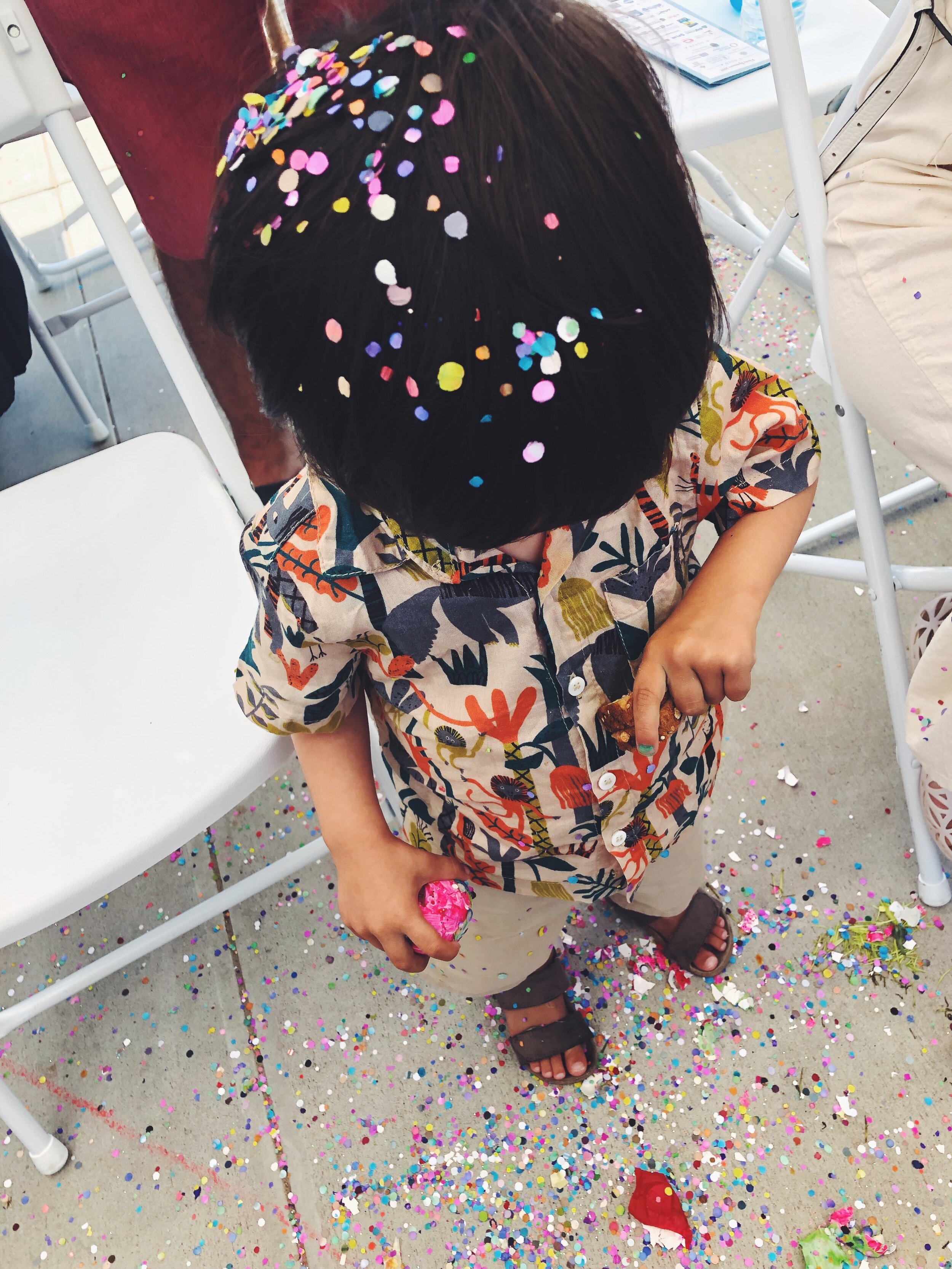
S covered in confetti at the parade. He had glitter stuck on his scalp for days after this. Our ongoing joke was that he’d go to college with it.
While in Santa Barbara, we also went to the beach - once. But still, I'm happy I got my ocean fix. We went to Hendry’s Beach, which in hindsight wouldn’t have been my first choice since it’s a very much dog-friendly beach. This meant cute doggos running around, but also having a dog run onto our towels and eating our food (while the owners watched, unfazed) as well as peeing all over the sand which our kids would subsequently, inevitably, eat.
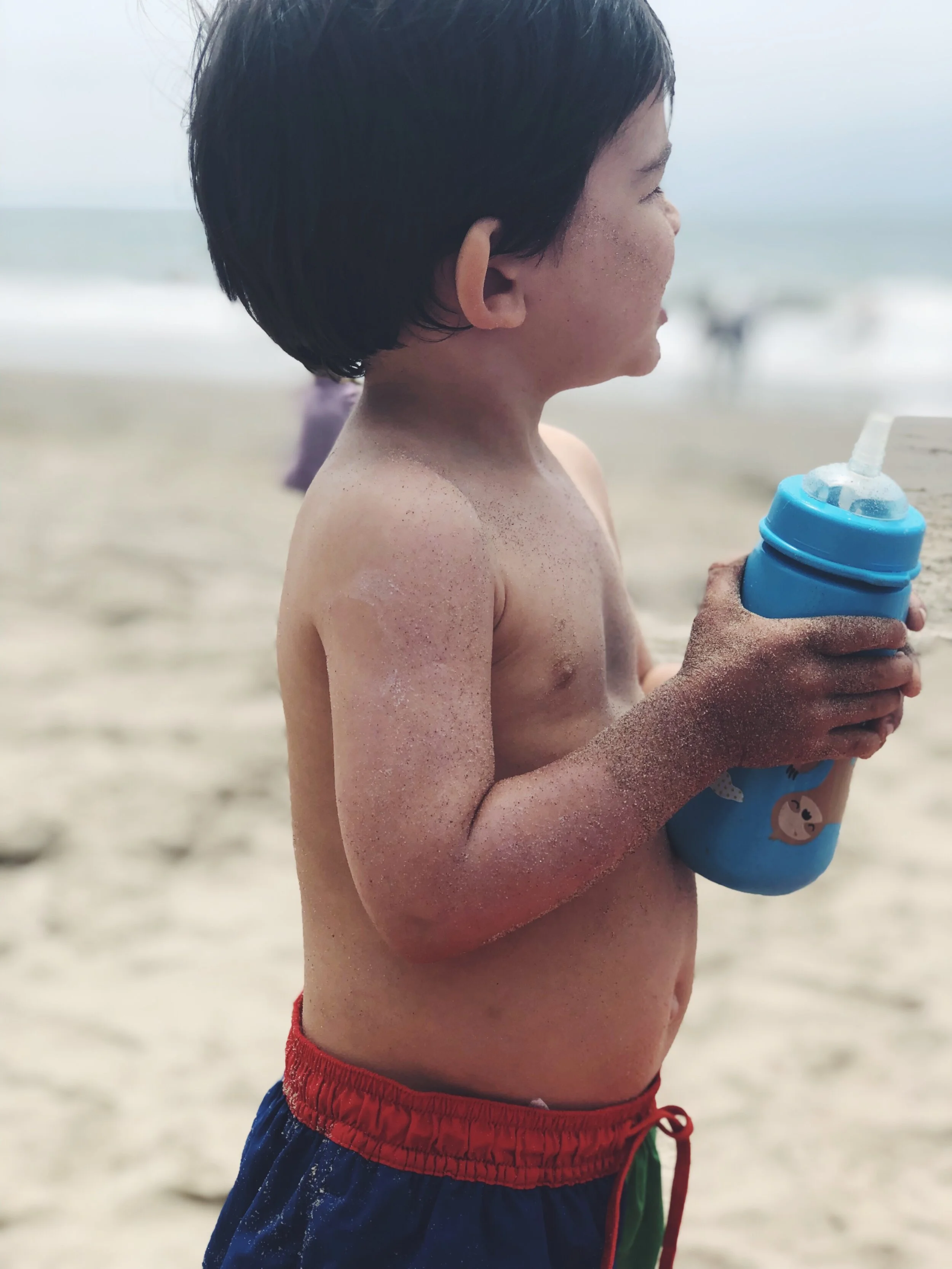
S covered in urine-soaked sand
We also had a really great time at the Santa Barbara Natural History Museum. S was legitimately interested, which is a first for us. There are so many cool activities for toddlers, we could’ve easily made it a longer visit (but then again hunger spoke louder). I do wish we’d had more time for the planetarium.
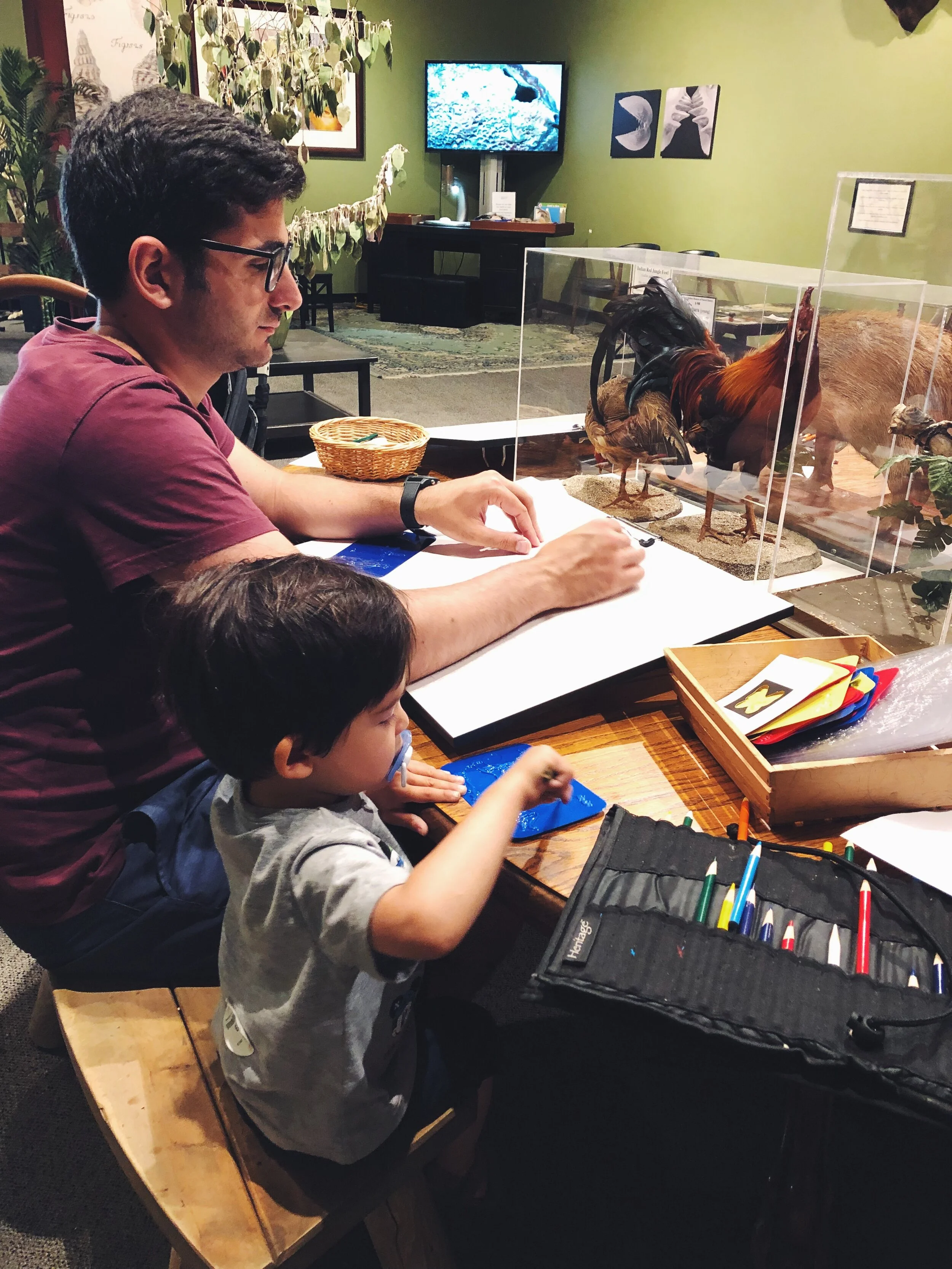
YY and S working hard at the Natural History Museum.
Finally, we also went to Solvang for a day. Have you heard of it (I hadn’t)? It’s the “Danish capital of America”, and it’s incredibly cute, but also very touristy. We found a great little coffee shop, because priorities, and otherwise walked up and down the main street alongside hoards of Chinese tourists. We were only there for a few hours, but I’d love to go back and explore the less touristic corners.
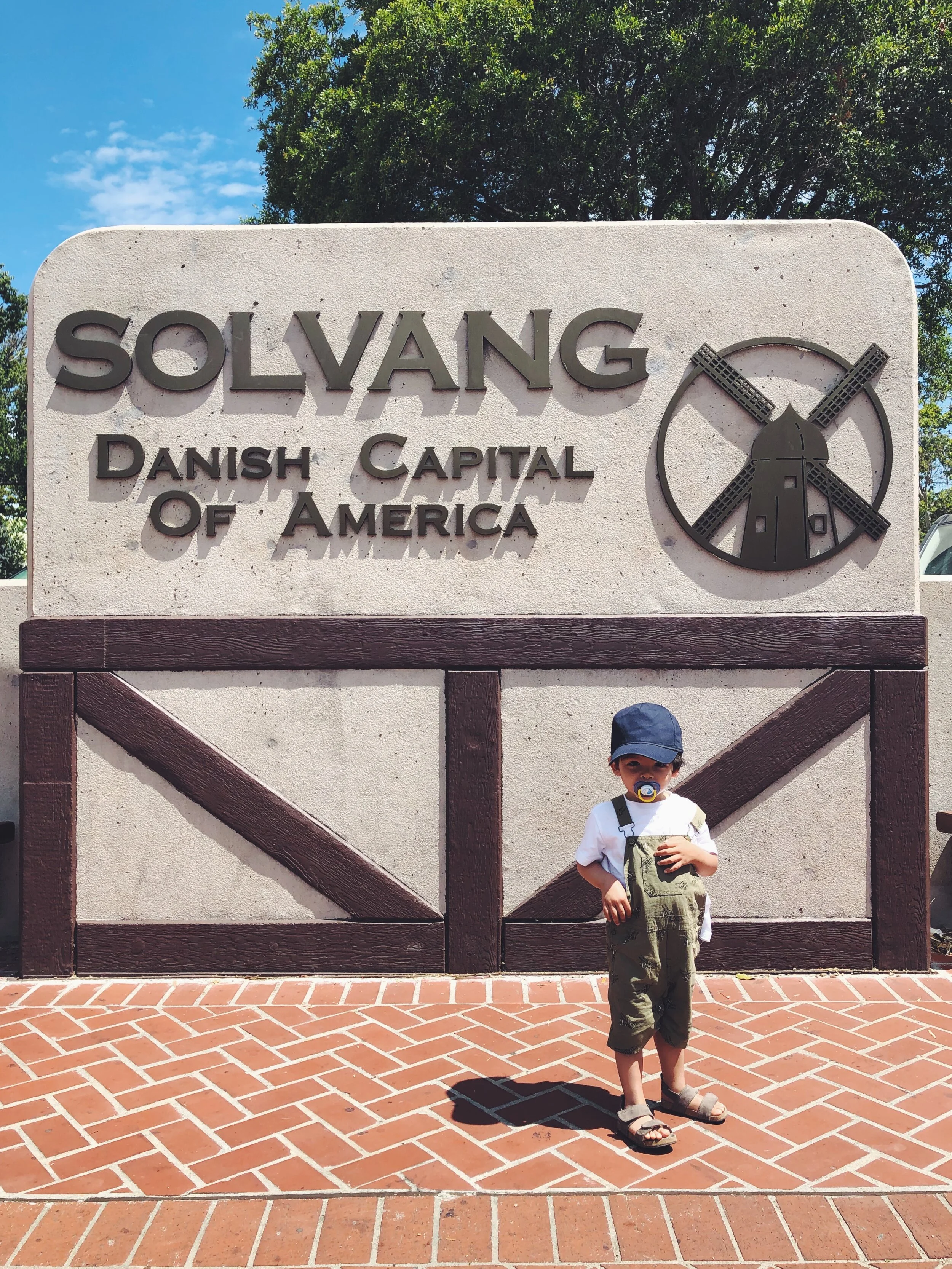
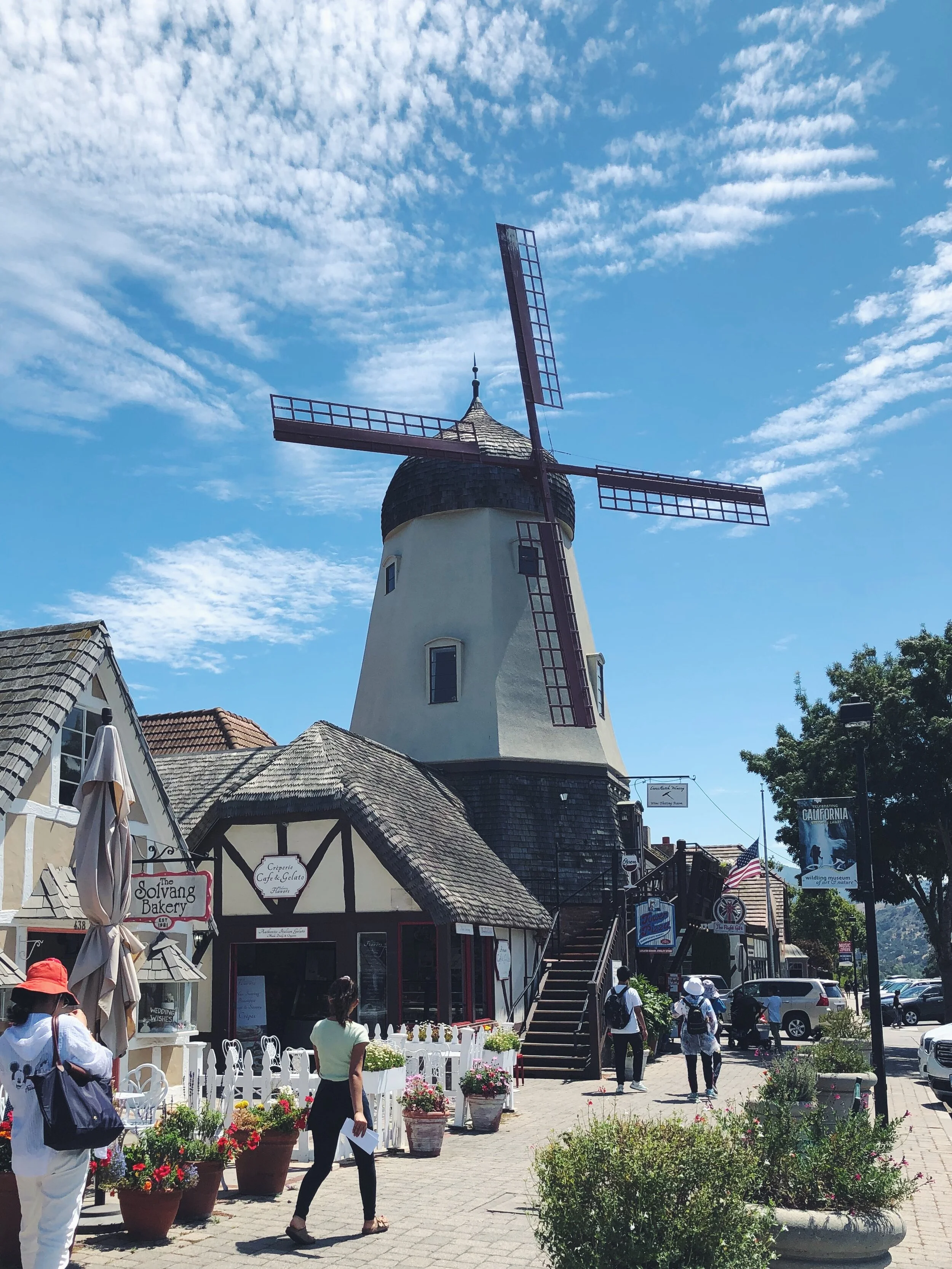
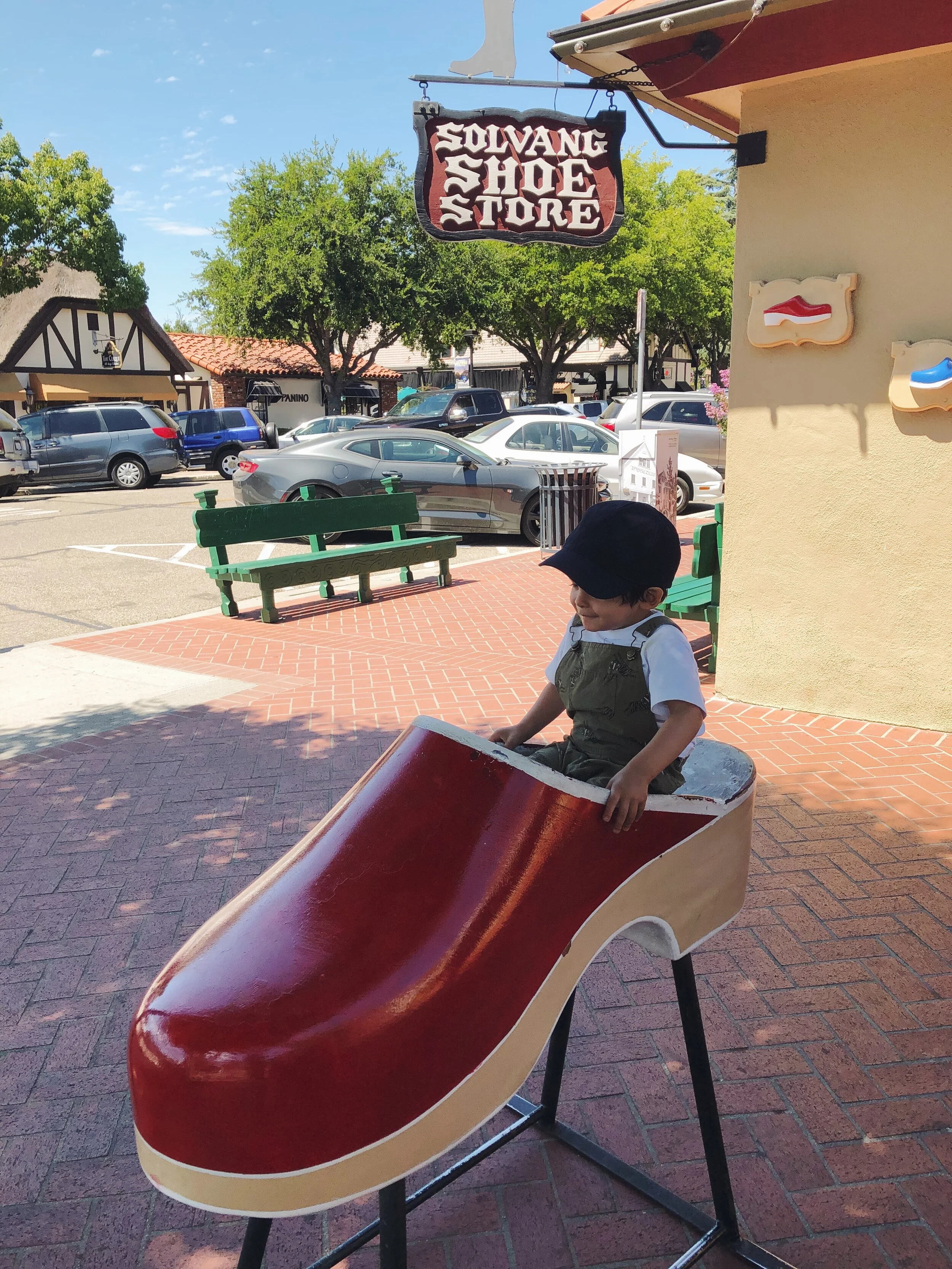
YY has the same picture at the same age!
Up next: Our stay in LA (and short visit to Palm Desert).
Getting over the anxiety of introducing solids
Introducing solids to a baby is a massive milestone. Whether you’ve done it before, and even if you’re literally studying the subject and have the most up-to-date information about it at your fingertips (like me), as a parent it is still likely you’ll feel anxious about it at some point. What if baby chokes? What if she has an allergy? What if she hates food??
Not only there’s too much information out there about how and when and with what to start feeding your baby, but there’s also the 99% likelihood you’ll encounter well-intentioned people who will approach you with their opinion and what they think you should do, based on what worked for them 30 years or 2 months ago (either way, it’s not necessarily what will work for you, now). The truth is that when it comes to food, just like with any other aspect in her life, your baby is unique. And there is no one who knows baby better than mom or dad.
Knowing this can be as overwhelming as it can be freeing, so try to think of it this way: humankind has been introducing solids to their offsprings for millennia, in every culture, at any given moment in time. We’ve survived as a species because ultimately there was always someone who knew what was best for their baby. So you’re not alone in this. And once you get the hang of it, it can actually be fun! Eventually.
Here’s how I’m doing it.
About 18 months ago, when I was introducing solids to S, my firstborn, I was so overwhelmed with motherhood that I didn’t think of much about researching different feeding methods or best first foods to offer. Instead, I chose to listen to our less-than-friendly German pediatrician at the time, who at 5 months suggested we started feeding him canned pureed baby food such as carrots and apple sauce mixed with a beef paste. Yuck, I know. Luckily I knew a little better than that, and instead chose to spoon-feed him homemade pureed food (it helped that my mom was visiting). I hadn’t even heard of baby-led weaning, and had no clue what to watch for as signs of developmental readiness. I followed the pediatrician’s lead, and to his credit S turned out just fine. But I always felt like I could have done better (hello, mom guilt).
Fast-forward almost two years, and it is time to introduce solids to our second child, L. This time around I know so much more, so I decided to do things quite differently. For starters, I am not overwhelmed by motherhood anymore, at least not all the time. Getting certified in holistic baby nutrition also helps quite a bit, as you may imagine. Yet, that it is not to say that I wasn’t anxious about her very first taste of “solid” food.
A few factors added to my natural uneasiness. I wasn’t exactly in a hurry to feed her solids, and as I waited for L to meet all developmental signs of readiness, I realized it probably wouldn’t be before her half-year birthday anyways. The problem is, she turned 6 months a few days after we arrived in California to visit family and, by then, not only we were jet lagged, but our daily routine was out the window. I was afraid that feeding her solids would stress her out even more.
I was also getting tired of being bombarded by the question “when are you going to feed her cereal?” (which is A. a very culturally American thing to do and B. something I have no intention of doing, not any time soon in any case). And I was also equally eager and apprehensive about giving baby-led weaning a go. But armed with knowledge and the confidence that comes with the second child, I decided to offer a classic as her very first food - steamed carrots cut in finger shape and size, topped with organic ghee. The verdict: She LOVED it.
For the following 3 weeks, we experimented with different BLW classics such as the soft core of raw cucumber and ripe bananas. I couldn’t feed her solids every single day, which is ok in the first few weeks. The plan was to get her introduced to solids slowly, giving her digestive system a chance to adapt (I was especially cautious since we were in a “foreign” country, after all).
Since we got back to Munich, I became more preoccupied with her iron intake. Iron is incredibly important for babies 6-12 months (in fact, their daily iron requirement is higher than that of an adult man). While trying to stick to exclusive BLW, I prepared fried egg yolk* cut in strips, to make it easier for her to grab. However, baby girl still isn’t too confident in grasping food and bringing it to her mouth, so her actual intake was very minimal.
* Egg yolk is an excellent source of some of the most important nutrients for baby (and mothers), such as iron, DHA, vitamin D, choline and cholesterol, to name a few. The egg white, however, is a common allergen and should be avoided until baby is a little older.
Therefore, while battling jet lag and a wild toddler (whose daycare is closed when we most need it!), I decided to compromise and go with combination feeding. Bingo! It’s been working really well for us. By “combination feeding”, I mean that I offer her both finger-shaped soft foods (following BLW instructions) and spoon-feed her pureed foods. I add meat, chicken, bone broth, or runny egg yolk to the puree - and that way I make sure she ingests a bit more iron.
The trick is to offer the finger-shaped food first, while she’s interested and eager, and then spoon-feed the puree. I have found that the biggest challenge with this method is not only to recognize her cues for not being interested anymore (e.g. turning her face away from food), but also to respect them. The plan is to slowly transition into BLW only, as her appetite grows and as L and I become more confident about her grasp. I will keep you updated on how that goes for us.
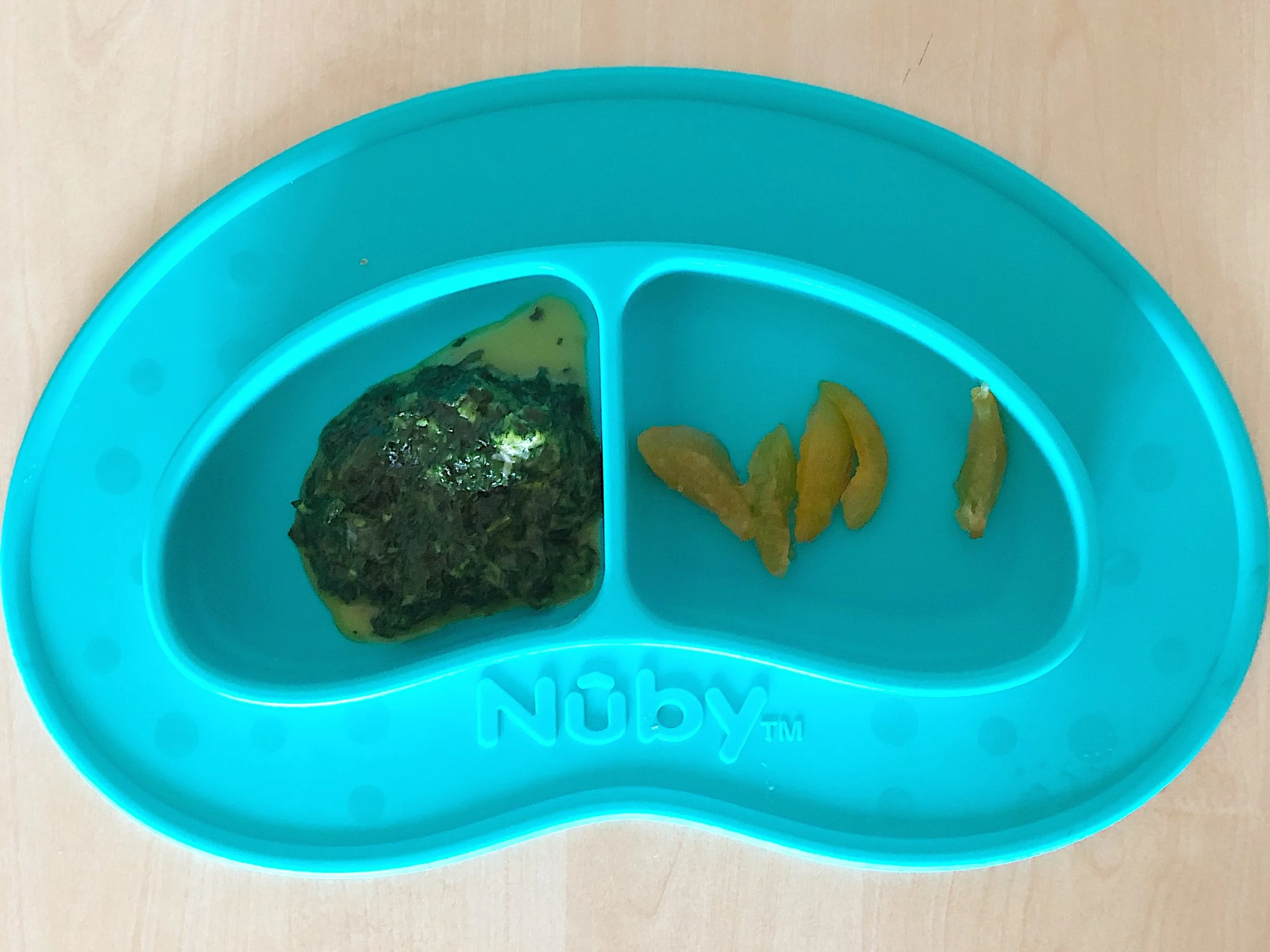
Sample combination feeding. Left: pureed spinach with grass-fed butter and runny organic egg yolk. Right: Plum, skinned and cut in finger shape.
I am very curious to know what worked (or didn’t) for your and your family. Were you also anxious about introducing solids? Which method(s) did you use? What first foods did you offer?
Back to business as usual
Hi there, how are you? It’s been a while since I last updated this blog, and a whole lot has happened since then.
Firstly, I had a few people from literally around the world approach me to say they read and like and take inspiration from what I write. And let me tell you, hearing this has got to be one of my favorite feelings in the world. Like any other millennial (or human, really?), I am constantly on the lookout for my “calling” and am often pulled back into writing. It really seems to be my thing, and I can’t thank you enough for appreciating it.
Secondly, my mom was visiting/helping us out for a few months, then we were away for a bit in Toulouse for a wedding and finally in California to visit family. I also turned 30! In other words, our daily lives and habits have been uprooted, shaken, and tossed around quite a bit lately - and we’re people who mostly thrive on a set routine, or at least I am. These trips were certainly less glamorous than they may sound (with two small kids in tow, nonetheless), but they were incredibly eye-opening and helped us refocus on what we want for our family in the future. They also added many points to our “traveling with kids” skillset, which I’m excited to share and hopefully help you from our experience.
And lastly, but not in the least less importantly, I’ve introduced L to solids! This is an exciting milestone for any parent, but even more so when you’re studying to help other parents introduce solids to their kids’ diet. This time around I’m giving baby-led weaning a go, and I’ve lost count of the amount of raised eyebrows I got or the number of people who asked me when we would start feeding her “baby cereal”. The answer being probably never.
That said, please let me know in the comments what you’d like to read about first:
A. Traveling abroad with small kids or
B. Introducing solids to baby L (while traveling!)
I’d also love to hear about your summer and past few months. What did I miss?
The fascinating female anatomy
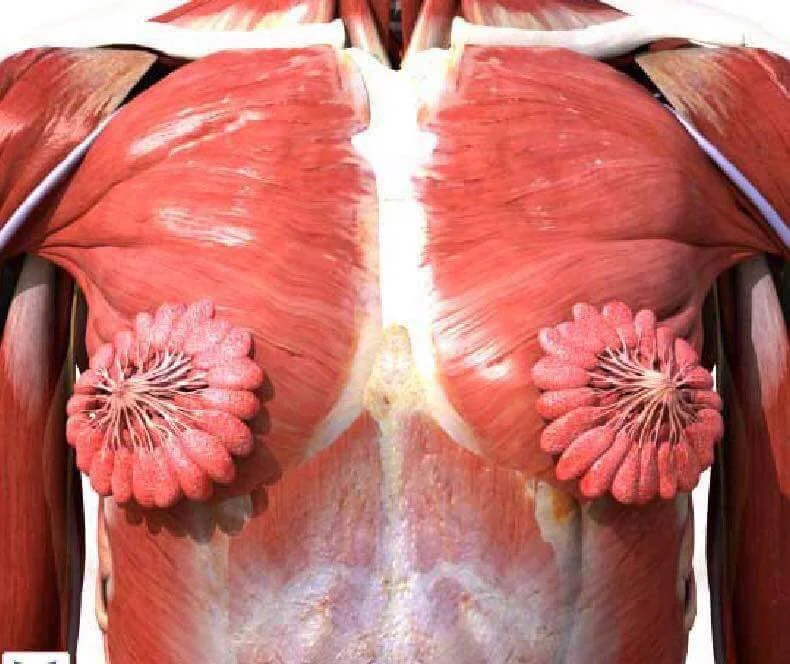
I saw the image above of a woman’s milk ducts multiple times on my Facebook feed last week - the first time while nursing my daughter, nonetheless. “How”, I immediately wondered, “can this be right under my skin, feeding my baby, right at this moment? How was I never taught this in school? How did I never read about this or see a similar image in the many - many - pregnancy books I’ve read in the past couple of years?”
It is a mesmerizing image. Many of the articles which shared it had comments from people who didn’t believe it was true. Some people, women even, were disgusted by it. Others commented on how the milk ducts look like flesh flowers. I, personally, was just in awe.
During both of my postpartum periods (still ongoing), my biggest struggle has been to come to terms with my new body. This is a body that doesn’t fit in most of my old clothes. It’s a body that took 10 months to feel like my own after S’s birth, and who knows how long it’ll take for this feeling to come back this time around. It’s also a body that nurtured two lives from scratch. It’s a body that continues to nourish, via milk ducts very similar to the ones picture above, a baby whose fat little rolls make me so proud.
Accepting vs. honoring my own body is a real, non-negligible struggle. It takes conscious effort to acknowledge and sympathize with how much it has gone through in the past two years. Both of my pregnancies were “easy” by comparison, which in turn makes it harder to come to terms with the monumental toll they took on my body. Producing rich, nourishing milk is another feat short of a miracle. Did you know that a woman’s body will take all nutrients the baby needs from her own stores to produce milk, regardless of whether she has enough for herself? Breastfeeding is in fact nutritiously more taxing on a woman’s body than pregnancy itself. No wonder there have been days (weeks, months) in which I felt depleted and occasionally defeated. If only I wasn’t so distressed by the image I currently see in the mirror, I should probably pat myself on the back.
Don’t get me wrong. I am proud of my babies. I am all for empowering women. It would be hypocritical of me to be hard on my own body while telling other women to love theirs, just because my old clothes once again don’t fit quite right. But I would also be lying - to myself, most importantly - if I didn’t admit that I’ve been conditioned to believe that I should “bounce back” after birth. That I am not disappointed every time I step on the scale and erroneously believe for a split second that I should’ve “shed the baby weight” by now. I remember wondering if I’d ever feel good in my own skin again months after giving birth to S. I now know that I will, but that doesn’t make this ambivalent transitional postpartum period any easier.
I was recently asked what I wished for all postpartum women. I said I wished they would be kinder to their own bodies, starting in their own minds, regardless of societal pressures. I said I wished that for myself. It is certainly what I wish for my daughter. Though I’m not quite there yet, I do wish those flesh flowers work as a reminder to us all that the female body is simply fascinating, regardless of its past, present or future shape or size.
My VBAC birthing experience
I’m not really sure where to begin in retelling my daughter’s birth. All I know is that there was a series of events and choices which led to an unfortunate experience - most of which could’ve surely been avoided with a bit more knowledge and/or assertion on my end. I own up to not having known enough beforehand, and having instead chosen to believe that the healthcare professionals involved in L’s birth (mostly women) had our best interest at heart. Which, to be honest, they probably did. It just wasn’t the best for me. And I believe that this is what the vast majority of women opt to do - trust - so I urge them through this humble platform to do their research, and stand their ground when it comes to this defining moment in their and their babies lives.
L was born on February 1st 2019, at 23:41h, in Starnberg, Germany. Weighing 2.780kg and with 51 cm, she was already the most perfect bundle of joy and we were immediately smitten. We decided to have her in Germany mainly because they’d allow me to try and have a VBAC, i.e. a vaginal birth after cesarean. Since there’s been less than 2 years since my son was born, there was a small chance of a uterine rupture - a chance they wouldn’t take in Brazil or France. In those countries, I would’ve had to have undergone another c-section, which I didn’t want. We don’t plan on having more children, so I truly wanted to experience vaginal birth. My heart was set on a VBAC as long as my daughter and I were healthy; so a VBAC is what I got.
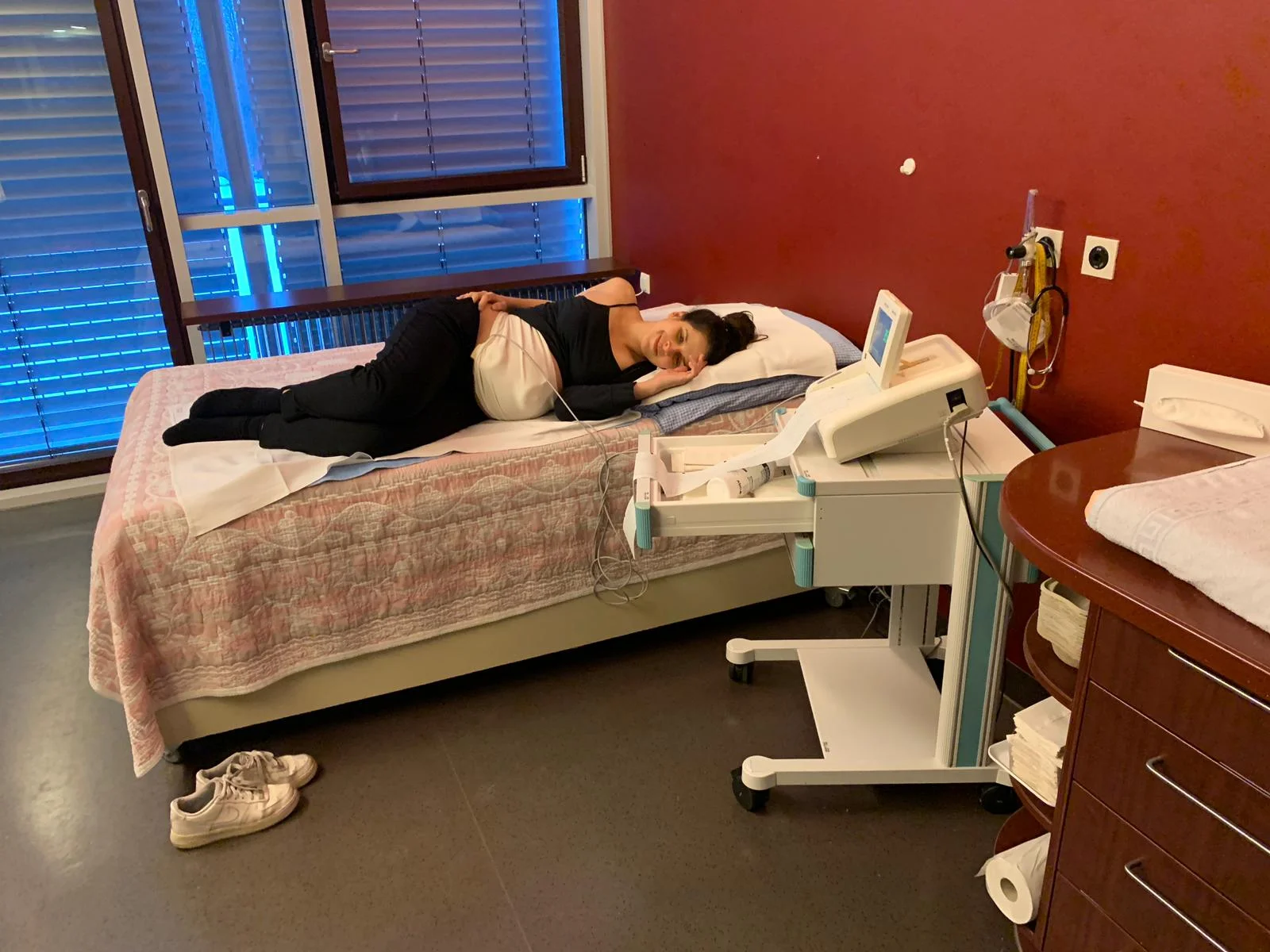
Yet, here’s what I wish I’d known in advance.
Cervical exams are optional
A cervical exam during pregnancy is when the doctor inserts two fingers into the vagina to check manually whether the cervix is dilated, by how many centimeters, etc.
The day before L was born, exactly a week before her due date, I was feeling a lot of pressure on my c-section scar and, after calling my doctor, decided to go to the hospital and have it checked (with the risk of uterine rupture, I wasn’t taking any chances). At the hospital, the doctor performed the standard cervical exam, rather aggressively, but although it was uncomfortable I didn’t see any harm in it - until it was too late. As she removed her fingers, a small gush of water came out.
That night, my urine was a bit tainted with blood. The following morning I woke up to my PJs soaked. My water had broken. I am now rather certain that this cervical exam the night before somehow contributed to PROM (premature rupture of membrane, i.e. when the water breaks before labor starts). I wasn’t dilated at all, L hadn’t “dropped”, I didn’t have any contractions. Yet the time had come, and at 7am we headed to the hospital.
Choosing a hospital close to where you live has also to do with postpartum
The hospital we chose was 30-40 minutes away from our place, in a city southwest of Munich called Starnberg. It came with excellent recommendations (unanimously good experiences by all women I asked) and, since it wasn’t in Munich, we had a higher probability of getting a private family room for my recovery. On the day of her birth we had more than enough time to get there. In fact, I would go on to spend the day walking all around and climbing up and down the hospital stairs, hoping it would trigger labor naturally.
However, what no one told us was that the hospital’s proximity is just as important, or even more so, during the baby’s and mother’s postpartum recovery as it is during labor. I’ll write more about this on my post about the first weeks of the puerperal period.
GBS testing is not standard in Germany
In Brazil as in other countries such as the US, where most of my pregnancy reading material comes from, GBS (Group-B Streptococcus bacteria) testing is pretty much standard. This is an important test, as GBS bacterial infection can pass onto babies born vaginally and, in very rare occasions, cause meningitis, pneumonia or sepsis. If a woman tests positive for it, or if she isn’t tested, she will be routinely administered antibiotics during birth - which I really didn’t want, as it could affect my daughter’s gut health for months to come. I was thus shocked, and frankly pissed off, when my doctor told me the day before L’s birth that I hadn’t been tested because “I didn’t ask for it, and the health insurance wouldn’t cover it”. At no point throughout the pregnancy had he asked me whether I was interested in taking it, and I assumed it had been routinely done. Again, my mistake in trusting and assuming. Alas, I’d be given antibiotics.
If you live in Germany and would like to be tested for GBS, which I recommend, make sure to discuss with your doctor in advance. You may need to be tested a few times throughout the pregnancy, as the result can change, affected for instance by your diet (probiotics can help a lot). The results take generally about 48 hours to come out.
If you aren’t vocal and assertive about your wishes, executive decisions can be made on your behalf without consulting you first
I arrived at the hospital around 8am, and by 1pm I was still walking around trying to trigger labor naturally. It didn’t happen. The midwife decided to give me medicine - oxytocin - to speed up the process, since my water having broken put L and me at a higher risk of infections. I had the right to refuse it, but I didn’t, which I take full responsibility for. To be entirely, 100% honest, I didn’t “feel like giving birth” at that moment. I didn’t feel empowered. I didn’t feel energized. I knew my daughter had to come out soonish by whatever means, and the only thing I was sure of then was that I wanted her to be healthy. I was fearful of a uterine rupture, and I was also fearful of stories I’d read about incontinence and ruined sex lives post vaginal birth. Yet, I didn’t want to have to recover from a c-section again (although my experience had been overall positive). All sorts of thoughts were going through my head and I didn’t know what to make of them, so I went on a trusting auto-pilot.
As I said before, I do take full responsibility for accepting other people’s suggestions rather than trusting my gut instinct. By 3pm I started feeling violent contractions triggered by the oxytocin, but they were then still far enough apart that I could rest a bit between them.
By 5pm though, I was already exhausted and miserable from the intensity and frequency of the contractions, and I was told I’d be given an epidural (which had always been part of my birth plan). For the following 3 hours I kept being told that the anesthesiologist “was coming”. When he finally showed up around 8pm, the hospital had somehow lost my paperwork - so he left while my mom, together with YY, filled it out all over again. I was truly miserable.
When the anesthesiologist finally came back, he told my mom and YY to leave the room. He didn’t speak a word of English and kept barking at me in German to not move - an instruction I tried to follow as best as I could despite the 1-minute-apart contractions. When the anesthesia caused a spasm on my right side, which obviously made me move, I was barked at again even louder, and this time by the midwife as well. I was so nervous and in so much pain that I started throwing up. Profusely. I have since learned that this “awful anesthesiologist” experience is somewhat common here. Once this whole ordeal was done and the pain had finally subsided, I was left in the room with YY and finally got to rest a little bit.
Asking you “not to scream” can be considered a form of psychological obstetric violence
Around 11pm, the doctor came to examine my cervix once again. At this point, thanks to the epidural, I finally was around 7cm dilated. I was overjoyed with the progress, and could at last envision the VBAC I’d hoped for. About 20 minutes later, however, I started feeling an overwhelming urge to push. I could feel L’s head putting a lot of pressure on my cervix, and quickly came to realize that I couldn’t “hold her in” any longer. I called for the doctor and the midwife, and as soon as they came in they told me to push. Continuously. It went against what I’d been told (to push slowly in order to avoid tear), but I was not about to contradict them. As I started pushing, screaming came naturally - at which point they told me not to. I was supposed to push, quietly.
I later learned that requesting women to be concerned about keeping things orderly during birth, when they’re at such a primal state, can be considered a form of psychological obstetric violence.
The “Kristeller maneuver” is not recommended worldwide, and is considered a form of obstetric violence
This is probably the part which shocked me the most during L’s birth, and one in which I felt like I had no control at all. The doctor performed the Kristeller maneuver (or “applied fundal pressure to facilitate childbirth”) in order to speed up the birth, since poor L was exhausted from labor and her heartbeat rate was dropping. I.e., she pushed L down the birth canal by aggressively pressuring my ribs with her arms and elbows. This maneuver is not recommended by the WHO, and hasn’t been routinely done worldwide for a while, including in Germany. The risks of this maneuver far outweigh the benefits. She could’ve broken my ribs. Worse yet, she could’ve broken L’s clavicle, or even caused brain hemorrhage - amongst many other tragic consequences which I don’t even want to consider.
With the additional aid of vacuum, L was out in about 5 minutes.
If you plan on giving birth in Germany, I urge you to include your preference for not having a Kristeller maneuver performed in your birth plan.
Suturing after a vaginal birth, no matter the degree of tear, takes longer than suturing after a c-section
Because the birth itself went by so quickly, and since I wasn’t dilated enough at that point, L came out ripping everything in her way. At first the midwife kindly reassured me that I had had “barely any tear”, but the doctor was quick to correct her. I had a third-degree tear, and suturing took longer than an hour. I thankfully had a healthy and hungry L on my chest for most of the time, but I couldn’t help but feel extremely fearful as the doctor called in other doctors to assist in stitching me up. Overhearing her say in German - twice, nonetheless - that it was a “catastrophe”, mustn’t have helped. She surely thought I was too “out of it” to hear, or assumed that I couldn’t understand German. Alas, I did hear her. And so did YY.
What I learned (much later, from another doctor, at another hospital) though is that suturing post-vaginal birth takes longer than a c-section, no matter the degree of tear. With my previous cesarean experience, S was out and I was stitched up in no more than 20 minutes. This time it took at least an hour and a half. Suturing a vaginal birth involves many unpredictable layers of skin and muscles, and doctors need to be particularly careful and attentive. Happily, I was reassured that they had done an “excellent job”, and I am ultimately thankful that they took the time they did.
By 3am, I was up in the recovery room.
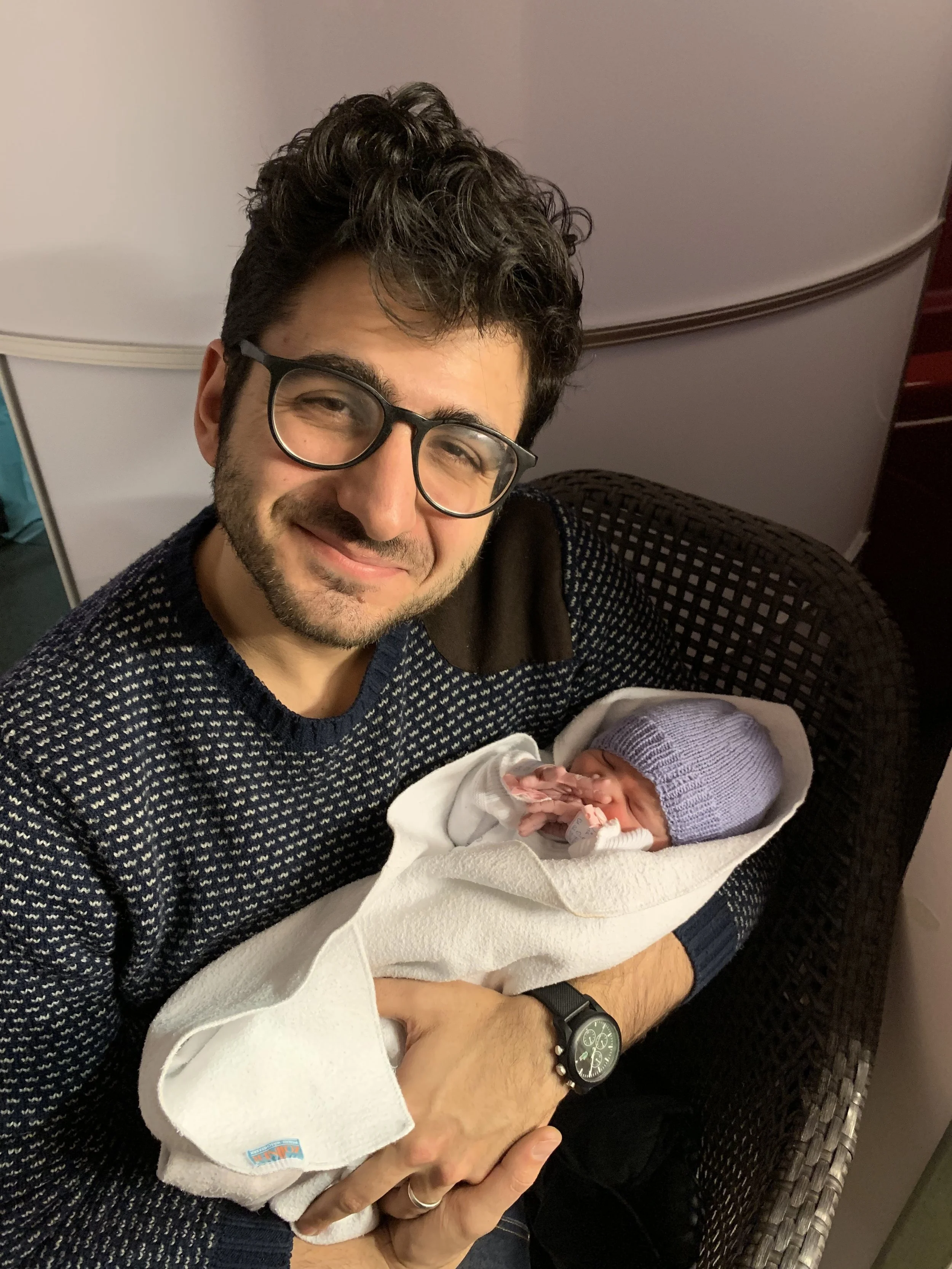
To be fair, my experience wasn’t entirely negative, and I would like to end this report on a more positive note.
I had an angel of a nurse with me throughout most of the painful part of labor, who kept holding my hand and telling me that I was doing great (she also said YY was an excellent midwife as he encouraged me to do some of the breathing exercises we had learned in a great birthing class). Without her, I’m not sure I could’ve put up with the whole experience without begging for a c-section.
I’ll also never forget the moment in which I realized my daughter was being born vaginally, when we were past any possibility of a c-section, which was when the midwife exclaimed that she could see her head (and that there was so much hair!). That was exactly what I needed to hear in order to make the final push. Moments later they passed me my daughter. YY and I looked at each other, and he said “you did it”. L and I had indeed done it.
As we waited to be taken to the recovery ward, the midwife offered me tea and crackers. Time slowed down as I recovered a bit of my strength. L nursed immediately and instinctively, and I could at last enjoy the first rush of hormonal postpartum bliss.
The postpartum daze
There’s been so much I’ve wanted to write about since giving birth to our lovely L almost two months ago. But it has taken me this long to be able to sit down, and try to digest and process what I went through - what L and I went through. Only now, 8 weeks later, I am feeling a little more confident and able to organize my thoughts a little better. But even now, I keep reading these lines over and over again in order to convince myself that I’m somewhat eloquent. So please bear with me - the daze is real.
I have done a lot of research since her birth, both as part of my certification as a Pregnancy and Postpartum Nutrition Consultant, as well as in an attempt to better understand the unfortunate series of events that led to a less than ideal birthing experience for both my daughter and me. There are so many things I wish I knew beforehand, and another handful of things that I was pretty confident about knowing. So I decided to create separate, more “digestible” posts about what I wish I’d known, dedicated to my VBAC birthing experience in Germany (it wouldn’t have been possible elsewhere), and to my recovery.
All in all, I am obviously very grateful that L and I are now healthy. I am grateful that we’re home and that we’ve had so much support from our families from day one. I am grateful to my body, for nurturing and birthing her, and for continuing to nourish her. But to my gynecologist, who said my birthing experience was absolutely normal, I say no. It wasn’t. If it was, well, there is something very wrong about what has become normal - and we most definitely need to talk about it. I hope that in sharing my experience in upcoming posts I can prevent a future mother from going through a similar situation, regardless of where she lives.
The elephant in the room
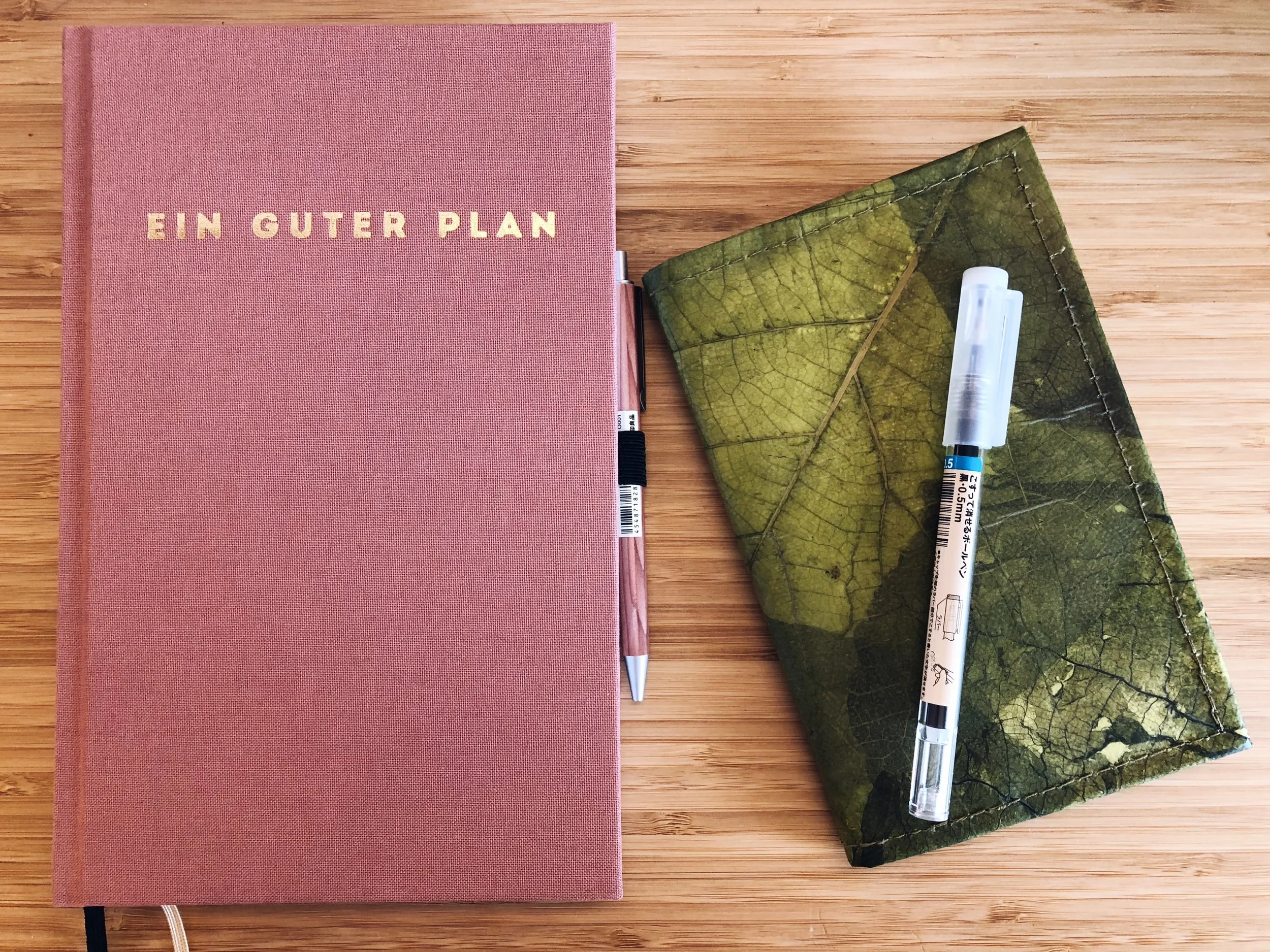
I have always been a big fan of new years. I can’t help but find the promise of a “new beginning” extremely enticing - I love reflecting upon the past 365 days, drafting resolutions, looking forward to a brand new calendar filled with wishes and above all hope. I like having an excuse to clean up clutter - physical, mental and emotional. And I particularly love following as many crazy Brazilian traditions as possible (i.e. wearing white and brand new underwear, eating 12 grapes at midnight, lentils, pomegranate, etc.), all in an effort to evoke some sort of cosmic help to bring forth the best possible year yet. As it’s often said after Cervantes, “yo no creo en brujas, pero que las hay, las hay” (or something like “I don’t believe in witches, but they do exist”). When in doubt, I have always done my best and felt utterly eager to start a new year, a fresh beginning, on the right foot.
This year, however, has felt somewhat different. With our baby daughter’s imminent birth always on my mind, I’ve been feeling quite uneasy. Not only because birth and the postpartum period are by nature highly unpredictable, but also because, this year, we must all address the elephant in the room - the one with the neon sign exclaiming that these are very uncertain times, especially for those of us raising little kids. I guess most of us can agree that last year wasn’t exactly a period of smooth sailing. Most “2018 retrospective” articles I read tried and failed to steer the focus from what a hot mess last year was for politics, for the environment, for women’s rights, for our basic sense of stability. Reading the news last year often felt like having the metaphorical rug being pulled from under our feet, day after day, until all we could do was lie on the floor and cease to be shocked by the grueling reality we’re currently living in.
Believe me, I am not a pessimist. I’m a realist most times, and otherwise an open-hearted optimist. I am after all expecting our second little one, so I must believe there is good left in the world. But I must also acknowledge that things are a bit scary right now. The back of my head is constantly coming up with emergency exit plans for my family if, you know, history repeats itself as it tends to do. Yann-Yves and I decided to stay in Munich (a place we’ve come to love so much) until at least 2021, i.e. while Merkel - and the EU - are still around. Everyone nervously laughs when we explain our reasoning, us included. The EU, and with it our right to live in Germany, is something we’d always taken for granted until Brexit kind of happened, and with it the galloping rise of nationalism worldwide. Just like abortion rights were a given in most of the US, or the Paris Agreement reflected just global common sense. If there’s one thing that this moment in time for humanity has taught me it’s that nothing we hold dear, and none of our rights, should be taken for granted - and that we must be ready to fight to keep them.
2019 is the year an ultra-right wing candidate I overtly and completely despise became the president of my country. It’s a year that began with a partial government shutdown in the US. It’s a year in which the gillet jaunes will certainly continue to wreck the French economy and Macron’s credibility (again, nurturing the perfect conditions for nationalism to continue to set and grow its ugly roots). You may think that none of this affects you, so why bother, but it mostly definitely does; so I guess it’s understandable why my enthusiasm for a “fresh new beginning” has been somewhat toned down this time around. But this is also the year we become a family of 4, the year I dive deeper into creating a career out of purpose, the year I turn 30. And that is, at last, what I choose to selfishly focus on.
As we all start setting into this new year, may we keep the hopes, the wishes, and the resolutions we set for ourselves on the 31st. But may we also acknowledge the reality of the massive elephant in the room - for it is there, and it shouldn’t be ignored if we are to stand a fighting chance.
To anyone I've wronged this year

I’m sorry, and thank you for your patience.
As 2018 comes to an end (or any year for that matter), like most other people, I start reflecting about things I’ve done, and things I wish I’d done.
I wish, for example, I’d texted my friend when I randomly thought of her on my way to pick up S. It’s the kind of thing I’ll note on my ever fleeting and flawed mental to-do list, never to be remembered again. And I’ve come to realize that I do that a lot.
I got plenty of tracking methods (hello, beloved bullet journal) and I have a hard time blaming these mishaps on “new mom brain” and/or “pregnancy brain”, even though these are 100% real. I’ll forget what I’ve had for breakfast, fine, but surely I could write down when I mean to reach out to someone.
So this goes out to those whom I meant to send a thank you card. I truly appreciate having you in my life.
To those whose birthday I remembered a few days too late (and didn’t dare sending the dreadfully awkward “happy belated birthday!” message). I hope you had a nice, special day.
To those who didn’t hear from me for months. I’m alive and well, how are you?
To those whose messages went embarrassingly unanswered. I’m afraid I’ll never get to them, I’m sorry.
To those whom I’ve promised to send a link to that thing I got on Amazon, but then almost immediately forgot all about it. I swear it’s not personal, please send me a reminder.
To those with whom I made plans to grab a coffee, and never ever did. I honestly think we still should.
To those I’ve unwittingly offended. I really didn’t mean to.
To those who went through difficult times and could’ve used a “hi, how are you?”. I see you and I promise I’m here for you.
To those whose special events came and went without a “congrats” on my part. I wish I had celebrated with you.
Rest assured, I’ve thought of you. All of you. I think about you constantly.
My sincere apologies for not being the best of friends, or relative, or acquaintance when it comes to reaching out.
I’m making this a resolution for 2019 - to reach out more. May this be my first step.
Second pregnancy woes
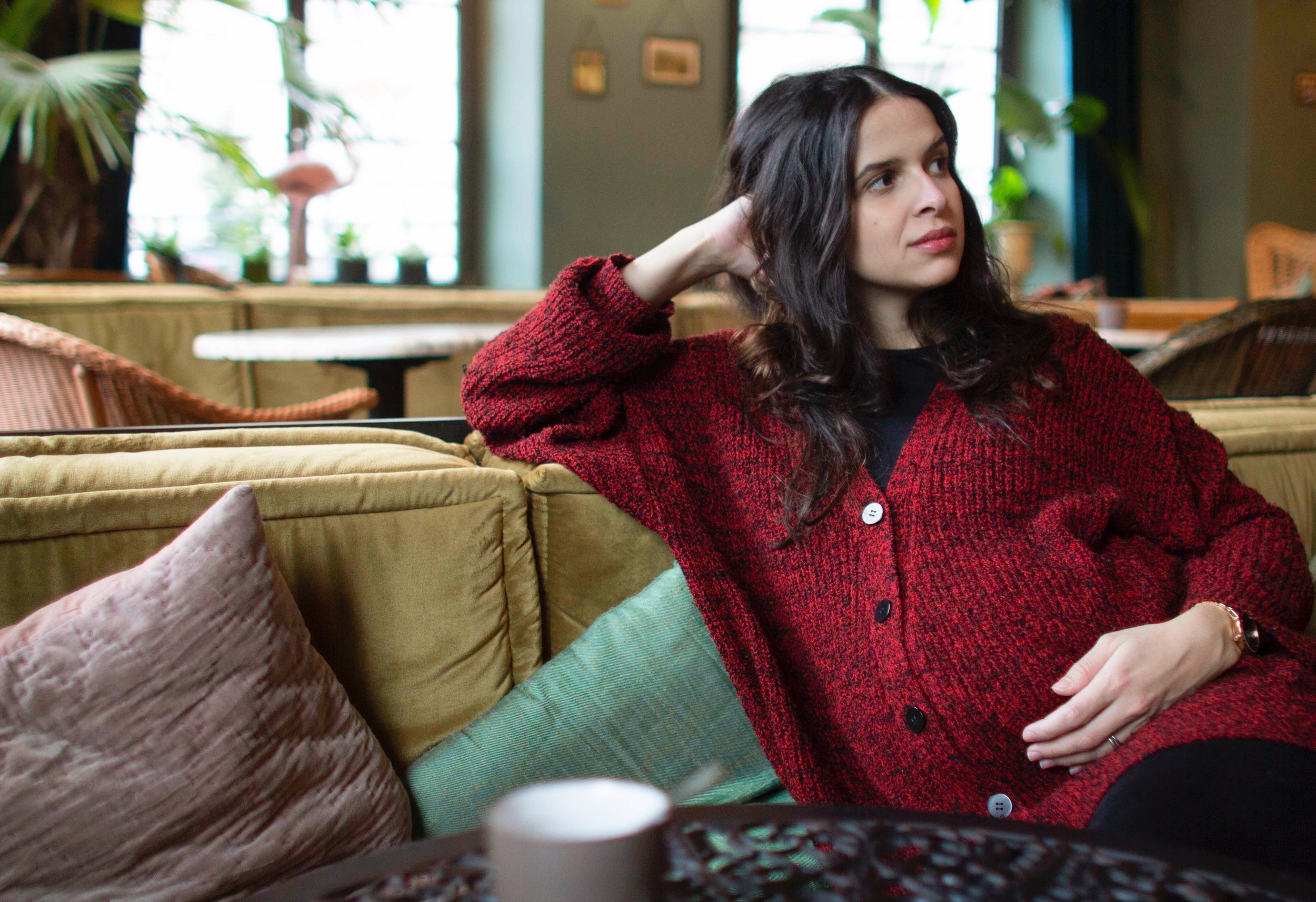
Earlier this week I stumbled upon my also pregnant next-door neighbor on the sidewalk. She was on her way to pick up her son at daycare; I was running back home from therapy hoping to have a quiet lunch before Yann-Yves came back with S. (Side note: Yann-Yves and I have hit the next-door neighbor jackpot: they’re one of the loveliest couples we’ve ever met, we share a number of interests and they actually give us flour when we run out of it).
We hit off a short exchange with the general polite conversation starter: “How are you doing?”. A question which you can’t help but answer honestly at any stage of a pregnancy. Her at 4 months of her second pregnancy and me at 8, we could definitely agree on one thing - being pregnant for the second time isn’t a walk in the park. Caring for a toddler (their son is around 4 months older than S) takes the glow out of you, and exhaustion tends to be the most common denominator throughout the whole 9 months. The time and energy I had to consciously relish my pregnancy through meditation and prenatal yoga when I was expecting S, a luxury even then, is now basically inexistent. I struggle wondering how this might affect my daughter (if, of course, at all).
We talked about how time passes so much faster the second time around. With S I felt so ready for his birth, but now that I know just how hard caring for a newborn is and the toll that it took on me physically and emotionally during the first month postpartum, I am urging time to slow down a bit. She had a hard third trimester the last time around, and is also apprehensive about what’s to come.
One of the many things “everyone tells you” is that each pregnancy is entirely unique, and they are right. This one started off completely different from my first, with intense morning sickness and general fatigue (which I took as clues that I am expecting a girl). I’ve also had to go to the emergency a couple of times due to unusual pains and a stomach bug. By now, at 32 weeks, I have started getting Braxton Hicks contractions, something I didn’t have at all while pregnant with S. The other night, as Yann-Yves and I were getting him ready for bed, I sneezed and peed a little. For the third time this week. I didn’t even need to pee! It wasn’t even a big sneeze! I’ve been doing my kegels! I cussed at myself. My body is able to nurture life from scratch, but apparently can’t hold back a little pee anymore. Plus, everything hurts at the moment. I took a deep breath. And at last remembered to be kinder with this body of mine.
It takes effort to keep in mind and act upon things I’ve been learning about myself through therapy. For instance, to accept and overrule my overwhelming feeling of guilt, and come to terms with the fact that, indeed, I too need rest. I need help. And that’s ok. During my short exchange with my neighbor, I couldn’t help but to be blunt about how hard it is to accept that although women have been bearing and birthing children for thousands of years in much rougher contexts, I am still allowed to feel tired, and vulnerable, and even sad at times. She couldn’t agree more. She mentioned that this was one of the key takeaways from her first pregnancy - trusting your body and admitting to yourself what and when you need something. It’s much easier said than done.
The silly guilt I felt each time I napped this past week stems from the knowledge that women everywhere have it much harder than I do. I stopped working at 30 weeks with both pregnancies. I have a supportive husband who is also a parent (i.e. he doesn’t “help” me with S - he’s his father, S is our responsibility, not mine). I have a roof over my head and food in the fridge. I am healthy. And yet I’m exhausted and wonder at times, for a fraction of a second, what the hell did I get myself into.
Does admitting this to myself, and now others, make me less resilient? I’m not sure. Do I even have the energy to care at this point?
S has an imperfect mother, and soon his sister will too. My limitations are for me to carry, and for us learn how to deal with them as a family. But one thing I know for sure: I will love them with every fiber of my being in my perfectly imperfect way until the day I cease to exist, and I can only hope that’s enough.
My neighbor and I both needed to run off, and as we parted ways I could only hope she’d taken as much solace in our brief exchange as I had. We are both incredibly grateful for the lives in our wombs and most definitely do not take them for granted, but like any woman, we are also entitled to a range of other feelings and emotions, some less pleasant than others. We are only human after all.
An entirely subjective guide to holiday gifts

The holidays are here, hooray!
If you celebrate both Hanukkah and Christmas like we do, gift-giving during the holidays can be particularly tricky. I do generally love offering gifts though, so in our family - so far, at least - we’ve been giving S 8 smallish gifts for Hanukkah and one bigger “Christmukkah” one. Since he’s not yet at an age to be picky about what he wants, it’s really up to us to observe and come up with ideas regarding what would be somehow useful for him - which is in any case so much more fun.
We try to stick to the following in order to make it a bit easier to figure out what to give him; and also so that, should we stick to the 8 gifts in the future, the kids know there are rules:
Something he wants
Something he needs
Something to wear
Something to read
Each of these times 2.
Here’s what we’ve gifted him for Hanukkah this year:
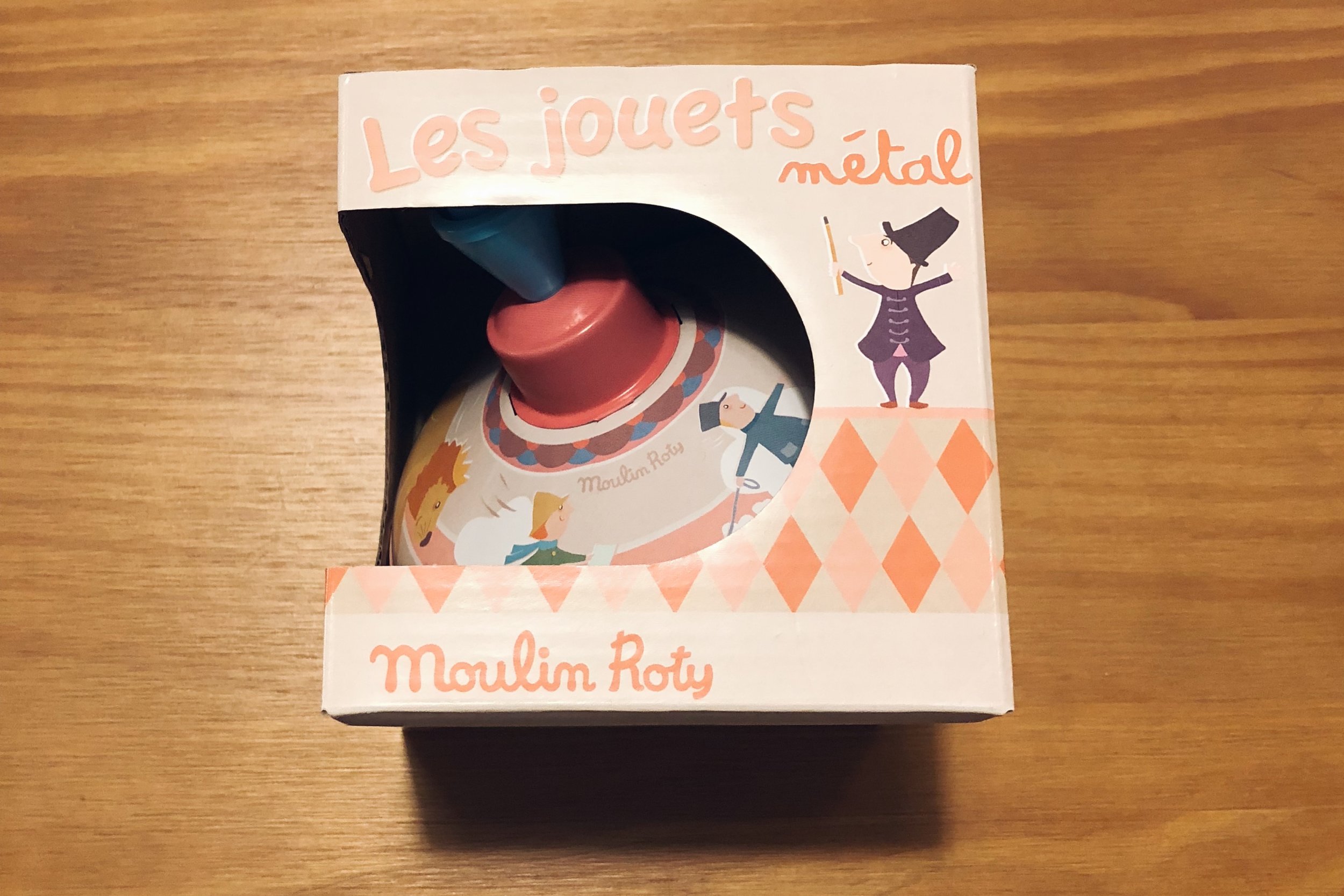
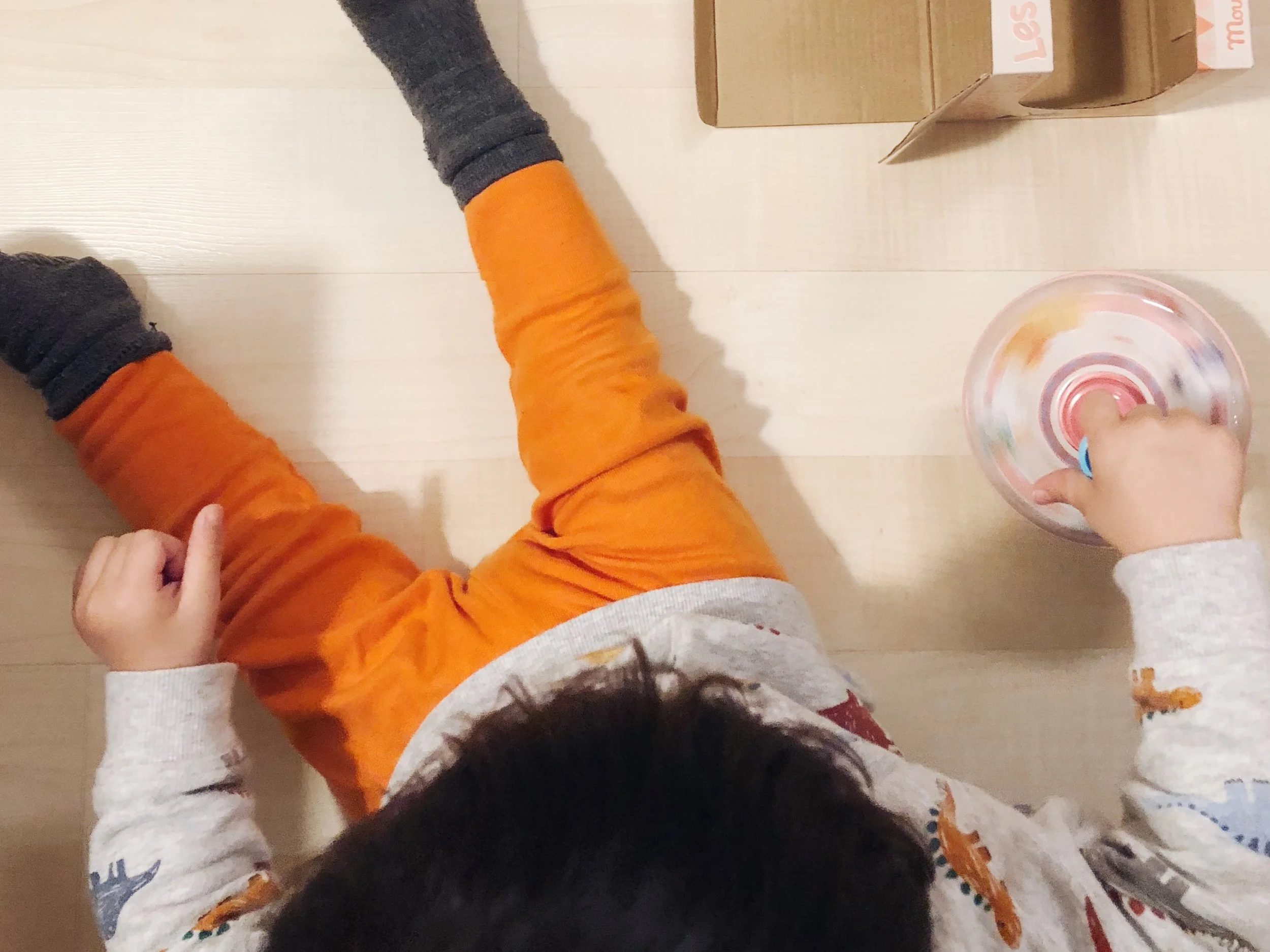
A spinning top. Whenever we go to kids’ cafés he goes straight for it. Since it’s a small, inexpensive toy I didn’t see the harm in giving him one, and 6 days later he still loves it, which is a win in my book. Category: Wants.
A donation to Doctors Without Borders. This is something Yann-Yves and I came up with last year and which we’re definitely sticking to in the years to come. I.e., one of the kids’ Hanukkah gifts must be a donation to an NGO or charity of their choice. Until they can choose, we’ll choose for them and make the donation in their names. Category of its own.
A musical book. Our family in Shanghai has introduced us to the wonderful world of musical books last Hanukkah, and S has been obsessed with them ever since. He’s broken/ripped a few of them already, so we can never have too many. Bonus: A “Curious George” book about Hanukkah sent by his auntie in China. Category: Read.
A ball. How exciting! I know. But he didn’t have a ball up to now and this is another kids’ café favorite. Again, small and inexpensive, and a total success. Category: Wants.
Winter boots. He didn’t have any yet and definitely needed them now that he’s walking everywhere. Category: Wear/Needs.
House shoes, ditto as above. Category: Wear/Needs.
A book about Jewish fairytales and legends. This one he’ll only be able to actually appreciate in a few years, but we find it important to start building a cultural library for him (and can’t wait to read him all these stories without him trying to rip the pages off the books!). Bonus - a book about interfaith holidays called “December’s Gift”, also sent by our family in Shanghai. This one made me tear up, as our strength as a family lies above all in love, with a firm foundation of tolerance and multiculturalism. Category: Read.
And finally, a LEGO Duplo set, once again sent by our super thoughtful and generous family. While S is still in a phase where he’s most interested in tearing stuff apart rather than building them up, this gift is definitely going to tickle his motor skills - and I can’t wait to build stuff with him. Category: Needs…?
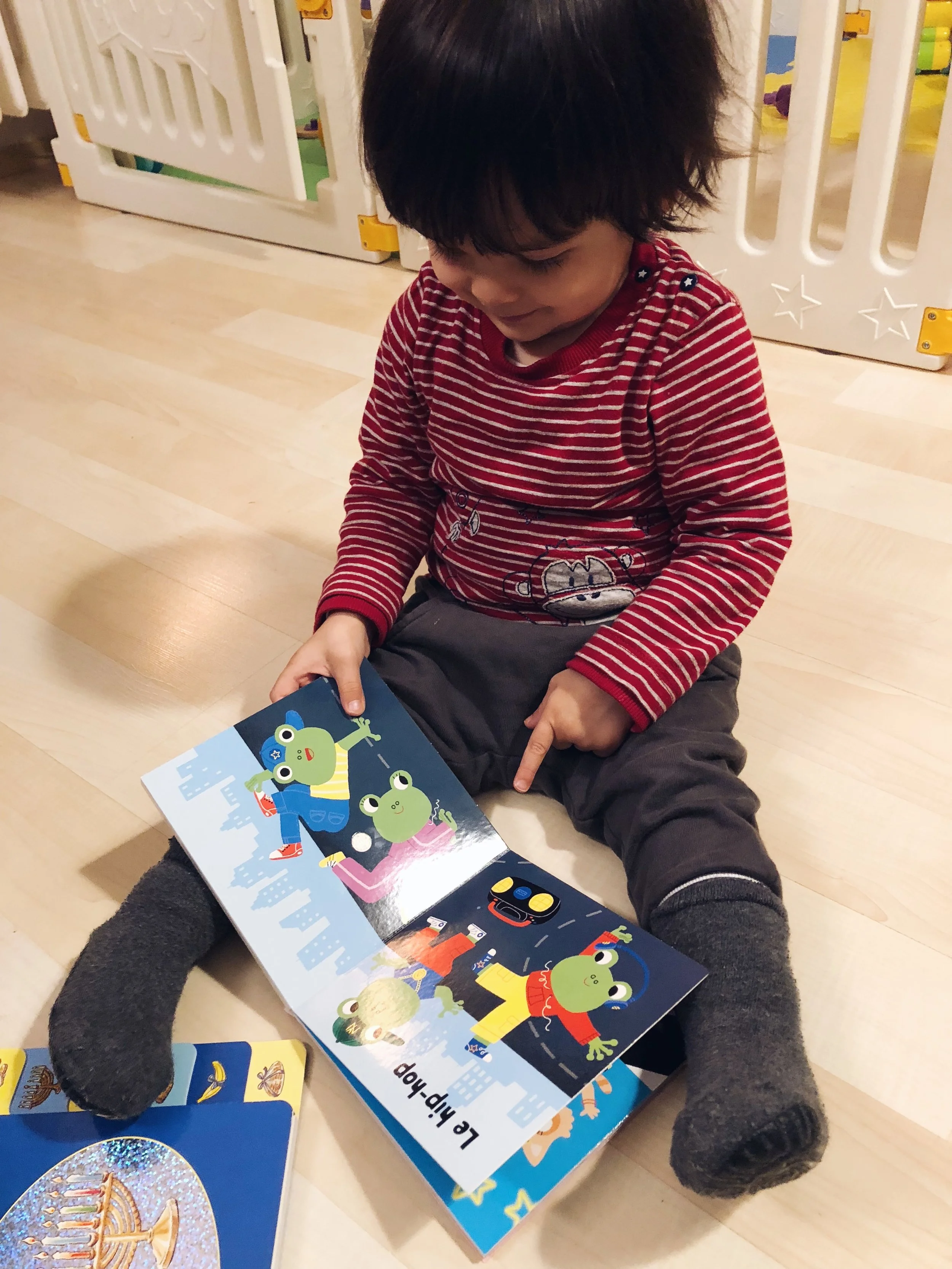
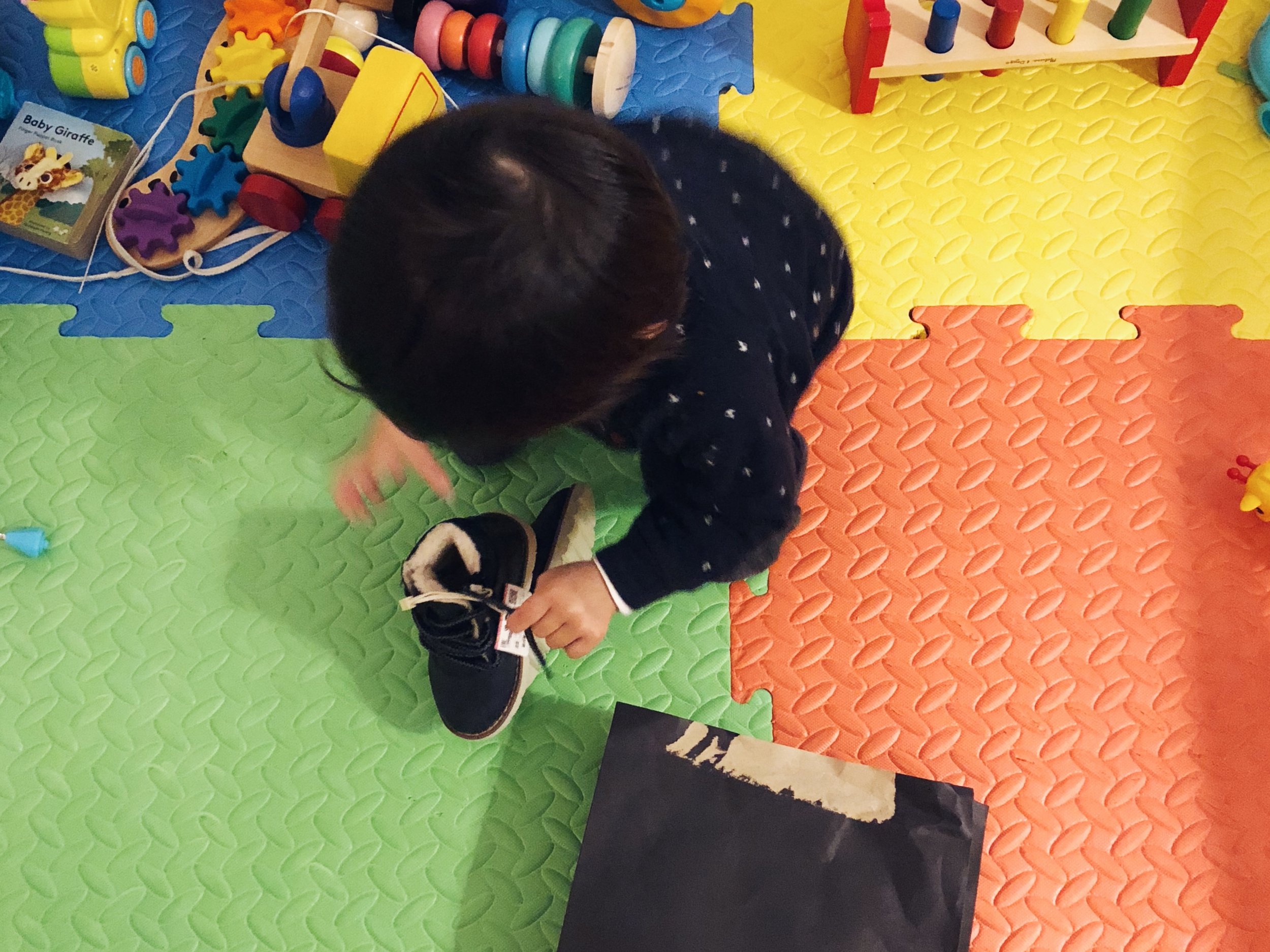
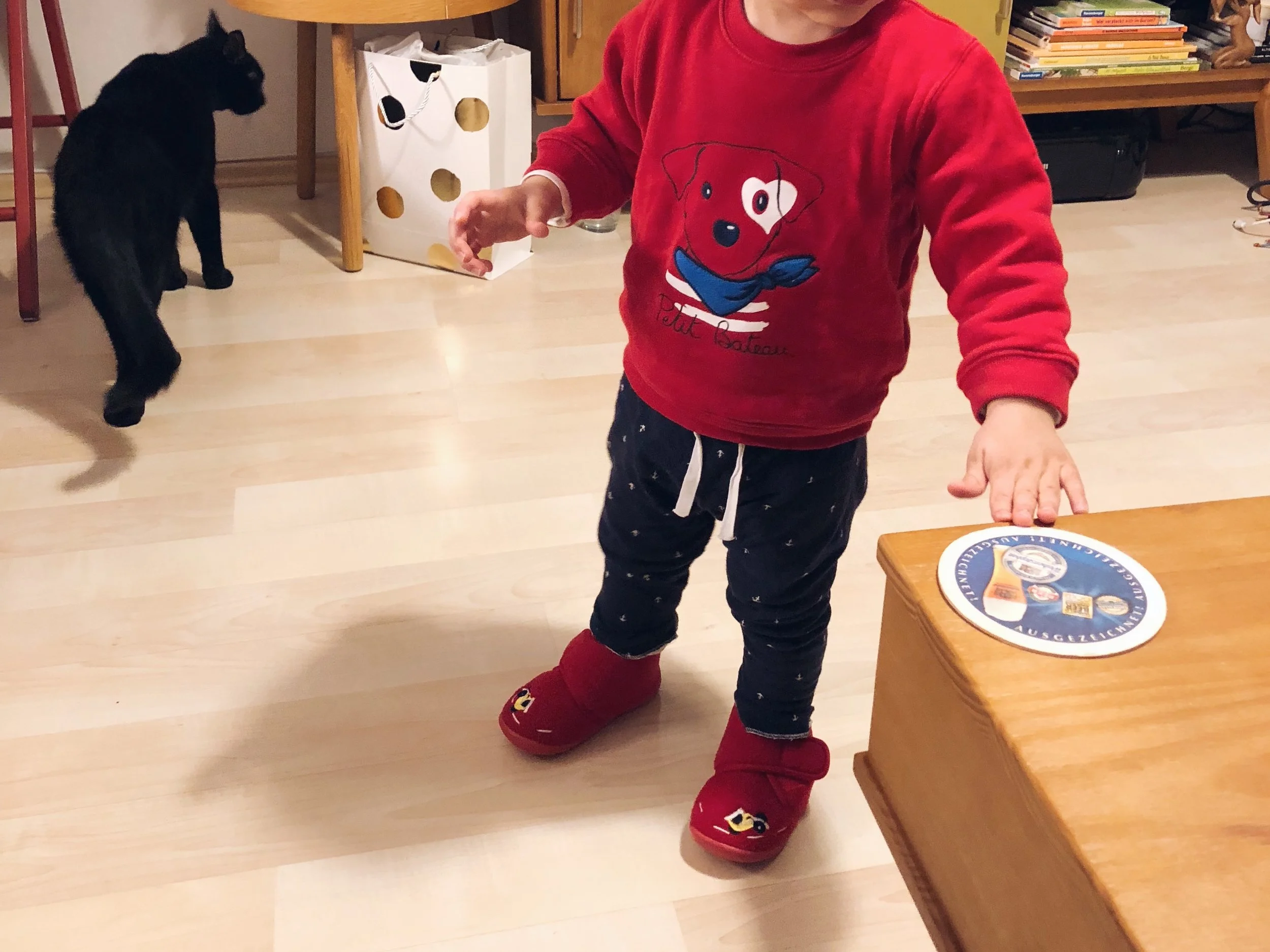
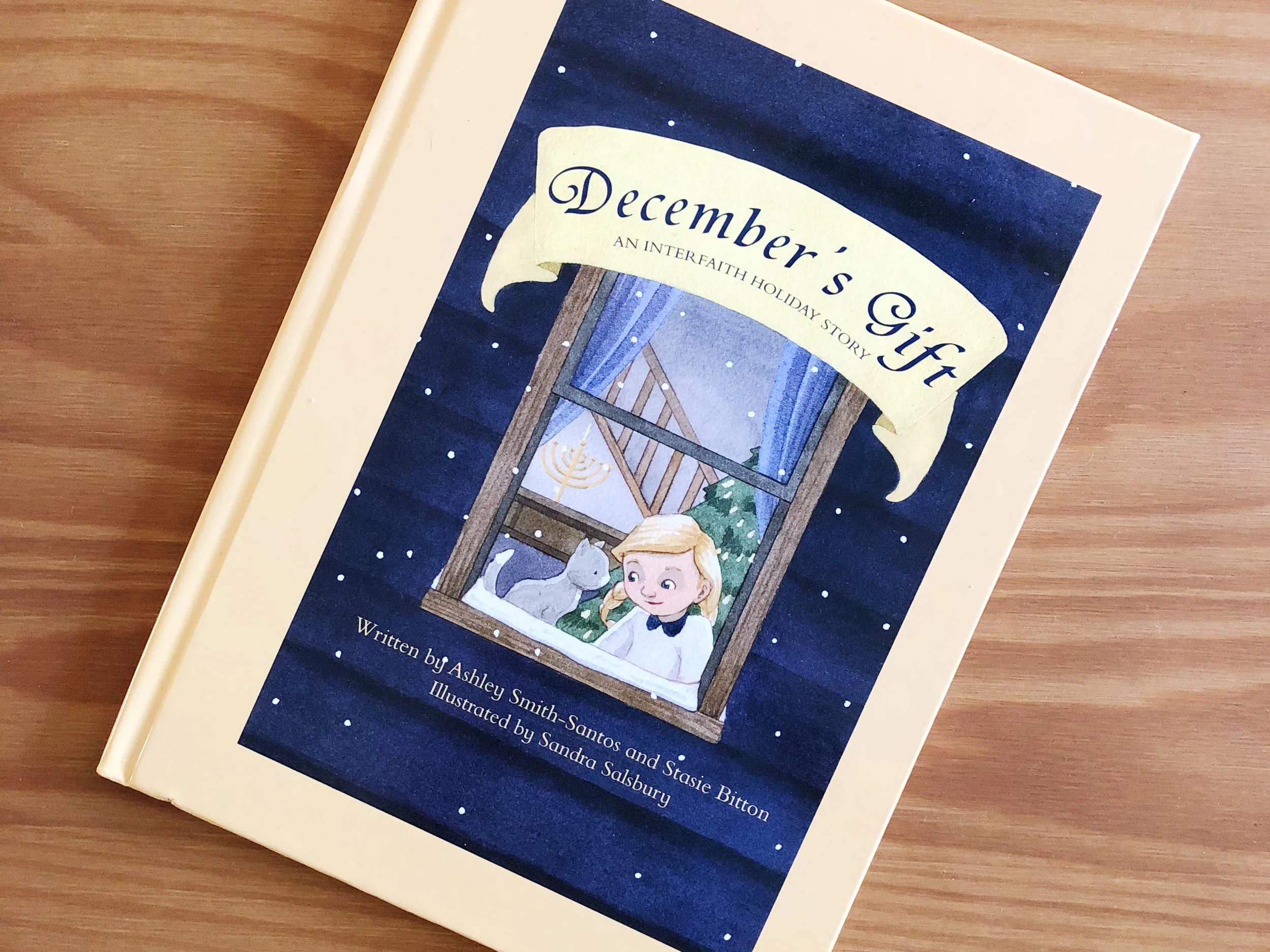
To be honest, he’s too young for these categories to be clearly defined. He can’t express what he wants yet, and most of what he needs blends in with something to wear since he outgrows his clothes so quickly. But these categories do give us, and relatives, a general guideline when choosing gifts. And, most importantly, they help us prevent raising super spoiled kids and accumulating stuff we/they don’t need.
Now, his Christmas gift is a whole other can of worms. He’s only getting one and we probably won’t be gifting him anything else before his birthday in July, so we’d like to make it count. We’re hesitating between a kid’s table + chairs, a mini kitchen, a little teepee…
Ideas would be greatly appreciated!
How is it December already?
Yesterday I had written a post about it being December already and how I’ve lost track of time this year. It was the first time I’d found a half hour to write in the past few weeks. It was a short but sweet little post and I planned on publishing it later that night. Then as I tried to upload an image, I accidentally deleted the whole text. I’d forgotten to save it - and just like that it had vanished. And I had a full-blown meltdown.
Yann-Yves and I have been so incredibly busy these past few weeks. We’re both working on exciting but challenging projects, I’m on the cusp of tackling a new career path (more on that soon), we’re completely rearranging the apartment in preparation for our daughter’s arrival (think Extreme Makeover: Nesting Edition) - and we’re also caring for a toddler while my bump grows exponentially by the day. Oh and I had a nasty stomach bug that left me couch-bound for most of last week.
Juggling all of the above requires a good amount of organization, and above all it requires control. My endless to-do list and busy bullet journal give me the illusion that I have it all under a carefully thought-out control. And then at the silly touch of a button I lose the text I’d been working on for precious 30 minutes of undivided attention, and I’m quickly reminded that it is not quite so.
I surprised myself as I snapped and broke down crying, suffering with the deletion of a short silly post. Trust me, it wasn’t a masterpiece. But at that moment the illusion of control was shattered, and I was flooded with frustration at the thought of all the loose ends that I must tie in the coming weeks. If I can’t even publish one finalized post, how am I supposed to get everything else done?
There’s my visa to renew. Paperwork to apply to. Market research to conduct. Books to read. A crib to buy. A bed to build. A business to kick-start. A maternity bag to pack. Maternity pictures to take. Clothes to donate. Furniture to give away. Courses to attend. Social media to manage (a particularly painful one for me). A husband not to neglect. A toddler to entertain. A baby to nourish. And then, maybe, there’s me.
The real list is much longer than the word limit of a blog post would permit, yet yes, I know I have it easy. But for the last few weeks it’s been truly challenging to see the figurative light at the end of the tunnel. As the reality of birth starts to dawn upon me, I’ve been piling myself up with an outrageous number of tasks to accomplish before our girl decides to show up, for fear (or acknowledgment) that I simply won’t be able to tackle them once she’s here.
So how is it December already? Any other year I would’ve put up the Christmas tree and decorated the house for Hanukkah weeks ago. I would’ve been listening to Christmas carols nonstop and would’ve driven Yann-Yves insane by now. I would’ve been drinking cosy drinks and soaking up the comfort of a nice smelling candle and all that hygge that comes with winter. More importantly for me, I would’ve started my yearly process of evaluating my past 12 months, in excited anticipation of the upcoming year and the “turning page” effect that it’ll bring.
But right now all I can do is finish writing this post and hope to publish it before accidentally deleting it again. Baby steps I guess?
Interview with Yann-Yves
I’ve said it before and I’ll say it again. I have only been able to bloom into the role of mother as I have thanks to my husband Yann-Yves. His unyielding support allowed me to have the breathing room necessary to appreciate motherhood, instead of potentially resenting it.* I cannot imagine how single parents (or people with absent partners) manage to keep their sanity in check, and while they have all of my respect, I’m thankful for each and every day in which I can count on Yann-Yves’ presence.
*Resenting motherhood is a somewhat taboo subject that does not get discussed nearly enough. It is real and scary. If you find yourself in that position, know that you are not the only one, and by all means seek help.
Since creating this blog I have exposed all sorts of topics which have become important to me. This process allows me to vent and to digest my experience while hopefully helping you process yours too. It also helps me to know that I am not alone, and neither are you. There is no shortage of women online who, like me, have found in blogs and/or social media the means to express themselves in this new role. Fathers? Not so much. Sure, there are a few out there, but overall men still feel vulnerable when exposing their opinions about fatherhood, their experience, their hardships.
This is why I decided to interview Yann-Yves. I wanted to know more about how this transition felt from his perspective. We know each other very well, but even in our open-minded household his fatherhood does not get discussed nearly as often as my motherhood. I suspect this is the case for others too.
—-
AC: When I first found out I was pregnant I nearly had a heart attack. I was so afraid of your reaction. We had been together for 7 years, but married for less than 2 weeks, and you often said that you weren’t ready to become a father. Yet from that very first moment you reassured me that we’d be just fine. What went through your mind then?
YY: When you told me you were shaking, and you were obviously terrified. So I just focused on you, on our relationship, on how to make sure that everything was going to be ok. I told myself we’d figure it out no matter what. It was in the books in any case, we’d talked about having kids. I would’ve liked to be a bit more financially stable because I had just started my business a few months earlier, but I didn’t really think about what it meant at that moment. I just wanted to make sure that you were ok.
AC: How did you feel when you first held S? I personally expected more of an instant “I’m a mother now” feeling than I actually got at that moment. Was it as you’d pictured it?
YY: I think that fathers have a different relationship towards newborns than mothers do; the woman carries the baby for the whole pregnancy. For me, the moment I held him in my arms for the first time was a moment of realization: “It’s real, we created this small individual, I’m a father”. But the actual feeling of fatherhood only came later - it slowly seeped in as I progressed into the role.
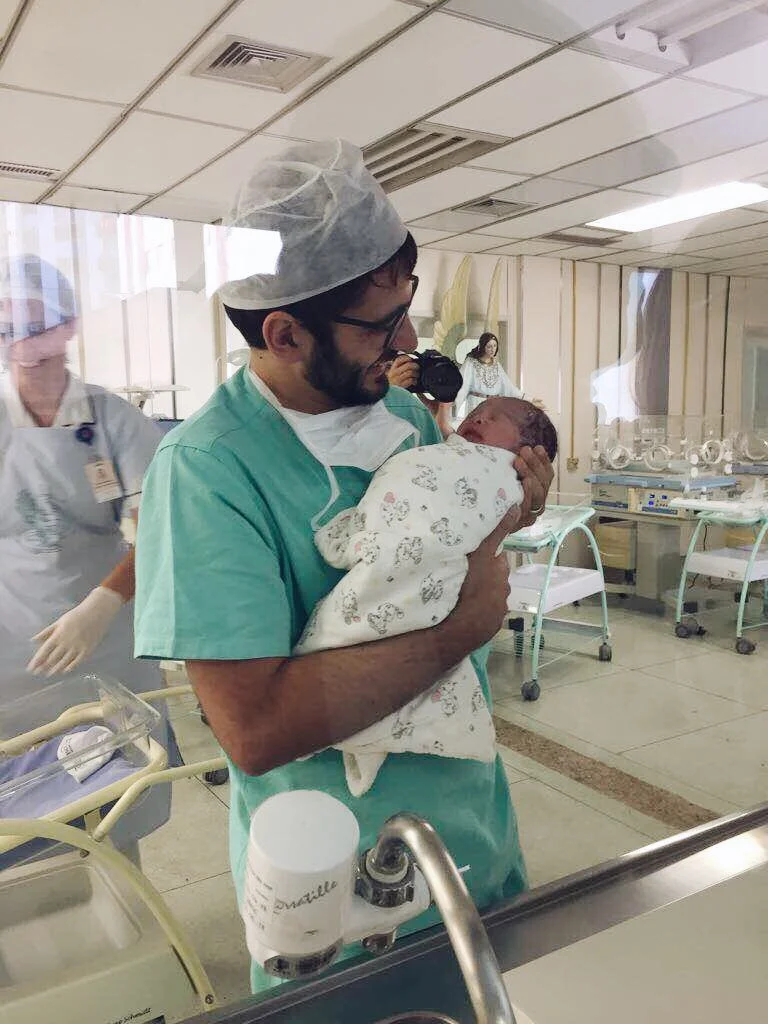
AC: What were your pre-conceived ideas about fatherhood? How has this changed since actually becoming a father?
YY: I didn’t really have any pre-conceived ideas about being a father… For me the role didn’t come with a map, it came with a compass, as in I knew more or less the direction which I would like to take, but I was open to whatever the adventure was going to be. In the vision I had of fatherhood I was going to be a lot more present. Since S was born work has luckily picked up, which means that I am less present than I would like to be. I’m still finding my balance. But sometimes I hear remarks from people saying they’re impressed with how involved I am, since in Brazil for instance it’s not that common - and that reassures me.
AC: How do you think your own relationship with your father has affected the way that you now approach fatherhood?
YY: All in all I think it’s actually the reverse - my relationship with S has affected my relationship with my father. We’ve become a lot closer, because I understand him a lot better now. I have enormous love and respect for my father. He was always very close to us, and he was never afraid to show his feelings. I’ve seen my dad cry multiple times of joy or sadness. That’s something that I even kind of take for granted at times when I’m with S, because I talk to him a lot and show him how much I love him, which for me is kind of a given. But I know it’s not like that for everyone. Growing up, my dad would make sure we spent time together just him and I, and I have the fondest memories of going with him to the LA Auto Show for instance. It’s moments like that which I’m trying to carve out with S, and in the back of my head I have many plans for spending time just the two of us.
AC: What has been the most difficult aspect of fatherhood for you so far?
YY: I think it’s the guilt. You want to spend time together, but you must keep a balance between work and life. Sometimes I have to justify to myself that everything I’m doing work-wise is to provide for my family, but it’s hard keeping that balance. That’s what I struggle with most.
AC: And the most gratifying?
YY: Watching him progress. It’s crazy, time is flying so quickly. Also some of my favorite moments in the week is picking him up at daycare - he has this pure, blissful smile when he sees me, and there’s just nothing better than that.
AC: Have you ever wondered whether we are being selfish by having children, when the world seems to be about to self-destruct? “Yikes”, I know, but this is something I personally find myself unwillingly wondering at times.
YY: I used to think that in my 20s. But now I think I have a more positive vision of the world, even though I have my skeptical moments. There will always be something to be afraid of, to make you question your actions. I just want to raise our kids the best way we can, for them to be great individuals who hopefully will help make the world a better place. I think it would be irresponsible if we couldn’t provide for them, but that’s not the case. Someone once told me that having children is pure arrogance, it’s just an extension of your ego. But the reality is that they put you to the test - you develop patience you never had before, you develop empathy. You develop all these great things that the world needs more of. Every child is a gift.
AC: What is your biggest fear regarding our kids? For instance, do you fear the rise of antisemitism?
YY: Unfortunately when you’re Jewish antisemitism is a theme that comes up a lot. I spent my high school and junior high years in France, where there has been a steady rise of antisemitism. The populist climate in the world makes me a bit worried. It’s not just antisemitism - it’s racism, it’s homophobia, all these things. Hate in general. I want to believe that there’s good people everywhere and that we’ll make it through these hard times, but as a parent you fear for your children. As for my biggest fear I don’t know… There are so many of them.
AC: We both agree on not setting expectations for our children other than wishing they are happy and healthy - but I often “joke” that I just don’t want them to become conservative and/or intolerant. Is there something that would secretly bother you, or that you fear they might become?
YY: Given their roots - on my side Jewish, on your side you have a great grandmother who was born a slave - I would be disappointed if they turned out intolerant. There are certain values you and I share which I would like to pass on, and it would bother me if they didn’t pick up those values. I also don’t want them to be materialistic. I don’t know. There are times when I encounter people and whatever they’re doing bothers me, and I find myself wondering “what would I do if my son or my daughter did the same?”. Part of me thinks it could be an opportunity for growth, for discussion, maybe to see things differently. On the other side I think that a gap might open between us. And that would bother me the most.
Do you have any questions for Yann-Yves? He has agreed to answer them - just post in the comments!
The 24-week mark
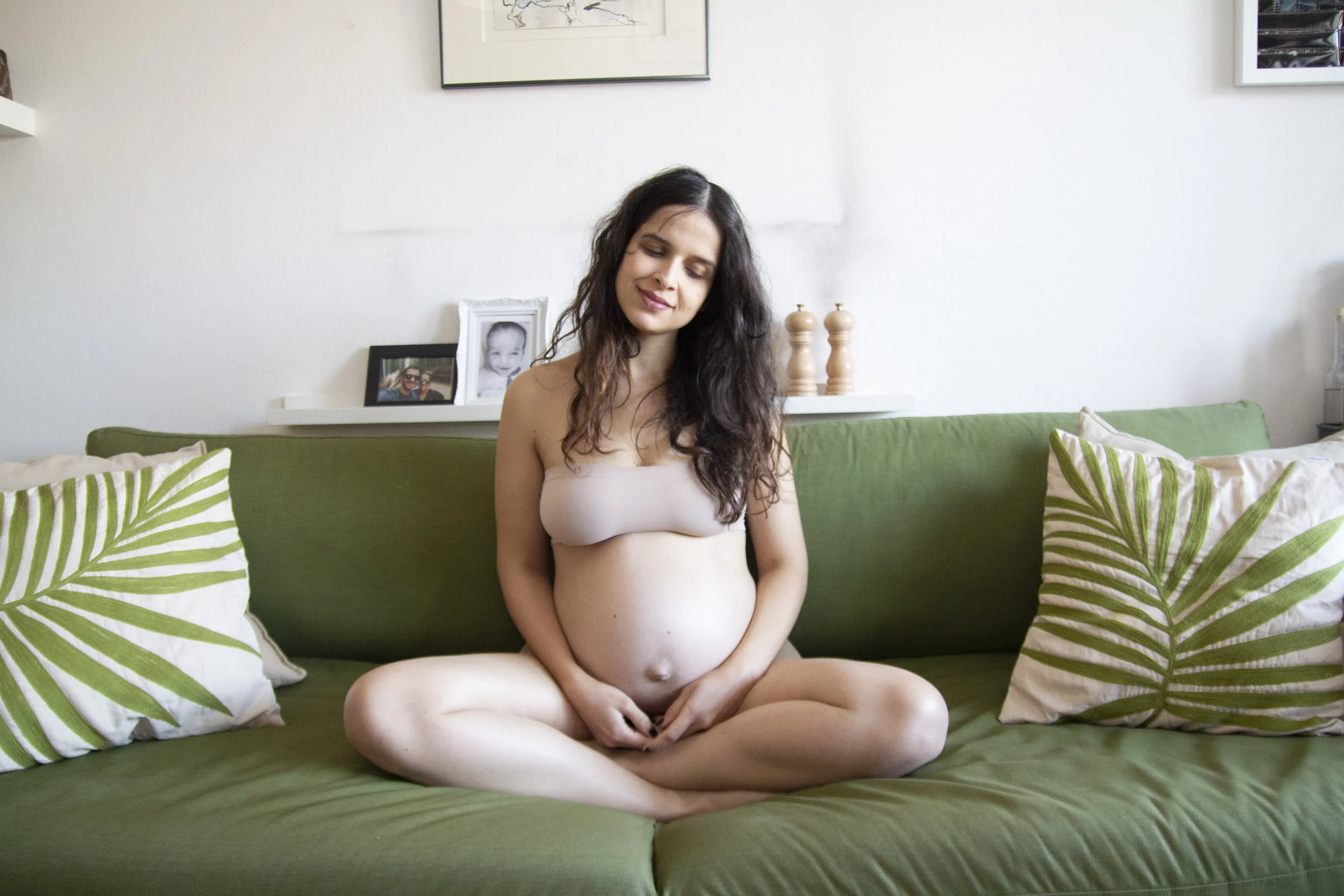
I wrote the short reflection below a few weeks ago. By now I am quickly approaching the third trimester, but the feelings remain true. I hope this resonates with you, too.
—-
I guess that most women who have been pregnant, or people interested in the topic somehow, know how much of a milestone reaching the 24th week is.
During my first pregnancy, I eagerly awaited this moment. Being 24 weeks pregnant means that, statistically, your baby has a good chance of survival with no long-term problems if she were to be born. All major organs are substantially formed by now, and for the next 16 or so weeks the baby is mostly fattening up (and, of course, developing her brain, practicing breathing, growing her lungs etc. - but you get the idea).
There are so many worries throughout pregnancy that one really holds on to every opportunity to breathe a little easier, at least figuratively. As the kicks get stronger, and the bump becomes undeniable, you become more confident in your body’s capacity to nurture this new life.
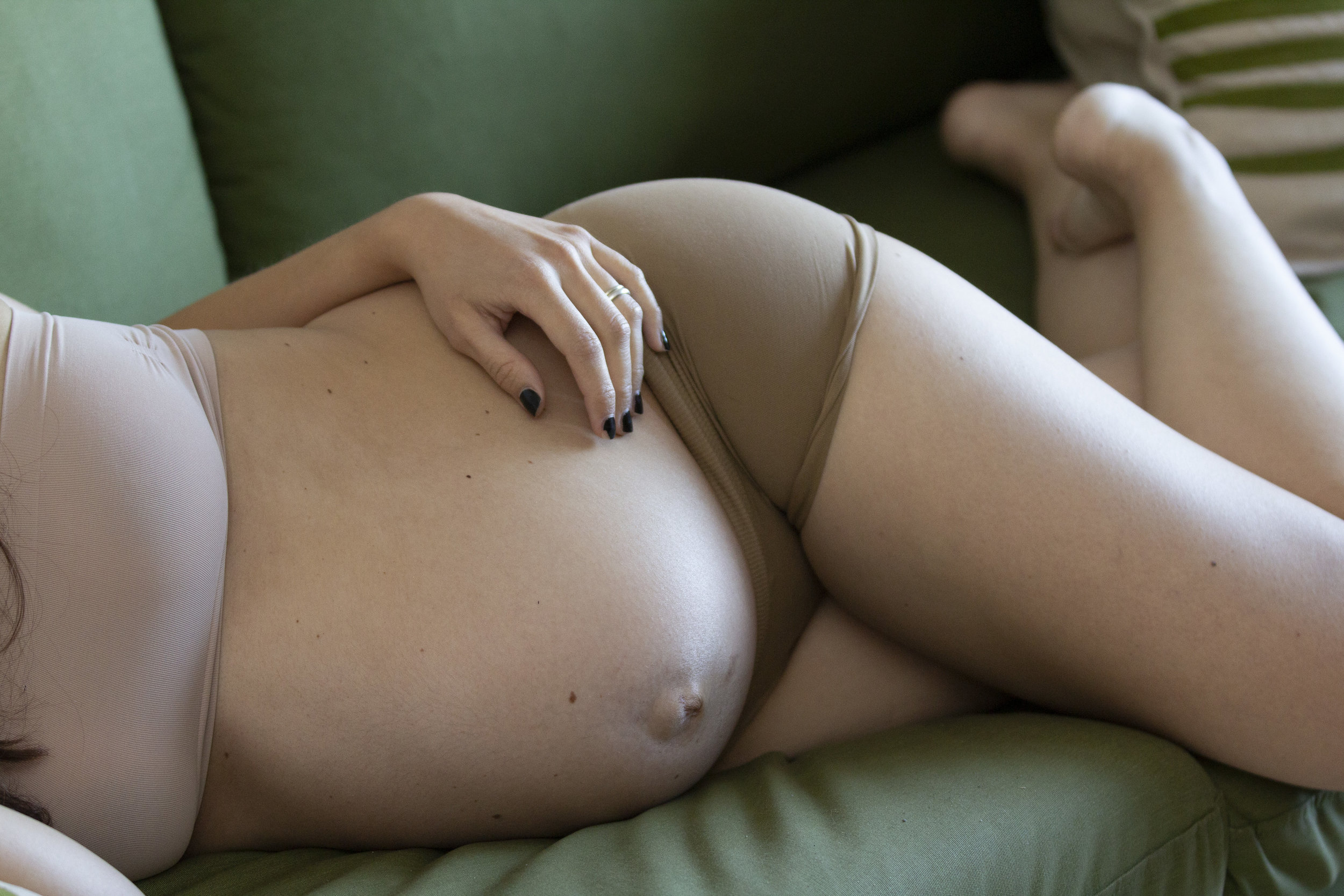
Even if you’ve already nurtured a life before, you’re constantly reminded that every pregnancy is indeed unique, and that each and every milestone should be celebrated accordingly. At least for me, this time as in the last time, knowing my baby is growing stronger means that I am growing stronger, too. I ultimately become my own favorite alter ego: a fatigued, waddling, life-bearing badass rockstar.
24 weeks is also a time when you’re clearly pregnant. “Move over, people! Pregnant lady coming through!” is what I tell myself as I waddle down the street. It’s beyond my control - I can’t help but feel important. Personally, I have never felt more confident in my own body than when pregnant. I don’t have to make excuses for my thick calves (they’re swollen) or my round belly (obviously). My body is at its most beautiful while creating another life - it’s mind blowing. For some reason I become prone to taking bikini pictures and showing off my stomach at every opportunity. I become proud, the good kind of proud; the kind that I must nonetheless consciously stick to postpartum as well.
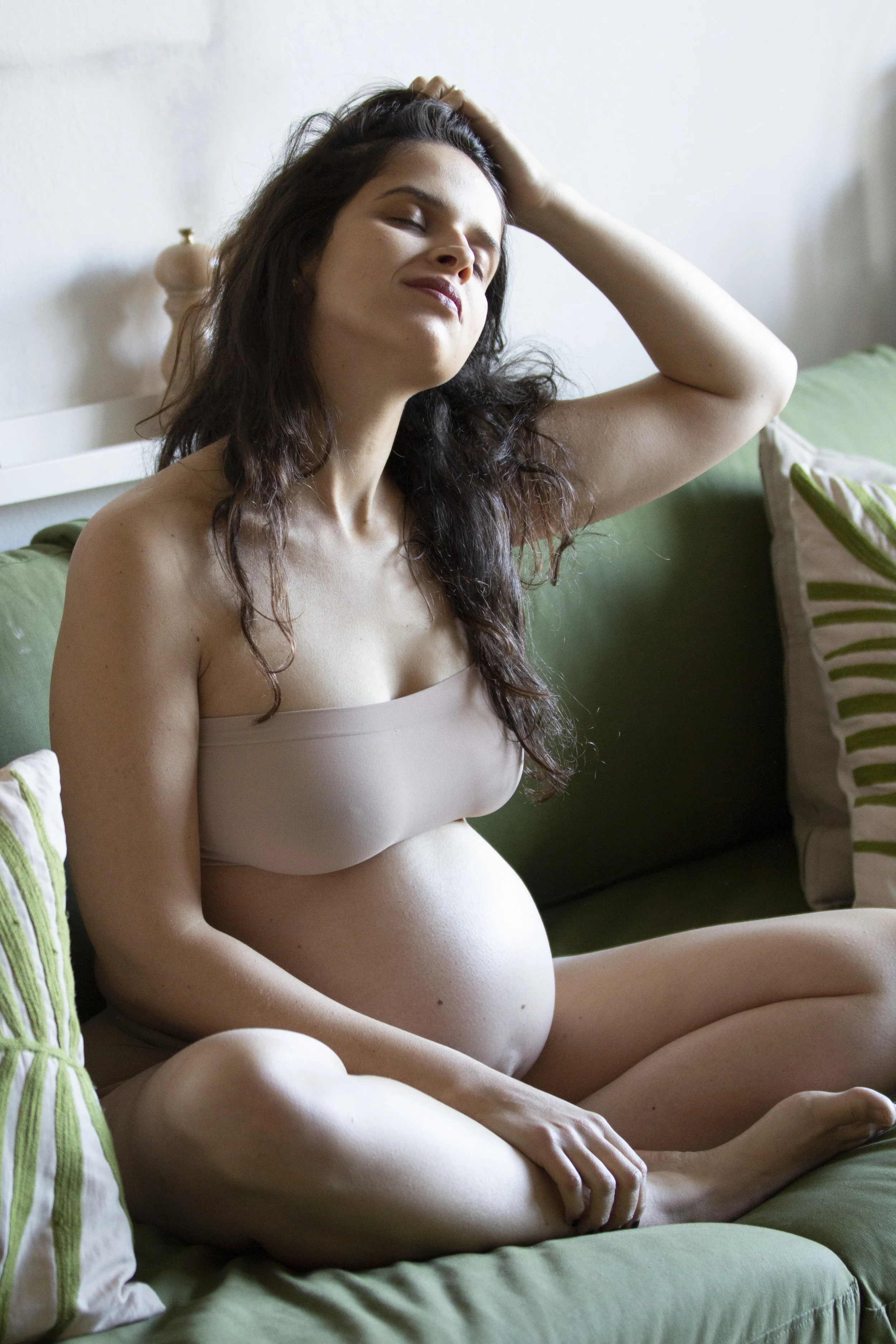

There are plenty of annoyances and challenges to be experienced during pregnancy, don’t get me wrong. But it has its upsides too, obviously, and I feel like these must be discussed and acknowledged at every opportunity. During my first pregnancy just as now, I know I’ll miss my bump and how empowered it makes me feel. The difference now is that I don’t know if I’ll get to experience this again, as we plan on sticking to being a family of four. It’s a bittersweet feeling. It’s also a welcome daily reminder to live in the present - something I terribly need.
At the Zoo
Full disclaimer: I don’t know how I feel about zoos. I’m always afraid of unknowingly perpetuating animal abuse with my visit. Yet part of me prefers to believe that most animals (in German zoos, in any case) are living somewhat comfortable lives compared to their mates in the wild, as we humans insist on destroying nature and killing off species.
Despite that uplifting note, I must say I have always been curious about the Munich zoo. I kept postponing the visit, thinking we should maybe wait until S is old enough to actually enjoy it (when in all honesty the visit was much more about my own curiosity). Last weekend we finally decided to take the leap, encouraged by our zoo-enthusiast friend Reema and by other people’s comments about how cool it is.
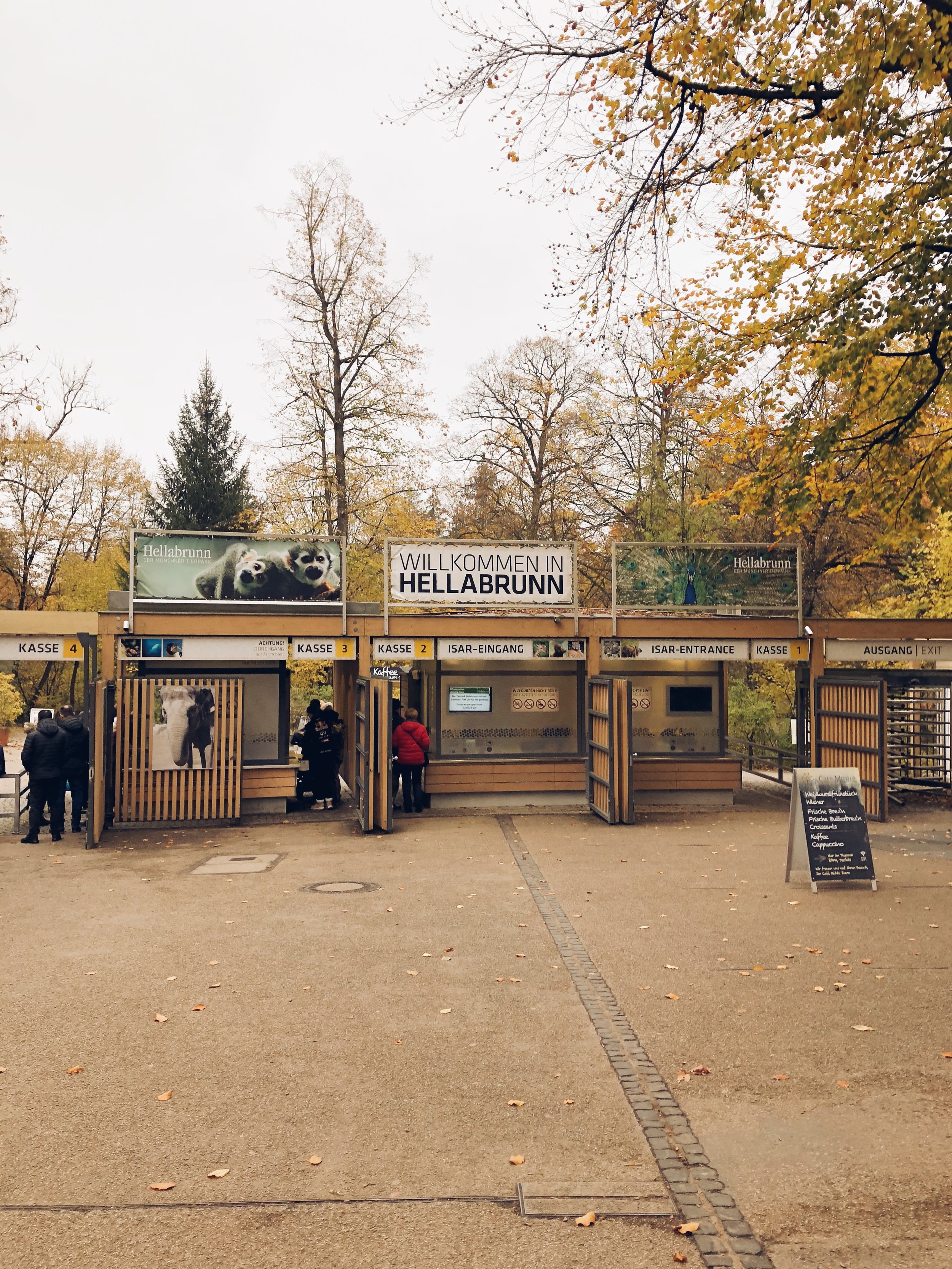
Our first stop was, naturally, at Cafe Mühle by the entrance. Imagine my joy as I found out that not only do they serve Emilo coffee (my absolute favorite), they also have all sorts of options to customize your drink - from caffeine-free to lactose-free. And don’t forget the soy milk!
I hope you appreciate the importance of good coffee on your visit (any visit) as much as I do. Anyways, on to the animals!
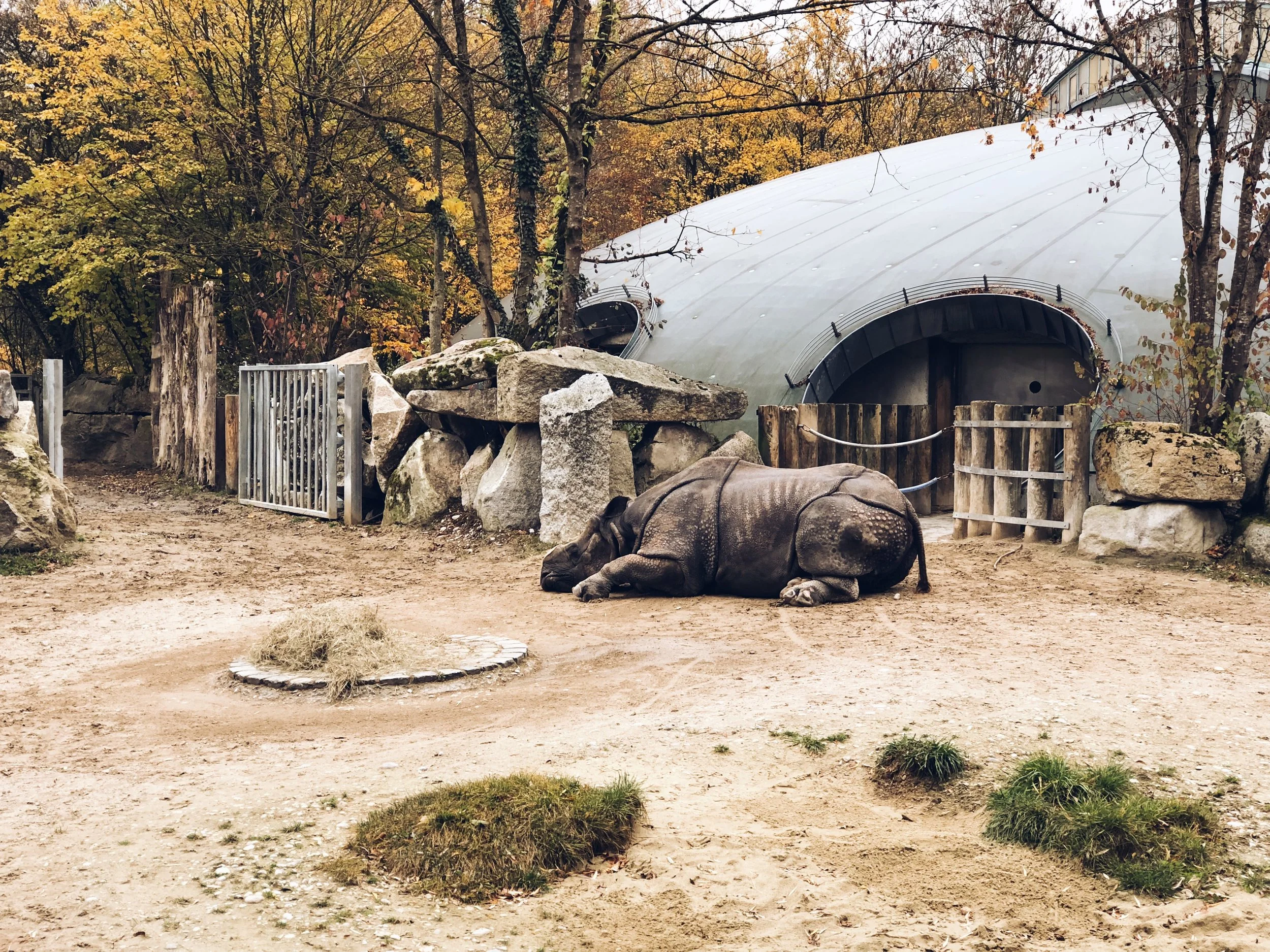

We opted to visit the zoo in the opposite direction of the route suggested on the map, since we wanted to prioritize visiting some animals (e.g. polar bears) over others (e.g. raccoons). We just knew we would start picking up the pace towards the end of our visit and necessarily neglect a few fellas. It’s inevitable - S would get tired and/or my pregnant body would start aching, so we needed to be strategic.
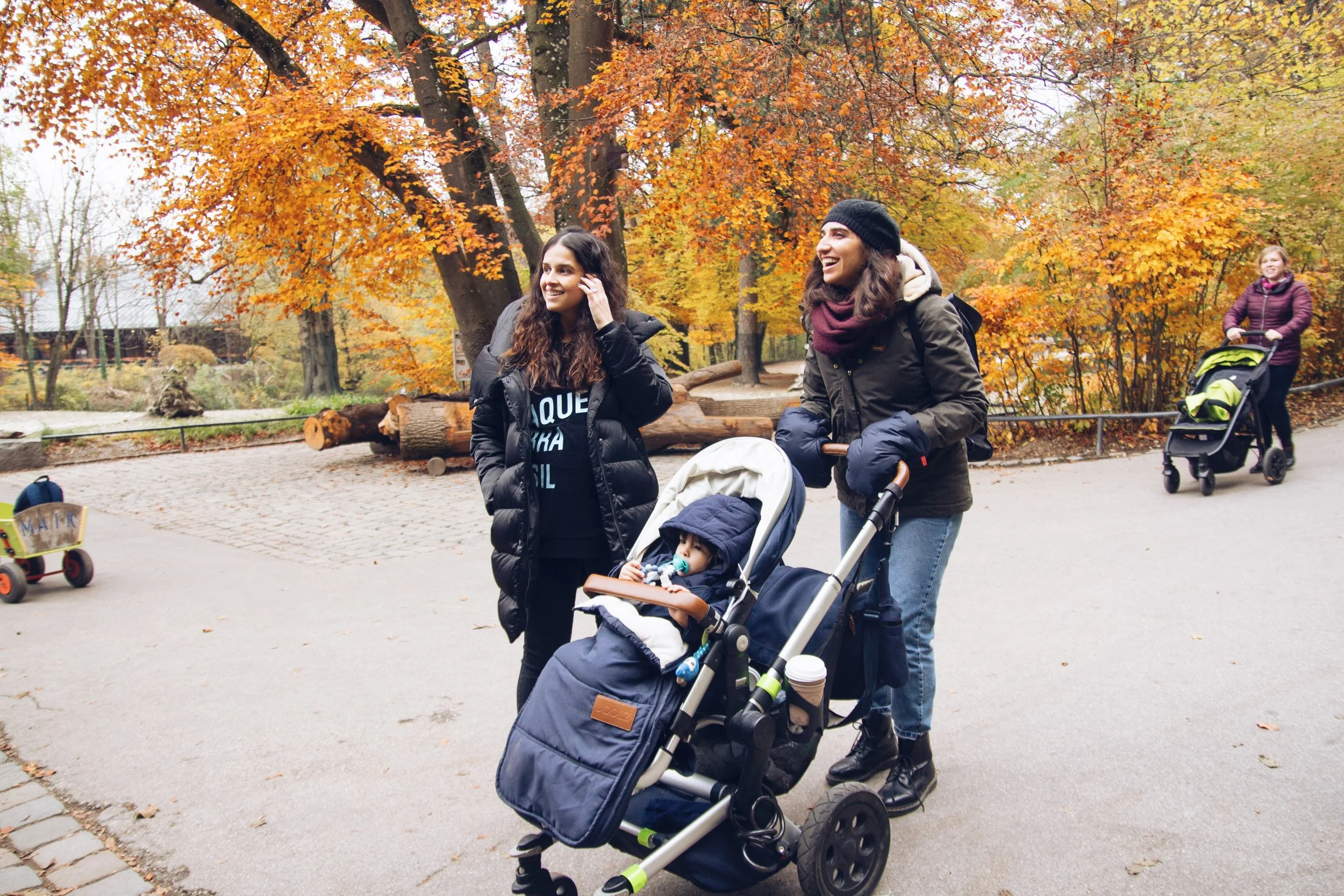
Great practical things about the zoo:
Many great quality snack huts scattered around the zoo and plenty of sitting areas for tired, hungry parents.
Plenty of bathrooms, too - and changing tables in most of the women’s WCs. Can’t speak for the men’s bathrooms, though.
Not so practical things:
Surprisingly for Germany, some of the animal '“houses” are only accessible by stairs, which can make the visit particularly difficult for people with strollers or on wheelchairs.
Same goes for the weight of the doors of some of the houses. I get it for the “jungle” (you don’t want birds flying away after all), but for the tortoises? I kept thinking I would’ve had a particularly hard time if I were by myself with the stroller and the bump, and how dependent I would’ve been on other people’s goodwill to help me out climbing stairs/opening doors.
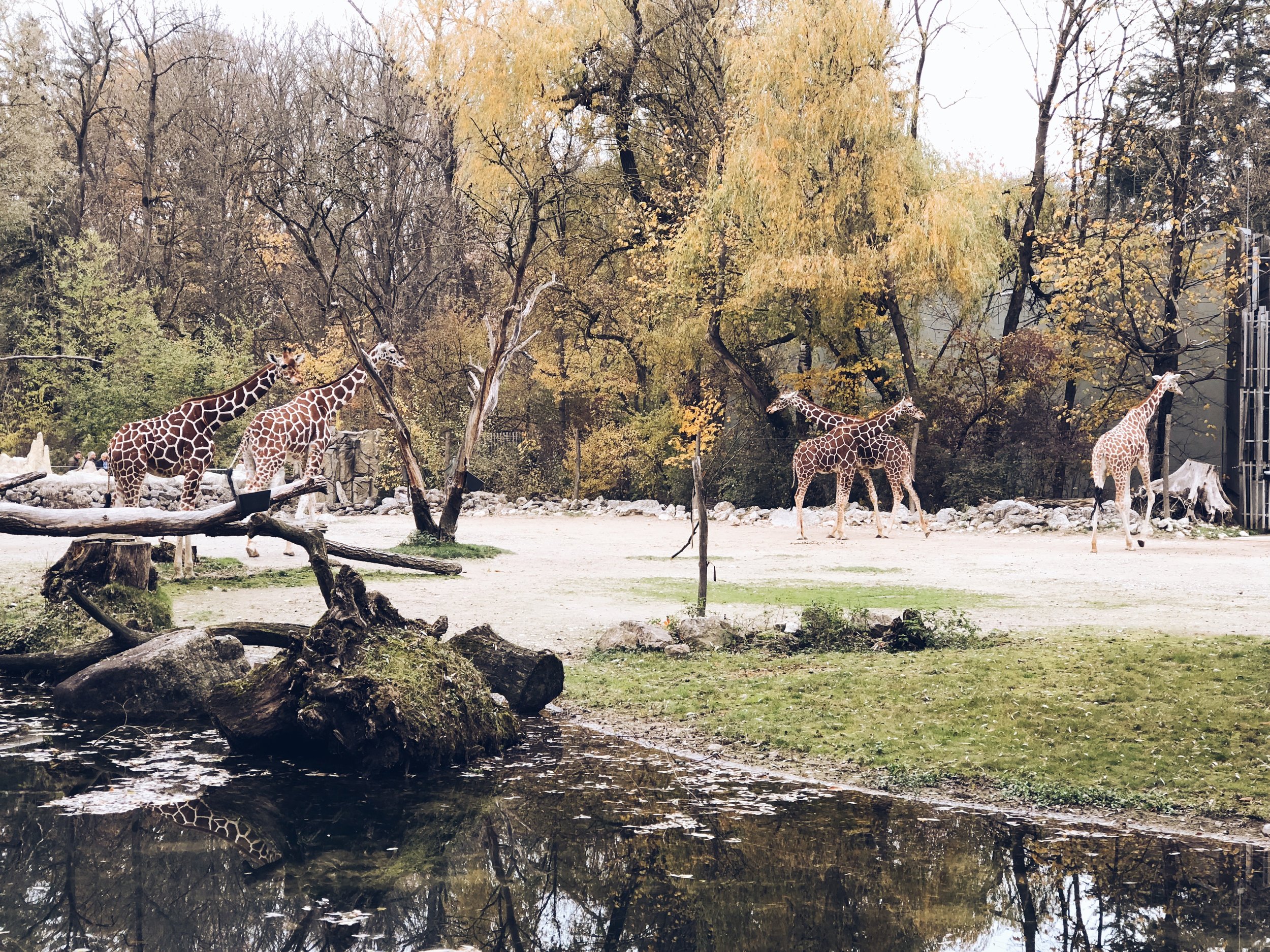
All in all, it was a great way to spend a Sunday morning, and we actually plan on getting the annual pass once S is indeed old enough to enjoy it (and the baby girl is not that tiny anymore). As predicted, towards the end of our 2:30h visit we were all pretty beat, so I’m happy we got to say hi to the rhinos and penguins first. Maybe next time we’ll give the raccoons a second chance, though.
Check it out: Tierpark Hellabrunn
All in all, the Munich zoo is pretty awesome and we couldn’t have picked a better day to visit it. It was a comfortably chilly fall day, which somehow encouraged most animals to be out and about.
We got there at 9:30 am on a Sunday, which I definitely recommend if you, like me, would like to avoid lines at all costs. By the time we left around noon, the lines had built up considerably. The ticket costs 15 euros/adult (or 98 euros for the family annual pass!), which is reasonable considering the size of the zoo.
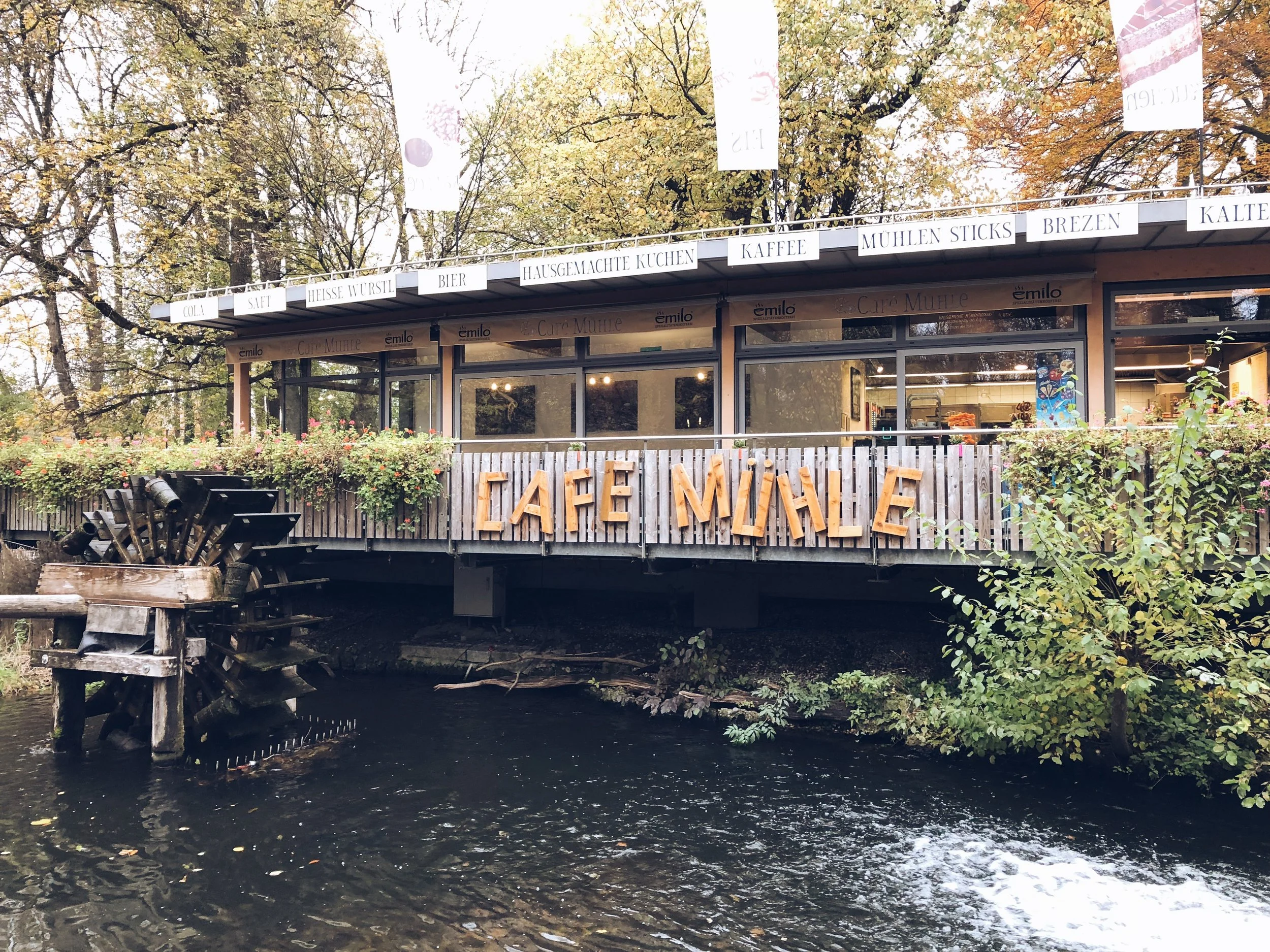
If you order it to go, you’ll need to pay a Pfand for a “recup” (an initiative across coffee shops in Munich and elsewhere in Germany, where you bring your own cup and get a discount on your drink). Since I’d been wanting my own recup for a moment, this worked out perfectly for me. But you can also opt to return yours and get your Pfand back.
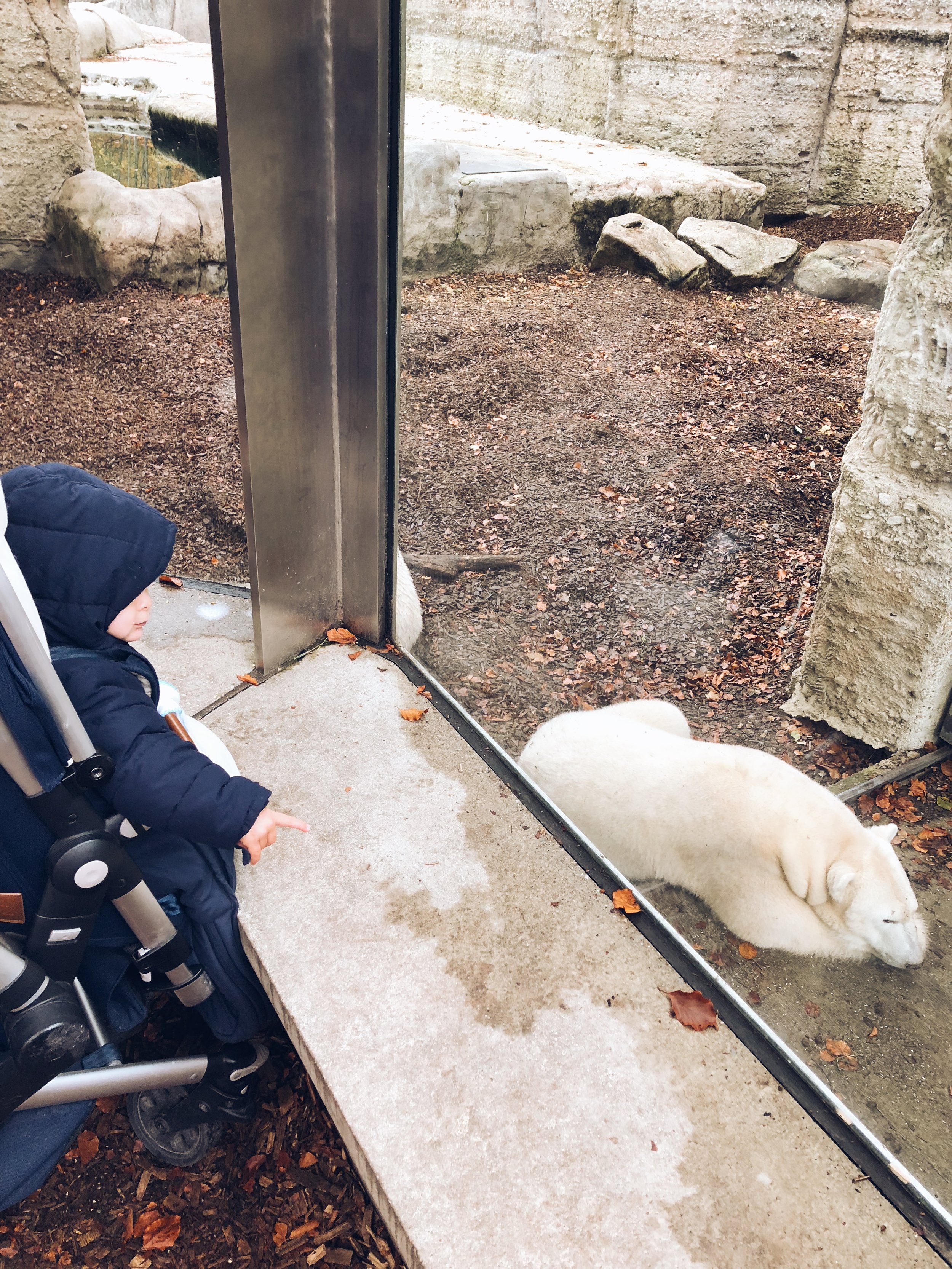
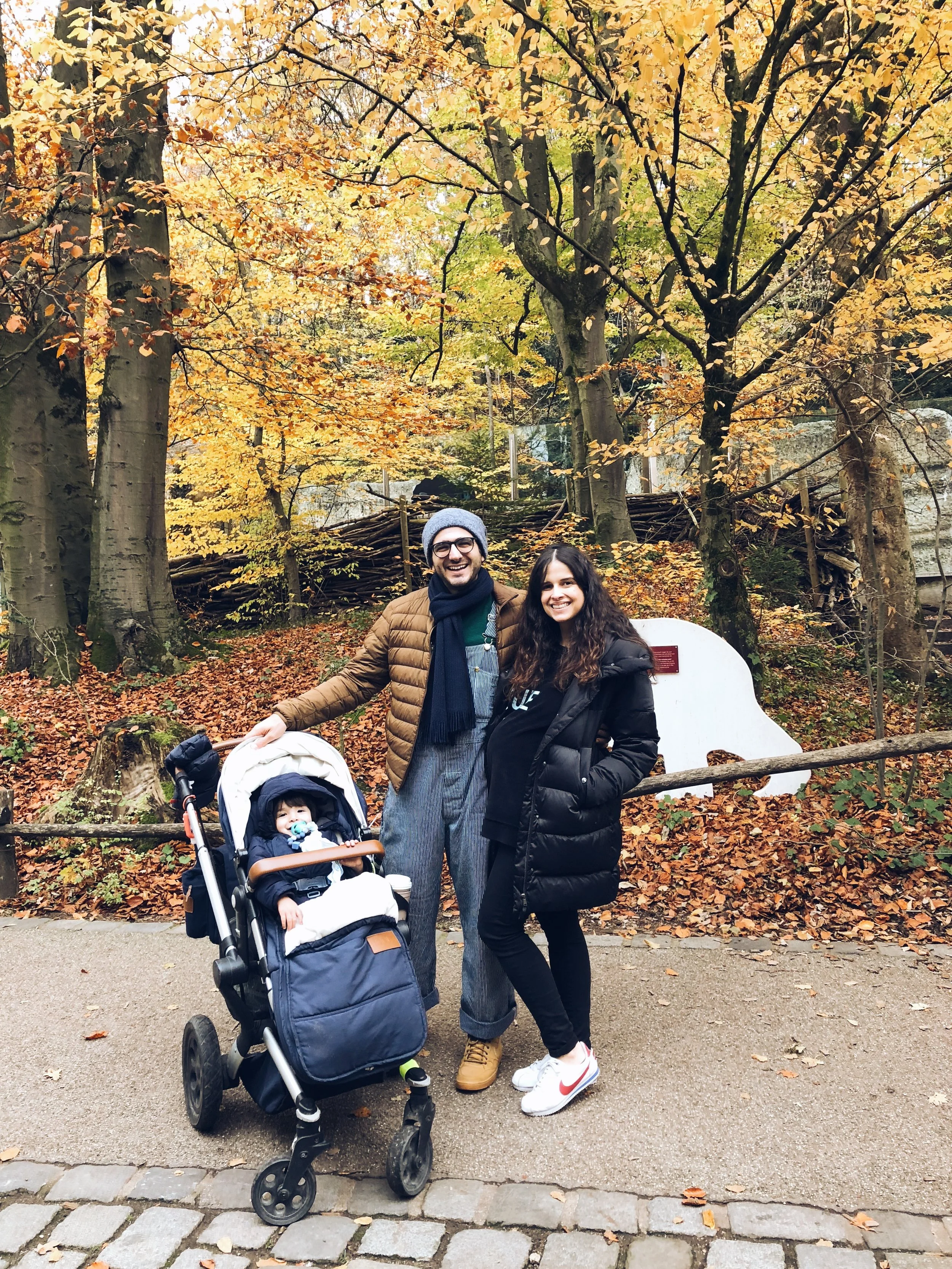
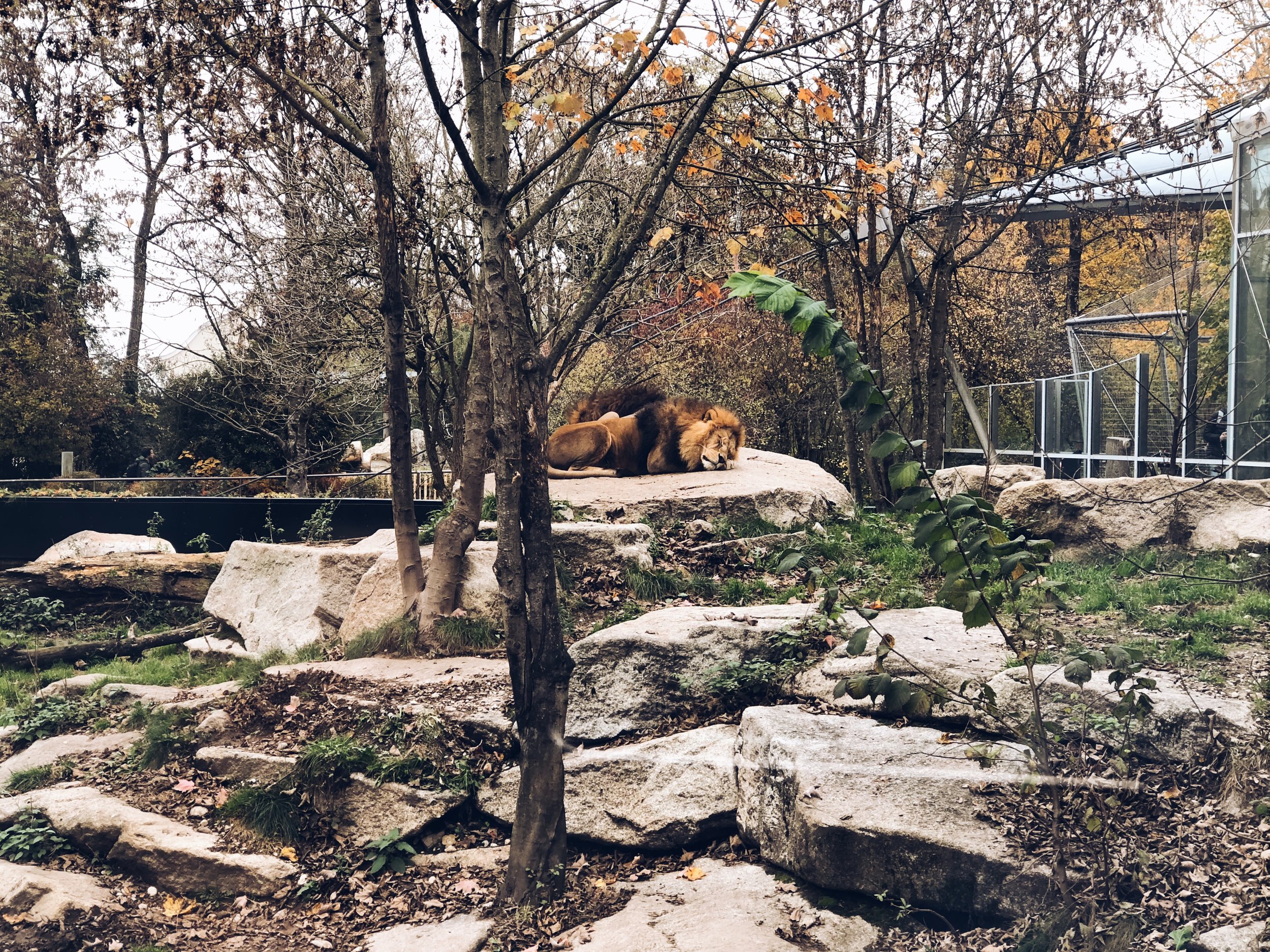
Other remarks:
Just surprising: Dogs are allowed in. Some pups were fine with their visit, while others were a bit too excited at the sight of elephants. Made me wonder if they stress out the animals in any way.
The gift shop kind of sucks. Womp womp.
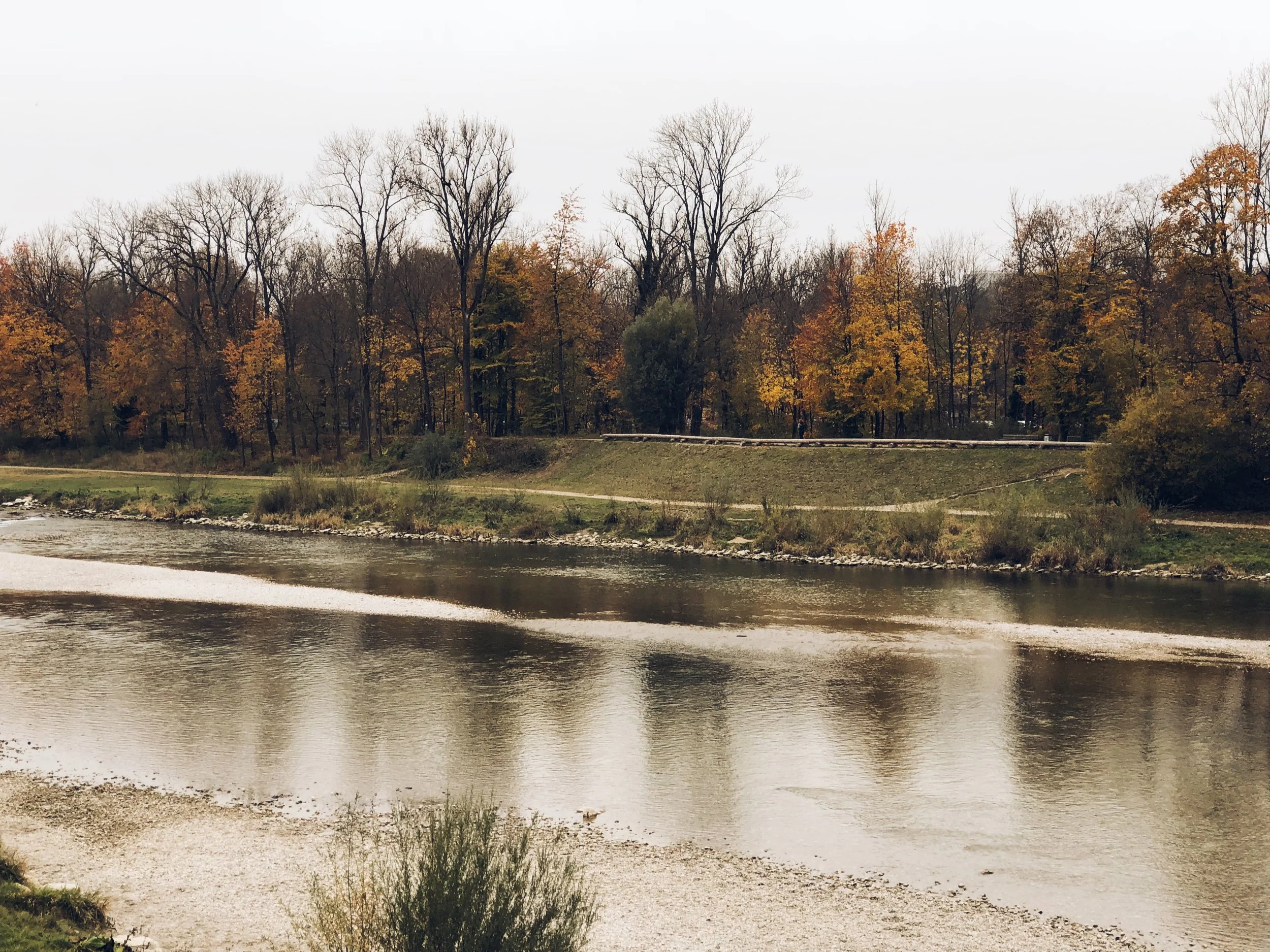
Eingewöhnung, or the daycare adaptation period
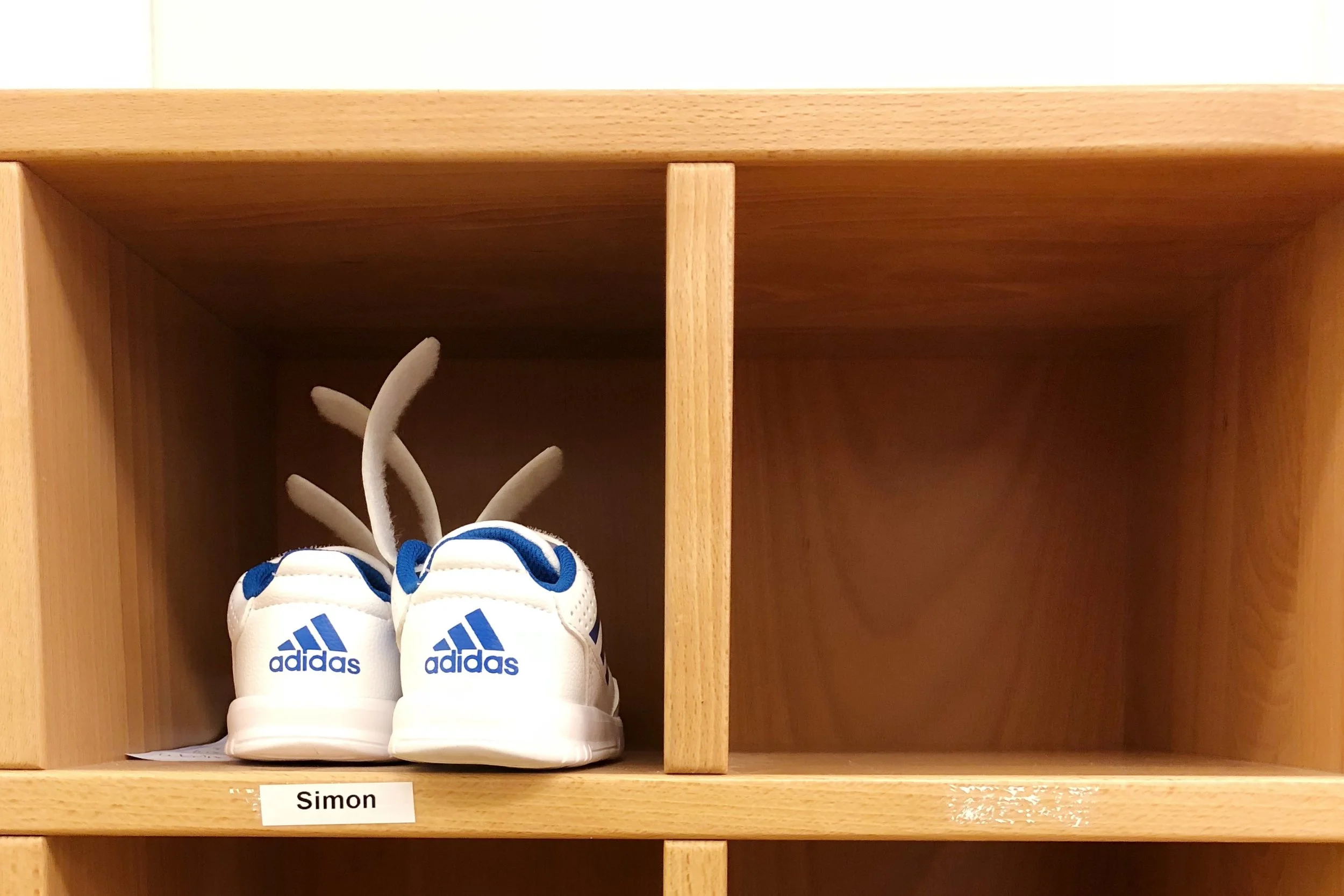
That raising a kid in Bavaria is fantastic is a well-know undeniable fact, but it definitely has its caveats. Starting off with the most obvious, being that with so many benefits (a cool year of partially paid maternity leave, “family money” paid by the government, almost full coverage of pregnancy and birth-related costs by your public health insurance, to name a few) people are bound to want to start and expand their families.
However, there is simply no room for all these kids at the nursery; so although a daycare spot is your right as a taxpayer in Germany, the reality tends to be different. The real options*, we have sorely learned, are: 1. Settle for something, errm, “less” than what you would like for your kid; 2. Become a stay-at-home parent (most likely mom) until your kid is old enough for Kindergarten; 3. Pay a ridiculous amount for a spot at a private, non-state subsidized daycare. We opted for the latter.
*For foreigners who live in the city center and learned about Kita Finder+ a little late, at least.
Wichtel Akademie is not only a wonderful nursery - it is also, most importantly, the only one that got back to us after close to a year of anxiously sitting on literally dozens of waiting lists, with no luck. And if we could, we would happily pay for S to continue attending it. As it happens, paying monthly 855 euros for up to 6h/day (1400 euros for full-time care!) is out of our financial scope. So he’ll be there for 3 months only, i.e. until mama goes back on maternity leave. We are hoping to find another spot at a daycare somewhere closer to us geographically and financially by January, but for now we have nothing but fingers crossed.
Anyhow, this is all just an introduction to the real topic of this post: the Eingewöhnung.
Let me start off by saying that I’m just happy we’re at the other end of the adaptation period by now. I tried to read up on the topic as much as I could beforehand in order to set the right expectations, but I kept on stumbling upon one annoying truth: it depends entirely on the kid, and there’s no way of really knowing how it will go in advance.
S is pretty detached from us on a daily basis, and since both of us have gone back to work for a few months already (he had been staying with my godmother), I assumed that it would be fine. That’s the issue, though - I could only assume. The instructor at the daycare said it could take anywhere from 8 to 12 weeks (!!). However, based on my motherly assumption, I decided to take “only” 3 weeks off work to accompany S during this period, obviously expecting, praying and hoping for the best.
Before I go on to describe how the weeks went, bear in mind that this is based solely on our experience. I know that different adaptation methods are used at different nurseries, but I am not a professional and S has only been to this one daycare so far, so all I can attest is what we, as a family, have gone through. Please keep that in mind, along with the fact that, obviously, every kid is different.
Week 1
The first week at the first daycare is a big question mark.
Everyone is learning. Your kid is learning to be around other kids, you’re learning to keep away from your kid and let him explore, the caretakers are learning about what’s ok or not for your kid.
With so much learning taking place, it can be utterly frustrating for one as a parent to stay there for a single hour at a time. To top it off, we missed two days due to a public holiday and a last-minute family trip. So after 3 days of sitting there for an hour at a time, anxiety started to consume me, as I wondered whether I’d be able to make it back to work in 3 weeks after all.
Week 2
That’s when it started getting interesting, as I was finally able to step outside for 15-minute increments (15 minutes the first day, 30 minutes the next and so on). S was NOT having it the second day, and part of me was moved by such a display of attention from a baby who is normally quite independent. But then we figured out he was just hungry; every morning since, the caretaker offered him a piece of bread right away and he almost instantly forgot all about me.
By the end of the week, he was at last able to stay a whole hour without me in the room - but I still wondered whether it was realistic to expect this one hour to turn into six by the end of the following week.
Week 3
As I arrived to drop him off on Monday morning, the caretaker announced that she wouldn’t be there for the next two days due a training she was attending, and that therefore I couldn’t bring him in. I nearly lost it. Some of my immediate thoughts (which I translated into a “polite concerned” tone before expressing them to the caretaker in question):
Can’t he just stay with another caretaker??
Couldn’t you have told me this sooner? That means I can’t go back to work next week!!
But we’re paying (a lot) for those days!*
*They promptly reimbursed us for those days after I wrote them a lengthy email.
Alas, the Eingewöhnung, such as most things, is taken very seriously in Germany. He couldn’t in fact stay with another caretaker because he was bonding with this one. It’s very important that he feels comfortable and safe there, and she had become the embodiment of that during his adaptation period. I understand this - but I also can’t help but think that other countries must have a very different (perhaps more abrupt) approach.
When I told her I was concerned about going back to work, she cooly reminded me that it could’ve taken 8 weeks or more and that S was doing exceptionally well at adapting. “Maybe you can delay your return by a day or two, or arrive late”, she very politely suggested. While I am indeed fortunate enough to be employed at a very flexible workplace, I couldn’t help but think “how is this ok?”. How can I be expected to take unpaid time off for 8 weeks or more, or to tell my manager I can’t come in because S’s caretaker had a training to do? I certainly can’t imagine this happening in Brazil or the US (where a 3-month leave is already a luxury), or even in France.
I’m aware that in Germany a lot of women - that is the reality - postpone their return to work from leave until their kid is well-adapted at a nursery. Which is ok, if you can afford it. I, too, could have asked to extend my leave, but that extension would have been unpaid - a luxury we simply cannot afford given the price of the daycare. So how does one solve this? Legitimate question.
Conclusion
For us, it fortunately worked out in the end because A. S is an exceptionally easygoing baby and pretty content as long as he has food and B. Yann-Yves has a flexible schedule that allowed him to accompany S on the two days after I’d gone back to work. So all in all, 3 weeks were in fact enough for us, had it not been the few setbacks.
But as someone who goes about life with a very organized, planned-ahead mindset, the adaptation period left me somewhat exhausted. Not knowing when I’d be able to resume working (and whether I’d have to be that person who postpones work because of this reason) was hard; feeling like I was failing to respect my son’s own time to adapt was harder. S doesn’t care about my responsibilities or expectations - and why should he, when he’s my number 1 priority? This, I guess, is undoubtedly what parenting is about.
—
Fellow parents out there, how did you deal with this adaptation period? Is the approach any different where you live? I’m eager to hear your thoughts!
The pursuit of joy
I’ve come to think that my own concept of “joy” has been radically redefined since giving birth, without me even realizing it.
After feeling “off” for a good while, I decided that I desired and deserved help, and started seeing a therapist a few weeks ago. The initial diagnosis: “baby blues”. Postpartum or prenatal, it’s early to say. But one of the very first questions he asked me was “what brings you joy?”. For what felt like the most uncomfortable 5 minutes of my life I sat there under his stare, frantically trying to come up with an answer. The more I thought about it, the more desperate I got to just say something, anything. That feeling stuck with me.
It felt like lately nothing truly brought me “joy”, and I was simply going through the motions of life a day at a time, grateful but unsatisfied, without joy. And even when there was joy, it often came with a side of guilt or regret as it involved being by myself, as opposed to spending precious time with my family.
Back to my therapist and his nagging question - the one and only answer I could come up with was my very last recollection of feeling joyful, which was when I witnessed S’s first steps. He nodded, and came up with an interpretation which nearly blew my mind. Safe for a health issue, which thankfully isn’t S’s case, kids his age inevitably start walking. This didn’t depend on me. S is thriving and will continue to thrive regardless of how inapt I feel as a mother sometimes. Regardless of me needing time for myself to “blow some steam” or simply recharge. He will certainly thrive with me, but also without my ominous presence. This realization lifted an incredible weight off my shoulders - it brought me joy.
Since that personal epiphany I decided to start a joy journal, to try and recognize that there is indeed joy in my life, and to hopefully get to know myself a little better. The list below is a work in progress, and what a massive progress it has been since that initial question:
Grabbing coffee and cake at a cafe (by myself, with my family, with a friend)
The kick I get after my first coffee in the morning
Having one-on-one conversations
Realizing that S is growing and has an independent personality, but still needs me
Walking around with a coffee warming up my hands on a cold day
A clean and organized apartment
Nice-smelling candles
Buying flowers for our home
Making S laugh, without tickling him
Reading a book without wondering at the back of my head whether it’s worth my time
Traveling somewhere I’ve never been before; ideally somewhere where I don’t speak the language
Both unplugging from social media and using it to connect with people
Device-free date nights
Feeling my baby girl move and kick
Daydreaming about moving to Japan with my family
Parenting with YY (something as mundane as drying S together after his bath makes me feel in my element, as if all the decisions I’ve made that got us to this moment were right)
So maybe what brings me joy hasn’t changed that much since becoming a mother, after all - it has expanded. Given my very introspective nature, many of the activities that have always brought me joy involve me being alone. Note: not lonely. I need time to think, to recharge, to reflect. I not only crave; I need time by myself. I often wonder if this is innate to me, or if I’ve become this way due to being an only child (hoping to answer this after some more therapy sessions). What has changed since giving birth was in fact the guilt that I now often feel whenever I do carve out time for myself. And this is what needs to be worked on.
Either way, it is honestly and unfortunately not a feeling that I desire for my children in our super-connected world. Being an introvert is often misinterpreted in both professional and social contexts; one can come off rude, shy, way too serious - all of which are not adjectives that relate to me at all. I do hope my children are happy on their own, but also that they can find joy in constantly being with others, more than their mother does.
Accepting who and how I am has been a very long journey with many ups and downs, and one which I am nowhere near reaching a final destination. But if there’s one thing I’ve recently learned is that the pursuit of joy and the road leading to accepting who I am are interdependent journeys - there is not one without the other.
It’s also a journey that goes beyond being an only child, an expat, an introvert, a mom - all things that I use ad nauseam to define, categorize, and limit myself. Oh, I’m also learning that introverts can be good parents, too, if you’ll allow them a solo cup of coffee from time to time. Through therapy and writing, I am coming to terms that finding time for my own joy while performing my motherly duties isn’t selfishness - it’s self-maintenance, and there’s absolutely nothing wrong with that.
To my daughter
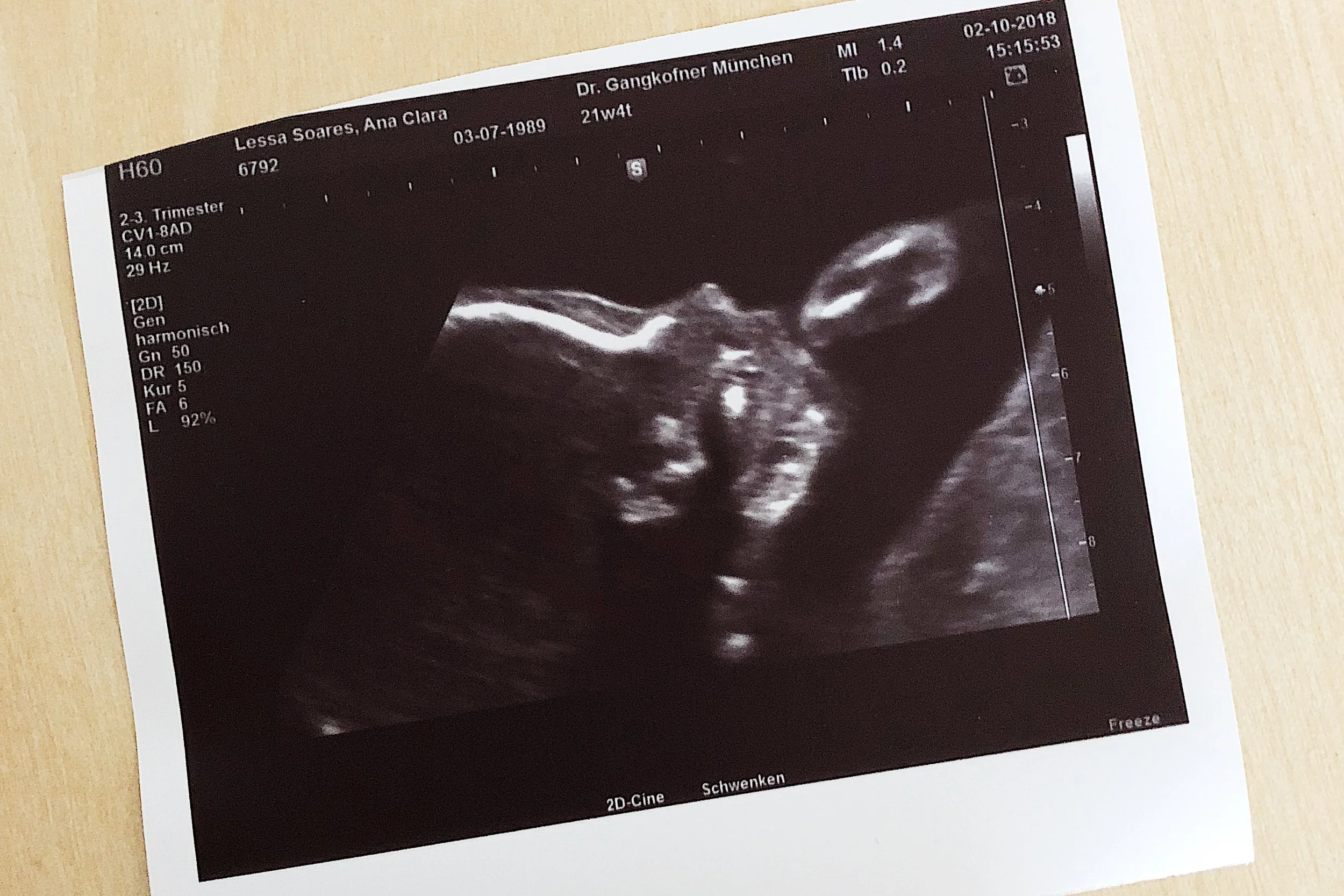
From the moment I found out that I am pregnant, I knew I am having a girl. This pregnancy has been wildly different from my first one, but not only because of that. Call it mysticism or what may, but I just knew. Like I also always knew that S would be a boy.
So back in August, towards the end of the first trimester, I wrote a little something for our daughter. I hoped with all my might that my intuition was right - but could we be that lucky? After two contradictory doctor’s appointments where one said she’s a she and another he’s a he, I became skeptical of my own gut (or womb) feeling. At that point I just wanted my baby to be healthy, because to be honest what’s between its legs is to me merely a detail in any case.
It took us over 21 weeks to finally confirm that she is indeed a “she”, and for me to admit that, if I were given a choice, I would have chosen a baby girl this time around all along. After all, who runs the world?
—
Here’s what I wrote back when I still had nothing but a motherly inkling:
Hello Baby Girl,
Please let your mama first and foremost apologize for not having written to you sooner. Being pregnant with you has been a completely different experience from being pregnant with your brother, and it took me a little longer to feel a bit more in charge - although you're still absolutely taking the reins.
Also let me assure you that you are so loved. I have prayed, to the best of my agnostic abilities, to get pregnant with you. Your father and I may jokingly say that we were "rolling the dice", but honestly, you are in no way, shape or form an accident. You're the product of love, thoughtfulness, and faith.
Just like with your brother, I truly try not to have any expectations for you other than health and happiness. The world is just as tough, if not tougher, than when we first learned the news about your brother's presence in my womb. Some have called your parents "brave", by which they probably truly meant "reckless" or "crazy" for desiring so bad to have you in our lives while your brother is still so young. Personally, I believe the right word for us would be "optimistic", as well as perhaps "blindly faithful" of the joy that your presence will bring not only to our lives, but also to this sometimes gloomy world.
That said, if I do get to have one wish granted it would be that you and your brother get along. Not all the time, because I'm realistic, but that at the end of the day you do have each other's back. I deeply hope that you love, cherish, and support each other like only siblings can. As I mentioned, the world can be scary, but being able to unconditionally count on someone makes our experience in it so much lighter and brighter.
I have no other way to express my gratitude for your existence than to acknowledge how blessed we are to have you in our lives.
We love you, baby girl.