
Getting over the anxiety of introducing solids
Introducing solids to a baby is a massive milestone. Whether you’ve done it before, and even if you’re literally studying the subject and have the most up-to-date information about it at your fingertips (like me), as a parent it is still likely you’ll feel anxious about it at some point. What if baby chokes? What if she has an allergy? What if she hates food??
Not only there’s too much information out there about how and when and with what to start feeding your baby, but there’s also the 99% likelihood you’ll encounter well-intentioned people who will approach you with their opinion and what they think you should do, based on what worked for them 30 years or 2 months ago (either way, it’s not necessarily what will work for you, now). The truth is that when it comes to food, just like with any other aspect in her life, your baby is unique. And there is no one who knows baby better than mom or dad.
Knowing this can be as overwhelming as it can be freeing, so try to think of it this way: humankind has been introducing solids to their offsprings for millennia, in every culture, at any given moment in time. We’ve survived as a species because ultimately there was always someone who knew what was best for their baby. So you’re not alone in this. And once you get the hang of it, it can actually be fun! Eventually.
Here’s how I’m doing it.
About 18 months ago, when I was introducing solids to S, my firstborn, I was so overwhelmed with motherhood that I didn’t think of much about researching different feeding methods or best first foods to offer. Instead, I chose to listen to our less-than-friendly German pediatrician at the time, who at 5 months suggested we started feeding him canned pureed baby food such as carrots and apple sauce mixed with a beef paste. Yuck, I know. Luckily I knew a little better than that, and instead chose to spoon-feed him homemade pureed food (it helped that my mom was visiting). I hadn’t even heard of baby-led weaning, and had no clue what to watch for as signs of developmental readiness. I followed the pediatrician’s lead, and to his credit S turned out just fine. But I always felt like I could have done better (hello, mom guilt).
Fast-forward almost two years, and it is time to introduce solids to our second child, L. This time around I know so much more, so I decided to do things quite differently. For starters, I am not overwhelmed by motherhood anymore, at least not all the time. Getting certified in holistic baby nutrition also helps quite a bit, as you may imagine. Yet, that it is not to say that I wasn’t anxious about her very first taste of “solid” food.
A few factors added to my natural uneasiness. I wasn’t exactly in a hurry to feed her solids, and as I waited for L to meet all developmental signs of readiness, I realized it probably wouldn’t be before her half-year birthday anyways. The problem is, she turned 6 months a few days after we arrived in California to visit family and, by then, not only we were jet lagged, but our daily routine was out the window. I was afraid that feeding her solids would stress her out even more.
I was also getting tired of being bombarded by the question “when are you going to feed her cereal?” (which is A. a very culturally American thing to do and B. something I have no intention of doing, not any time soon in any case). And I was also equally eager and apprehensive about giving baby-led weaning a go. But armed with knowledge and the confidence that comes with the second child, I decided to offer a classic as her very first food - steamed carrots cut in finger shape and size, topped with organic ghee. The verdict: She LOVED it.
For the following 3 weeks, we experimented with different BLW classics such as the soft core of raw cucumber and ripe bananas. I couldn’t feed her solids every single day, which is ok in the first few weeks. The plan was to get her introduced to solids slowly, giving her digestive system a chance to adapt (I was especially cautious since we were in a “foreign” country, after all).
Since we got back to Munich, I became more preoccupied with her iron intake. Iron is incredibly important for babies 6-12 months (in fact, their daily iron requirement is higher than that of an adult man). While trying to stick to exclusive BLW, I prepared fried egg yolk* cut in strips, to make it easier for her to grab. However, baby girl still isn’t too confident in grasping food and bringing it to her mouth, so her actual intake was very minimal.
* Egg yolk is an excellent source of some of the most important nutrients for baby (and mothers), such as iron, DHA, vitamin D, choline and cholesterol, to name a few. The egg white, however, is a common allergen and should be avoided until baby is a little older.
Therefore, while battling jet lag and a wild toddler (whose daycare is closed when we most need it!), I decided to compromise and go with combination feeding. Bingo! It’s been working really well for us. By “combination feeding”, I mean that I offer her both finger-shaped soft foods (following BLW instructions) and spoon-feed her pureed foods. I add meat, chicken, bone broth, or runny egg yolk to the puree - and that way I make sure she ingests a bit more iron.
The trick is to offer the finger-shaped food first, while she’s interested and eager, and then spoon-feed the puree. I have found that the biggest challenge with this method is not only to recognize her cues for not being interested anymore (e.g. turning her face away from food), but also to respect them. The plan is to slowly transition into BLW only, as her appetite grows and as L and I become more confident about her grasp. I will keep you updated on how that goes for us.
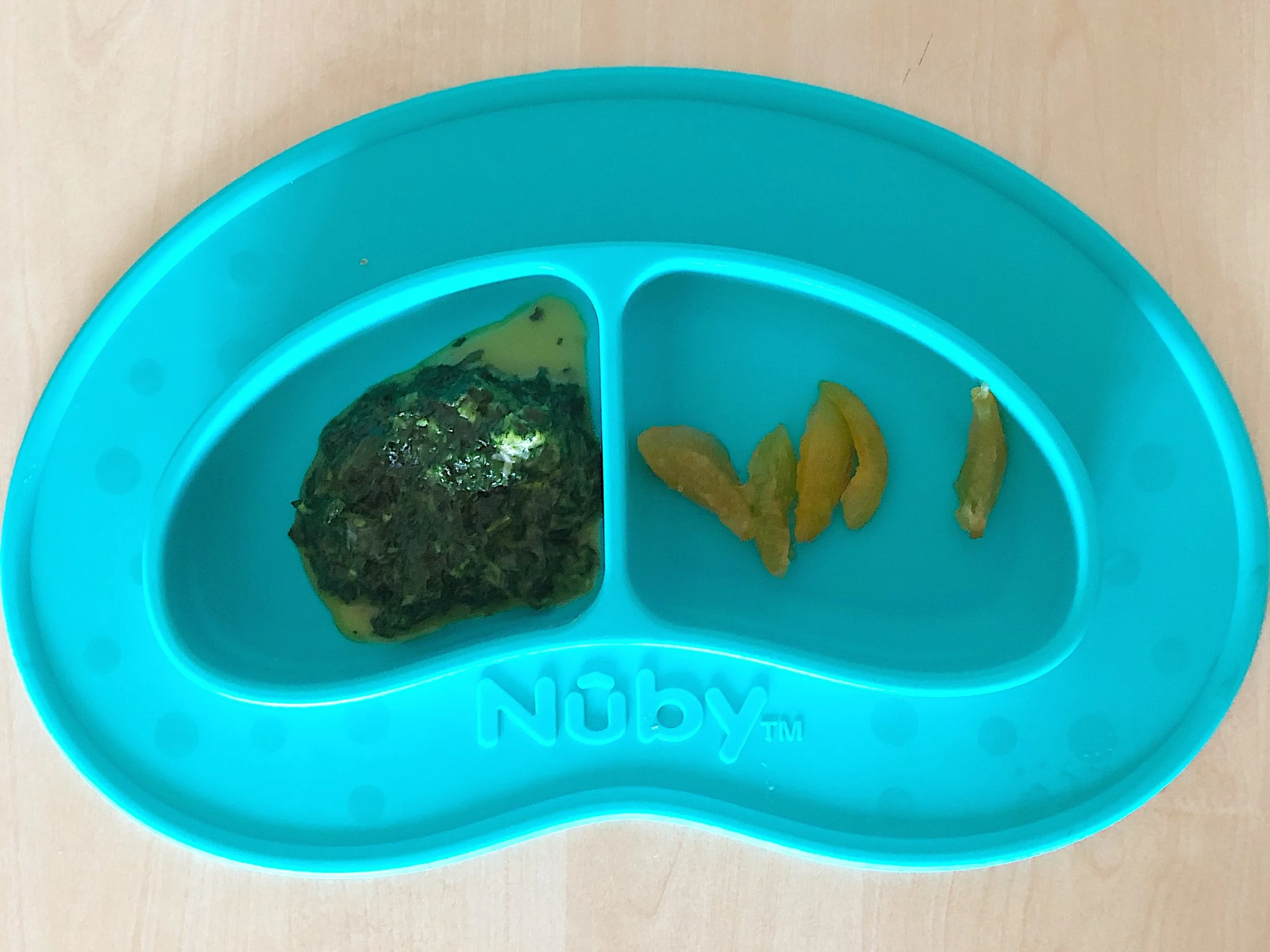
Sample combination feeding. Left: pureed spinach with grass-fed butter and runny organic egg yolk. Right: Plum, skinned and cut in finger shape.
I am very curious to know what worked (or didn’t) for your and your family. Were you also anxious about introducing solids? Which method(s) did you use? What first foods did you offer?